

Clean Water and Sanitation
Enhancing water sustainability through our research, operations and services is critical to combat climate change and ensure equitable access to water resources.
At La Trobe University we are contributing to the United Nations Sustainable Development Goal 6: Clean Water and Sanitation.
We have water use efficiency policies in place, our research leads to the protection and restoration of water-related ecosystems and we support communities to improve water and sanitation management.

LOCAL AND GLOBAL IMPACT - OUR RESEARCH CONTRIBUTING TO SDG 6: CLEAN WATER AND SANITATION
See below for measurable, demonstrable, and beneficial change occurring beyond the university as a result of our research
-
Energy, waste and water
Energy, waste and water
-
Rapid water test reduces outbreaks
Rapid water test reduces outbreaks
-
Climate change threatens billion-dollar industry
Climate change threatens billion-dollar industry
-
La Trobe wins global sustainable leadership award
La Trobe wins global sustainable leadership award
-
Centre for Freshwater Ecosystems
Centre for Freshwater Ecosystems
-
Invertebrate community ecology
Invertebrate community ecology
PROMOTING CLEAN WATER AND SANITATION ACROSS OUR OPERATIONS
Water consumption is monitored in each of our buildings and across our campuses. Consumption levels for the whole University are reported quarterly and annually.
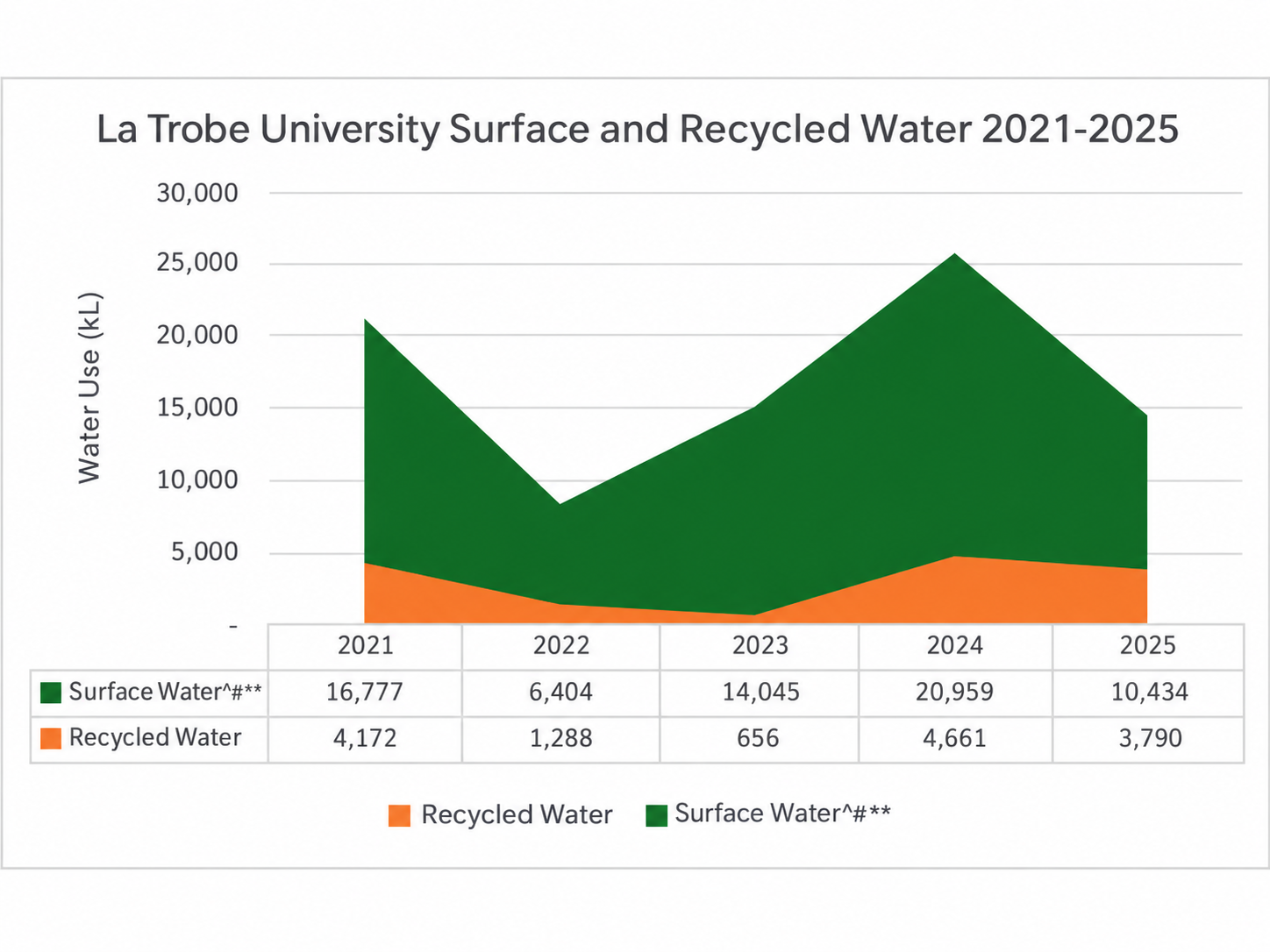
The Annual Water Consumption graph highlights that municipal water consumption represents the major water source. Other water sources include surface water (such as water from the moat) and wastewater from partner organisations.
La Trobe University uses local council wastewater treatment processes and facilities to treat wastewater across all its campuses. Providers for wastewater treatment for La Trobe University include Yarra Valley Water, Lower Murray Water, Coliban Water, Goulburn Water.
Environmental Management & Pollution Prevention
La Trobe’s ISO 14001-certified Environmental Management System (EMS) ensures proper servicing of grease and pollutant traps, and establishes procedures for dealing with environmental incidents (like spills or flooding) to safeguard water quality.
Stormwater Treatment & Reuse (Melbourne Campus)
The university maintains a series of water bodies known as the Nangak Tamboree biodiverse corridor. These water bodies naturally clean stormwater before it enters Darebin Creek. The captured water is then reused onsite for purposes such as irrigation, toilet flushing, and mechanical services.
La Trobe University has processes in place to prevent polluted water entering sewer, stormwater and natural water systems, including controls for environmental incidents and the management of chemicals and trade waste.
1. Environmental Management System
La Trobe’s ISO 14001-certified Environmental Management System supports the protection of on-campus and nearby waterways. Measures include appropriate servicing of grease and gross pollutant traps, procedures for responding to environmental incidents such as spills, leaks and flooding, and water-sensitive urban design initiatives.
2. Chemical management and incident prevention
- La Trobe’s current Health and Safety Procedure - Chemical Safety applies across the University and establishes controls for the procurement, handling, storage and disposal of regulated chemicals. It requires chemical risk assessment, documented risk controls and local emergency procedures designed to prevent incidents and adverse environmental impacts.
3. Stormwater Management
At the Melbourne Campus, water bodies within the Nangak Tamboree biodiverse corridor help filter and clean stormwater before it enters Darebin Creek. Water-sensitive urban design measures, including indigenous plantings around water bodies, also help filter pollutants.
4. Trade-waste controls
La Trobe maintains trade-waste agreements with relevant water corporations. These agreements set requirements for the physical and chemical characteristics of wastewater discharged from University facilities into sewer systems.
5
La Trobe has water fountains installed across our campuses to allow the community to refill and stay hydrated for free, so bring a reusable bottle and save some money and the environment by refilling.
The University's Design Standards have been revised and implemented to ensure minimum performance requirements are met when designing new space and implementing water sensitive urban design initiatives. Water harvesting from buildings and storage within tanks is encouraged. Rain water is to be reused where possible, with appropriate systems, for toilet flushing, landscaping and other uses.
- All new buildings and major refurbishments must comply with La Trobe’s Sustainable Building Design Standards.
- These standards align with Green Star and NABERS ratings (national sustainability benchmarks for buildings).
- They include requirements for:
- Water-efficient fixtures (low-flow taps, showers, dual-flush toilets)
- Water-efficient appliances in labs, kitchens, and residences
- Smart irrigation systems using weather and soil data
- Integration of rainwater harvesting and recycled water systems
The performancee requirements included in University's Design Standards include to ‘Select species appropriate to the local micro climate(s) created by the building (i.e. shade, dry tops of mounds, wet boggy areas, water gardens).’ And to ‘Select drought resistant species to minimise watering requirements’.
La Trobe University's policy commitment to maximising water reuse is detailed within our Environmental Sustainability Policy, Water Self-Sufficiency Strategy, and Design Standards
Environmental Sustainability Policy
- This policy (Part D – Water Management) requires the university to:
- Minimise potable water consumption
- Maximise use of alternative water sources, including recycled water and treated stormwater
- Ensure compliance with all relevant water legislation and sustainability standards.
Water Self-Sufficiency Program (Melbourne/Bundoora Campus)
- La Trobe has a formal program aimed at achieving 50% water self-sufficiency.
- Key reuse initiatives include:
- Stormwater harvesting and treatment at the Nangak Tamboree waterway
- Reuse of treated water for toilet flushing, irrigation, and mechanical services (e.g., cooling towers)
- Connection of some regional campuses (e.g., Albury–Wodonga) to reclaimed water networks for irrigation.
Sustainable Building Design Standards
- New buildings and refurbishments must incorporate rainwater harvesting, greywater reuse, and recycled water systems where feasible.
- Fixtures and irrigation are designed to reduce demand on potable water and increase reliance on reused sources.
At La Trobe University we measure the amount of reuse water collected from surface and recycled water across the University.
The surface water collected from the moat are reused to water large sports fields at the Melbourne campus.
Recycled waters are reused to water gardens at the Albury-Wodonga campus.
In 2025, the reused water collected from surface water reduced by 50% due to metering issues in Q3 and Q4.
Figure 1. La Trobe Water Usage in 2021-2025
Graph Notes:
^ In 2022, surface water use figure is lower than expected due to an issue with onsite metering equipment.
# In 2023, surface water increased due to better metering systems which provided a more accurate data capture.
** There are some metering issues for surface water for Q3 and Q4 2025
The Mann Lecture is a free annual public lecture held at our Albury-Wodonga Campus (also accessible online).
2024 Mann Lecture - Tech and AI in farming and water management
Thursday, 15 August 2024
6pm to 7.30pm
La Trobe University Albury-Wodonga Campus, 133 McKoy Street, West Wodonga
Join La Trobe's Professor Nick Bond for an exciting conversation about the opportunities for disruption and growth through tech and AI in farming and water management.
Panelists:
- Professor Nick Bond (Facilitator) - Director Centre for Freshwater Ecosystems, La Trobe University
- Stuart Upton - General Manger, Australia, AgriProve
- Lisa Ryan - General Manager, Digital and Business Innovation, North East Water
La Trobe University supports water conservation beyond its campuses through applied research and industry partnerships that improve water-use efficiency, alongside community education about water quality and freshwater ecosystem health.
Improving water efficiency in agriculture
In partnership with Queensland ag-tech company Aglantis, La Trobe researchers developed a smart irrigation system that uses sensors, artificial intelligence and real-time environmental data to help farmers apply water more precisely. The system is designed to reduce overwatering, water loss and agricultural runoff, improving water-use efficiency while supporting more sustainable farming practices. The technology was first commercialised in December 30th 2024 and has since been rolled out across farms in North Queensland’s Lower Burdekin region. Early results reported by La Trobe indicate water savings of around 20 per cent.
Water education and community participation
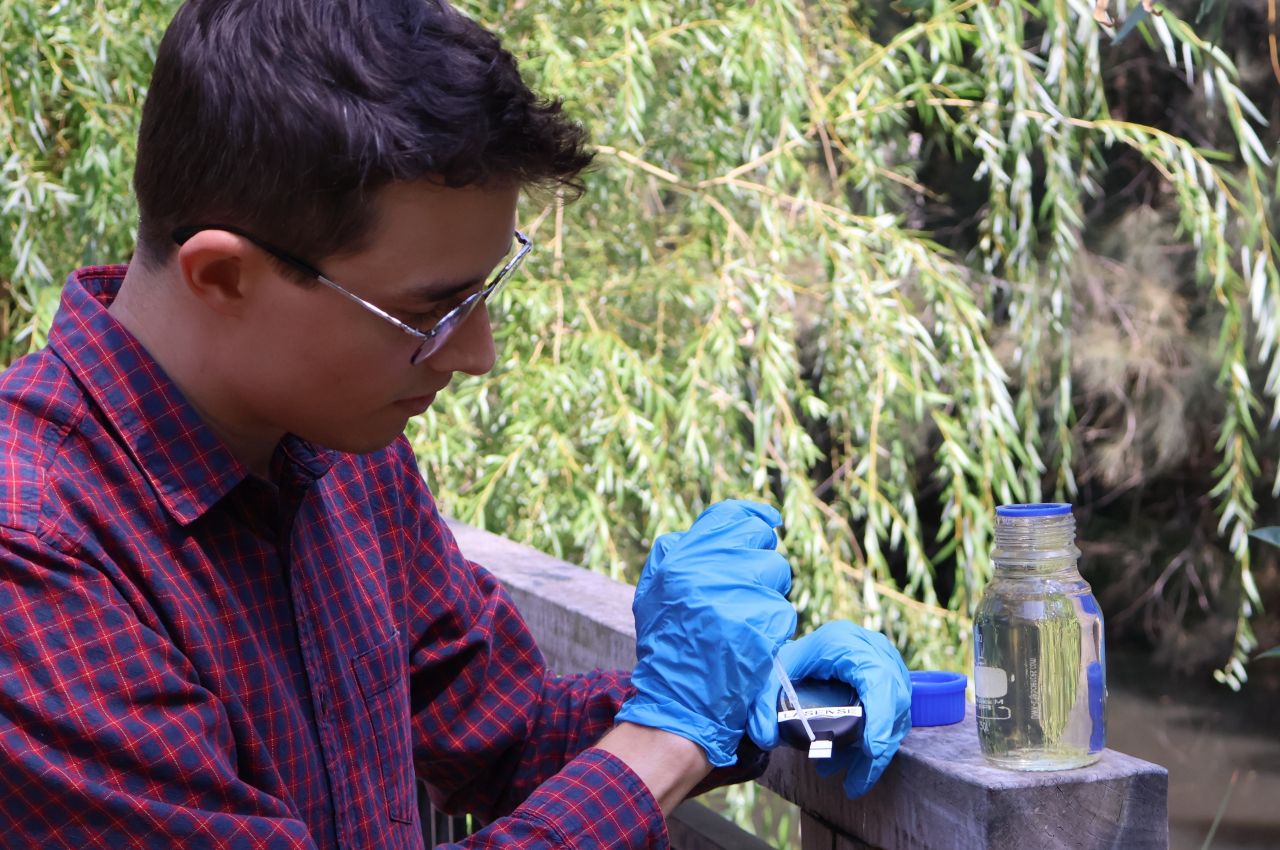
La Trobe also provides practical water education through the Nangak Tamboree Wildlife Sanctuary. In 2025, 2,617 students participated in water-related education activities, including What’s in the Water, Catch Me If You Can, Restoration Revolution, Dip Netting and Close Encounters. These activities continue in 2026 and include water-quality testing, aquatic-invertebrate sampling and interpretation of environmental data.
Students and community volunteers also contribute to ongoing water-quality monitoring across the Sanctuary and connected waterways. Monitoring includes measures such as turbidity, pH, salinity, dissolved oxygen and temperature, helping participants understand how water quality is assessed and how healthy freshwater ecosystems can be maintained.
The requirement to adopt sustainable water extraction technologies across the University is detailed within our Environmental Sustainability Policy, Water Self-Sufficiency Strategy, and Design Standards
Moat Extraction Point Metering
Our Design Guidelines require that La Trobe complies with a Melbourne Water Take and Use Licence in regard to the extraction of stormwater from the moat system. The licence requires all extraction points to be metered using meters specified by Melbourne Water. Current extraction point water meter specifications should be sought from the Diversions team at Melbourne Water. Meters are to be connected to and be compatible with the LTU cloud hosted energy monitoring system (liaise with AZZO).
Water Efficiency & Monitoring
- All extraction and reuse systems are linked to smart monitoring and control technologies, ensuring water from the Melbourne campus moat is extracted sustainably. Water levels are monitored to balance irrigation needs with maintaining sufficient water levels to protect the moat’s ecosystem and support local wildlife.
Use of Reclaimed Water Networks
- At regional campuses (e.g., Albury–Wodonga), La Trobe connects to reclaimed water networks supplied by local water authorities.
- This allows the campus to use recycled water sustainably for irrigation and other non-potable purposes, avoiding extraction from rivers or aquifers.
- On the Melbourne/Bundoora campus, water is captured from stormwater runoff and stored in constructed wetlands (e.g., Nangak Tamboree corridor). The wetlands naturally filter pollutants, recharge aquifers locally, and provide water for irrigation, toilet flushing, and cooling systems—minimising reliance on potable or external water sources.
La Trobe University works with government agencies and water-management organisations to support sustainable water management, environmental restoration and evidence-based decision-making.
In 2025, La Trobe continued its collaboration with the Murray–Darling Basin Authority through Voices from the Basin, a project led by Professor Katie Holmes that records the experiences of communities living with environmental change and water management across the Basin. The project provides insights into community perspectives on waterways, environmental change and the operation of the Basin Plan.
La Trobe also worked with Melbourne Water, Parks Victoria, the Darebin Creek Management Committee and Wurundjeri Woi-wurrung Narrap Rangers on waterway restoration at Nangak Tamboree. In 2025, partners collaborated to re-wet an ephemeral wetland that had stopped receiving the water it required, supporting wetland habitat and ecological restoration.
La Trobe University promotes conscious water use on campus through efficient infrastructure, water reuse, smart technology, sustainable landscaping, education and ongoing monitoring. These initiatives reduce water consumption across La Trobe’s campuses while demonstrating practical water-saving approaches that staff, students and visitors can also adapt in their own homes and communities, visit Moving Towards Water Self-Sufficiency for more information.
Examples of conscious water use on campus, and how similar practices can be implemented at home, include:
- New buildings and major refurbishments incorporate low-flow taps, dual-flush toilets and water-efficient appliances which releases less water. Older facilities are progressively retrofitted to improve their water efficiency.
- Smart irrigation systems use real-time soil moisture and weather data to adjust watering, ensuring that lawns and gardens receive only the water they need.
- These systems are complemented by drought-tolerant and native plantings, which require less supplementary watering. La Trobe’s Indigenous Plant Nursery also provides an opportunity to promote the use and understanding of Indigenous plants suited to local conditions. Staff, student and the community looking for inspiration can go for a self-guided walk and imagine how plants could be used in their own gardens. The team at Nangak Tamboree Wildlife Sanctuary run Backyard Biodiversity workshops providing practical advice on how people can create wildlife habitat to promote water conservation within their own backyards.
- Stormwater and rainwater are captured and reused for purposes such as irrigation and toilet flushing, reducing reliance on drinking-quality water. Staff, students and the community could also install rainwater drums to capture and reuse to water plants or lawns during drier weather conditions.