
Consumer and Community involvement
We include people in research, via our Consumer and Community Involvement program.
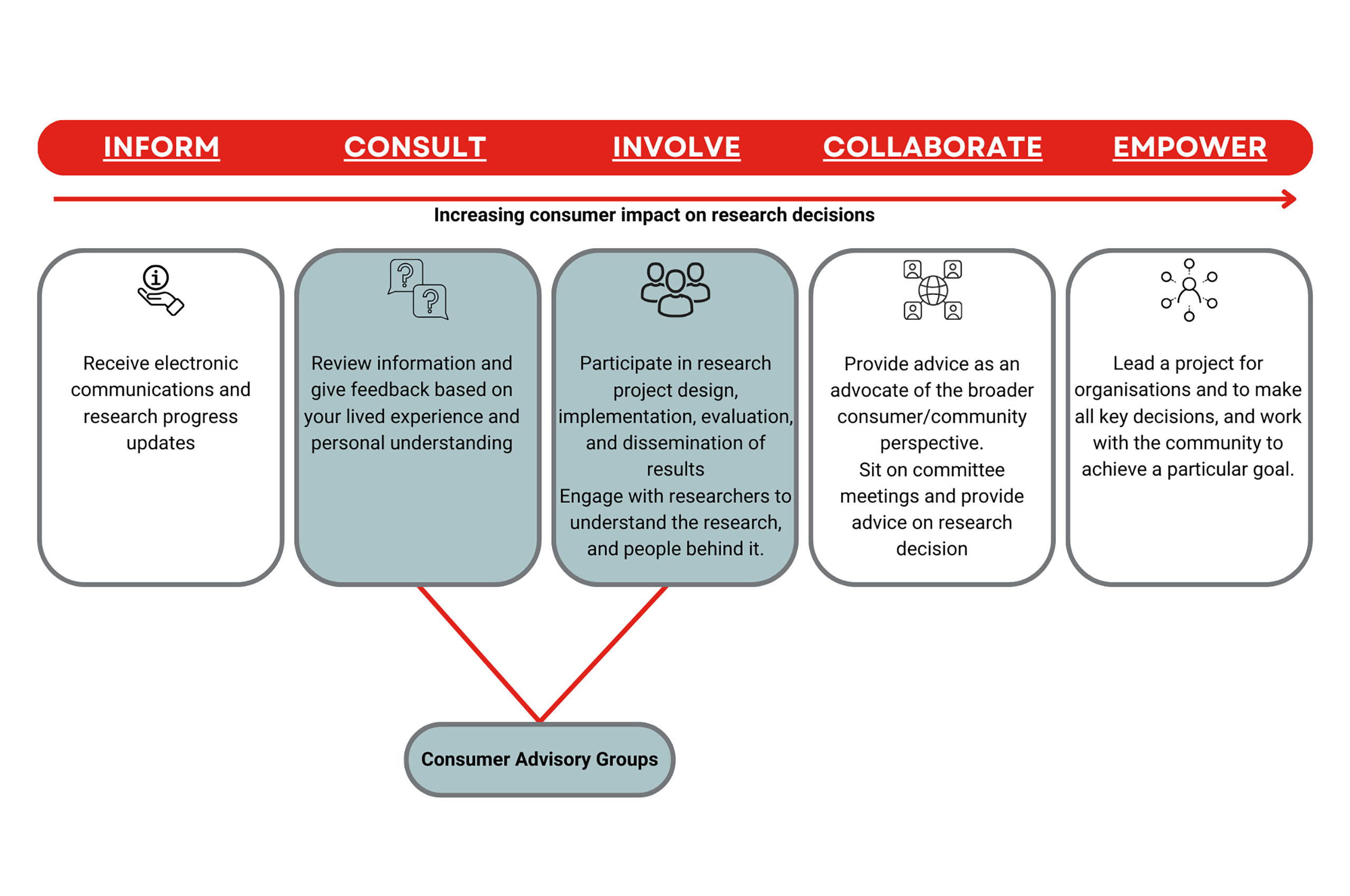
People with (or at risk of) musculoskeletal pain/injury are central to research design, delivery, and dissemination. People with lived experiences partner with researchers to conduct meaningful research and improve health outcomes.
People with (caring for or working with) sports-related injury (e.g. knee or concussion), can join our Consumer Advisory Groups (CAG). We strive for diversity in age, gender, experience, and geographical location. No research or scientific background is required.
Consumers are consulted across our projects. Explore our Consumer Advisory Groups below. If you are interested in getting involved join our network.
Aim: To design, deliver, and disseminate research to make sport safer for women and girls.
Who is, or can be, in the CAG?
- Women and girls who play/ have played sport at any level (with and without a history of injury)
- Coaches and administrators (any sex/gender)
- Researchers or people from other sports, with an interest in injury prevention (any sex/gender).
Current CAG activities
- Co-designing research projects to reduce concussion in women’s football (AFL)
- Parents and/or carers of women and girls who play/have played sport at any level (with and without a history of injury).
Completed CAG activities
- Bruder et al. 2019 10.1016/J.PTSP.2019.08.005
- Bruder et al. 2020 10.1016/J.JSAMS.2019.10.019
- Bruder et al. 2021 10.1016/J.BJPT.2021.05.003
- Bruder et al. 2024 10.1136/BJSPORTS-2023-107518
- Cowan et al. 2023 10.1136/BJSPORTS-2022-106055
- Bruder et al. 2023 10.1016/J.JSHS.2021.09.003
- Patterson et al. 2022 10.1136/BMJOPEN-2022-062483
Aim: To design, deliver, and disseminate research to reduce the burden of knee injuries for women and girls.
Who is, or can be, in the CAG?
- Women with serious injuries
- Parents and/or carers of women and girls who play/ have played sport at any level (with and without a history of injury)
- Health professionals working with women with serious knee injuries (e.g. physiotherapists, exercise physiologists, etc.).
Current CAG activities
- Setting research priorities for women’s knee health
- Designing research to enhance and improve women’s outcomes after ACL reconstruction
- Inform PhD programs of research
- TRAIL W – Promoting women runner’s health and running participation (10.1136/BMJOPEN-2022-068040).
Aim: To design, deliver and disseminate research to understand how people are impacted by anterior cruciate ligament (ACL) injury and the subsequent development of post-traumatic osteoarthritis, and the best treatments for them.
Who is, or can be, in the CAG?
- People with ACL injury or health professionals working with ACL injuries (any sex/gender)
- Health professionals working with ACL injured patients (any sex/gender).
Current CAG activities
- OPTIKNEE – Setting research priorities for knee health after injury: 10.1136/bjsports-2022-106299
- SUPER-Knee – Designing research to test exercise for knee health after ACL injury: 10.1136/bmjopen-2022-068279
- EMBRACE – Designing research to test knee braces for knee health after ACL injury.
Aim: To design, deliver and disseminate research to understand how and why concussion happens, and improve prevention and management strategies. The consumer group helps us set research priorities and design research that is meaningful for athletes, coaches, health/exercise professionals and sporting organisations.
Who is, or can be, in the CAG?
- Contact sport athletes (and/or their parents/carers) of any age, any level
- Coaches, trainers, health/exercise professionals working with contact sport athletes
- Contact sport administrators/officials (e.g. club presidents, coaching directors/educators, umpires)
Current CAG activities
- Research priority setting for concussion prevention in contact sports
- AFLW Video Analysis Study – designing a framework to evaluate head impact mechanisms in elite women’s Australian Football
- I-CARE Project – designing research to understand the knowledge and attitudes of community and elite men’s and women’s Australian Football players on concussion, symptom reporting, and return-to-sport guidelines.
- AFLW VALD Project – Designing research to understand the physical profile and risk factors for injuries in elite women’s Australian Football