
Out in suburbia
Improving LGBTQ wellbeing and inclusion in outer suburban Australia
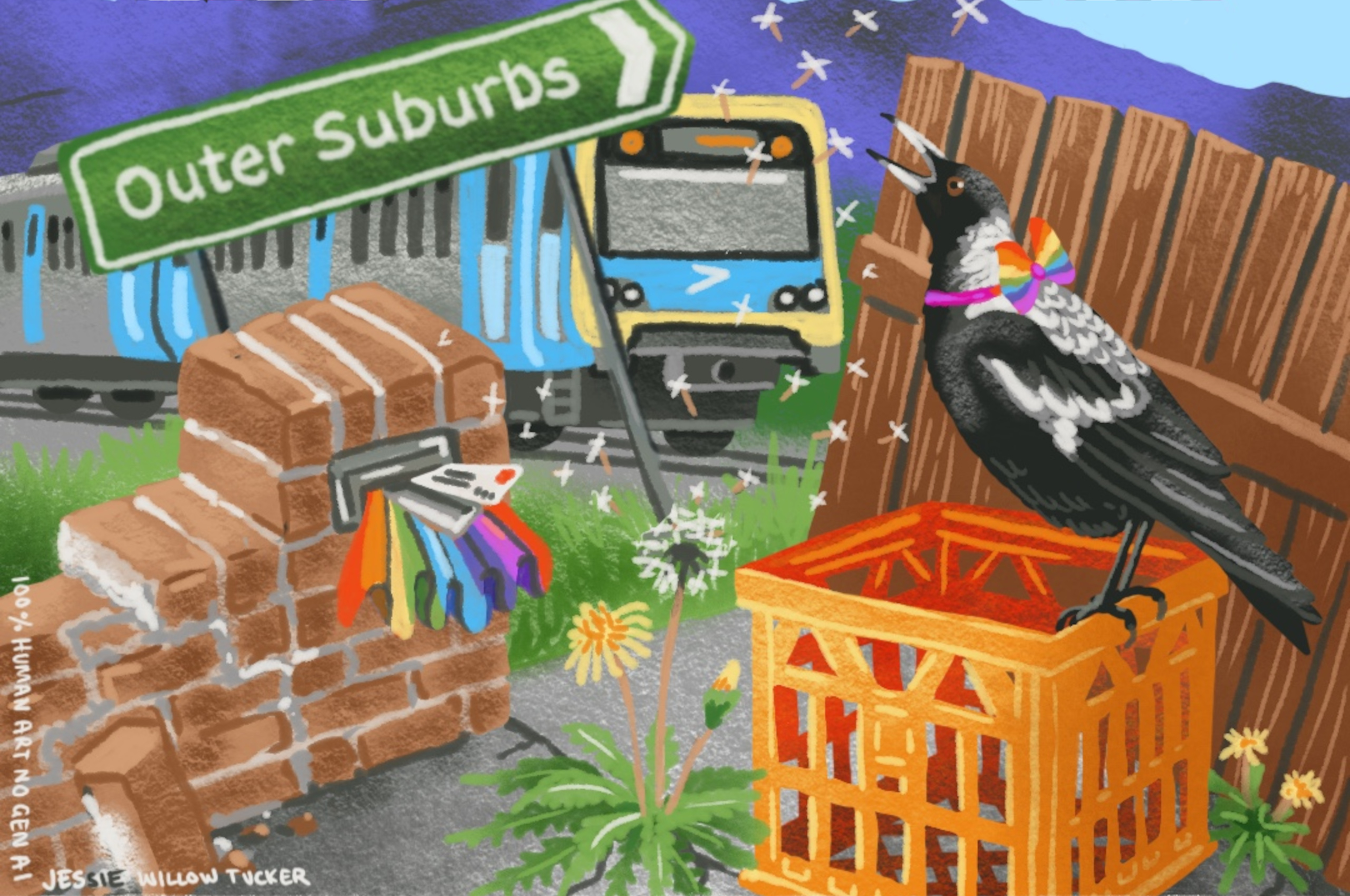
Are you LGBTQ+, 18+, and live in the outer suburbs of Sydney, Melbourne or Hobart?
Help shape how local governments and community organisations support LGBTQ residents!
Out in Suburbia is a qualitative study exploring LGBTQ identity and experiences, community and belonging, and challenges in outer suburbs.
2026-2028
LGBTQ people living in Australia's outer suburbs experience significant barriers to wellbeing. This project aims to understand how living in outer suburban areas shapes LGBTQ belonging and inclusion, how local government policy and action impacts LGBTQ wellbeing and community connection, and how these experiences can be improved.
Expected outcomes of the project include identifying approaches to LGBTQ-inclusion in outer suburban areas that can be translated into policy that enhances local government responses to diversity and inclusion and promotes social cohesion and suburban liveability.
Project PhD scholarship
PhD Scholarship: LGBTQ wellbeing in outer suburban Australia
We are seeking a highly motivated PhD student to join our research team on a project that aims to develop new knowledge about LGBTQ wellbeing in outer suburban Australia.
LGBTQ people living in outer suburban areas face unique health and wellbeing challenges, yet little attention has been paid to their specific place-based experiences in comparison to the better researched contexts of inner cities and rural areas.
This PhD project will be conducted as part of Out in Suburbia, a qualitative research project exploring LGBTQ identity and experiences, community and belonging, and challenges in outer suburbs.
We are seeking a PhD student with a background in sociology, social geography, health psychology, or a related field. A strong interest in research related to LGBTQ populations and local governments is highly desirable. Experience in qualitative research is desirable, and applicants with an interest in developing these skills are warmly encouraged to apply.
Expected to commence as soon as is practicable, this PhD will have an emphasis on place-based wellbeing and belonging for LGBTQ communities in outer suburban Australia.
The research will be determined by the successful candidate’s interests and expertise, and may include:
- LGBTQ wellbeing and community connection in outer suburban areas
- Wellbeing and community connection for culturally diverse, First Nations, migrant, or disabled LGBTQ people in outer suburban areas
- LGBTQ community development and inclusion in outer suburban local governments
The successful candidate will have the opportunity to work with a multi-disciplinary team with expertise in LGBTQ research and to contribute to high-impact, policy-relevant research. The successful candidate will be supervised by Dr Ruby Grant, Dr Sean Mulcahy and Prof Adam Bourne and based at the Australian Research Centre in Sex, Health & Society (ARCSHS) at La Trobe University, which houses Australia’s largest research program on LGBTQ health and wellbeing.
The successful candidate will receive a stipend of $36,000 per annum (2026 full-time rate) for 3.5 years.
To express your interest:
- Ensure you meet the entry requirements for a PhD.
- Read our postgraduate application instructions.
- Email Dr Sean Mulcahy at S.Mulcahy@latrobe.edu.au with:
- A 300-word research project proposal outlining your interest in the project and your research goals
- Academic transcripts of your previous degrees
- A writing sample (e.g. your Masters or Honours thesis, or any published academic journal articles)
- An up-to-date curriculum vitae
Who is eligible to participate in Out in Suburbia?
We're hoping to speak to LGBTQ+ people aged 18 and over, living in the following outer suburban local government areas:
Melbourne
Wyndham, Melton, Hume, Mitchell, Whittlesea, Nillumbik, Yarra Ranges, Cardinia, Casey, Greater Dandenong, Frankston
Sydney
Sutherland, Campbelltown, Camden, Liverpool, Fairfield, Cumberland, Parramatta, Penrith, Blacktown, Hills, Hornsby, Blue Mountains, Hawkesbury
Hobart
Kingborough, Glenorchy, Brighton, Sorrell, Clarence
What will I be asked to do?
If you are selected to take part in this study, we will ask you to complete an interview. The interview will take 60-90 minutes of your time. This can be done in person in your suburb, or online.
If you decide to complete the interview in-person, we will arrange a meeting point and time, and ask you to take us on a walk through your suburb, identifying key locations significant to you. We will discuss the walking route when we meet and confirm that the spaces to be visited are safe and accessible (i.e., no private residences, bushlands, or creeks) and include bathroom stops along the way. We are calling this a ‘go-along interview’.
If you decide to complete the interview online, we will ask you to annotate a map of your home suburb, either physically on paper or on Google Maps, identifying key locations significant to you. We are calling this a ‘virtual interview’.
What are the risks?
The interview topics will cover your LGBTQ identity, experiences, challenges, and feelings of connection, belonging, safety, comfort, and wellbeing. The interview topics may raise feelings of distress. If you do experience distress, we will direct you to LGBTQ-affirming counselling and support services. You may also decide that you do not want to be part of the study.
What will happen to information about me?
As part of your expression of interest questionnaire, we will ask questions that help us understand more about you, your life, and your experiences in your local area. We will collect information about you in ways that will reveal who you are, but that information will be stored confidentially.
If you are selected to participate in a confidential interview, we will only publish information about you in ways that will not be identifiable in any type of publication from this study. The storage, transfer and destruction of your data will be undertaken in accordance with La Trobe University’s Research Data Management Policy. The personal information you provide will be handled in accordance with applicable privacy laws.
Do I have to participate?
Being part of this study is voluntary. If you want to be part of the study, we ask that you read the participant information and consent form (Word) carefully. If you decide not to participate, this won’t affect your relationship with La Trobe University or any other listed organisation.
Further info
For more information, please review our participant information and consent form (Word).
If you would like to speak to us, please contact Dr Sean Mulcahy, Project Manager: s.mulcahy@latrobe.edu.au or (03) 9479 8747
Associated publications
The Out in Suburbia team is working on publications based on the findings from the study. These will be added to this webpage as they are published online. If you cannot access them via the links below, please contact arcshs@latrobe.edu.au.
This article critically examines the contemporary applicability of homonormativity in understanding LGBTQ experiences in outer suburban Australia. Findings reveal that LGBTQ people in outer suburban Australia experience higher psychological distress and suicidal ideation compared to their inner suburban and rural counterparts. Additionally, they report lower levels of connection with LGBTQ communities, indicating a dearth of supportive resources in these areas.
Residential location can significantly impact the mental health, wellbeing, and community involvement of LGBTQ young people. While research has explored geographical differences in LGBTQ adult wellbeing, limited knowledge exists regarding LGBTQ young people’s experiences. Using a large Australian cross-sectional survey of 6,620 LGBTQ individuals aged 14–21, this study examined the associations between residential location and wellbeing outcomes.
Meet the project team
- Ruby Grant (she/her) is a leading sociologist specialising in LGBTQ wellbeing, whose research offers novel insights into the complexities of identity, community, and health within a regional context.
- Andrew Gorman-Murray (he/they) is a highly active researcher with global recognition in geographies and planning in relation to sexualities and genders, and changing spatial experiences of home, work and mobility.
- Adam Bourne (he/him) is a globally leading public health researcher specialising in LGBTQ+ health and wellbeing.
- Sean Mulcahy (he/him) is a socio-legal researcher with extensive experience on LGBTIQA+ inclusion initiatives in local government.
Partners and funding
Out in Suburbia is being delivered in partnership with Western Sydney University and is funded by the Australian Research Council (DP260100756).
Social media tiles
Right-click or long press to save - share with your LGBTQ+ outer suburban networks!