
LGBTQA+ mental health and suicidality
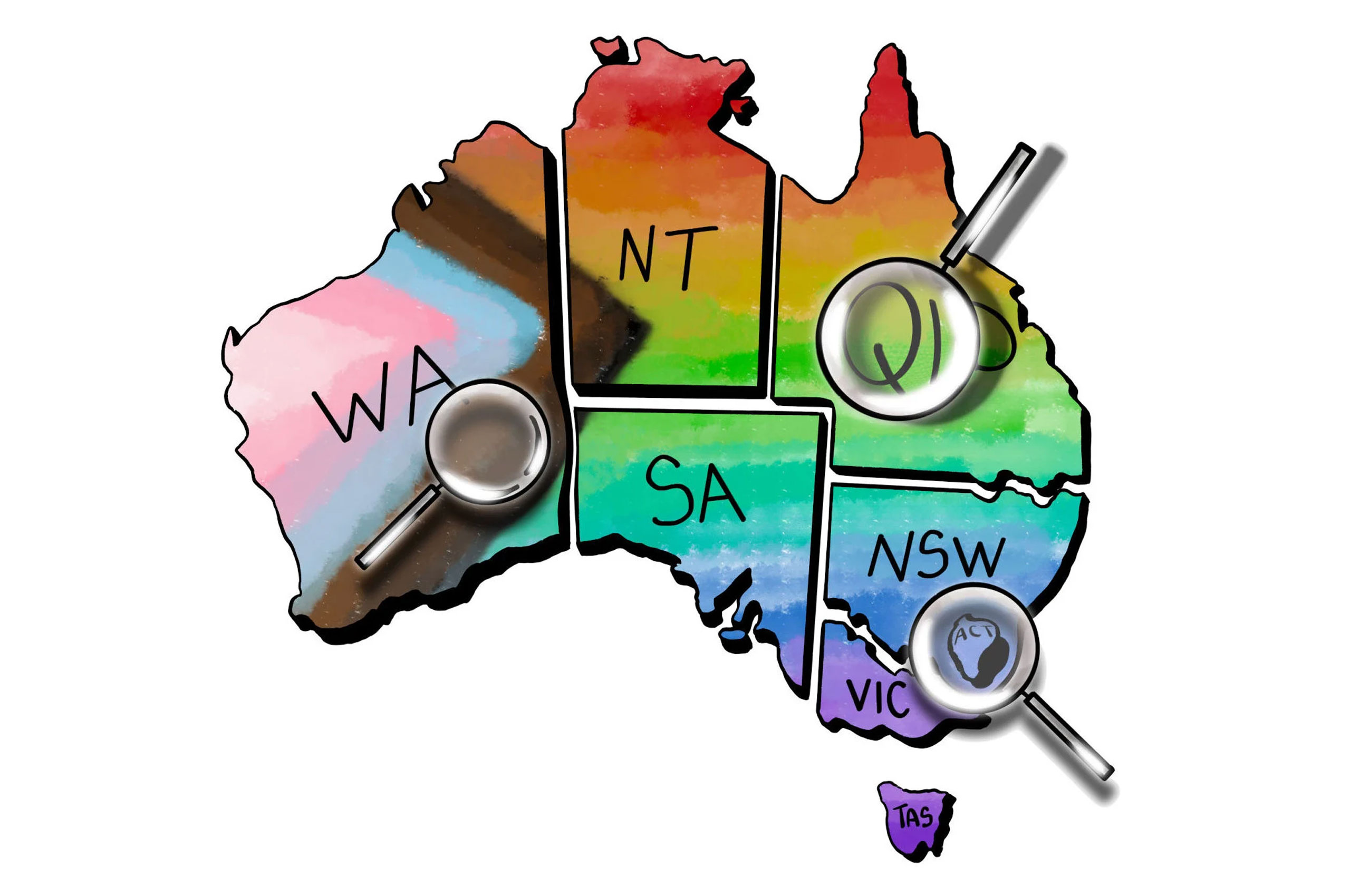
These two sets of briefing papers offer deeper insights into LGBTQA+ mental health and suicidality: geographically by state and territory, and intersectionally with ethnicity, older age, residential location and socio-economic status.
2025
Drawing from three national samples of LGBTQA+ health data in Australia (Private Lives 3, Writing Themselves In 4, and Pride and Pandemic), these two series of briefing papers document the rates and associations of mental health and suicidality for LGBTQA+ community members with specific characteristics.
The first series documents mental health and suicidality at the State and Territory level in Australia. Across eight individual reports, analyses focus on State- and Territory-level rates of suicidality, mental ill-health, healthcare service access and modalities, risk factors such as discrimination and harassment experiences, and protective factors such as community- and school-based belonging. Each report also documents the association between these factors and levels of suicidality within each State and Territory in Australia.
To establish a broader context for these results, each report also provides comparative estimates between (a) the State or Territory results with general population estimates in Australia from the Australian Bureau of Statistics, and (b) a comparison between States and Territories (broadly) from the available data. Lastly, these reports also provide an assessment of each State or Territory's current policy and programming context (along with an assessment at the Primary Health Network level) to establish ways of furthering policy and health reform at the State and Territory level.
The second series of broadsheets take deep dives on specific data on mental health and suicidality among LGBTQA+ people, exploring four specific characteristics: ethnicity, older age, residential location and socio-economic status.
LGBTQA+ Mental health and suicidality state and territory briefing papers
Overview: State and territory snapshots 
Australian Capital Territory (ACT) briefing paper
Jordan D. X. Hinton, Gene Lim, Natalie Amos, Joel Anderson and Adam Bourne
New South Wales (NSW) Briefing Paper 
Jordan D. X. Hinton, Gene Lim, Natalie Amos, Joel Anderson and Adam Bourne
Download New South Wales Briefing Paper
Northern Territory (NT) Briefing Paper 
Jordan D. X. Hinton, Gene Lim, Natalie Amos, Joel Anderson and Adam Bourne
Download Northern Territory Briefing Paper
Queensland (QLD) Briefing Paper 
Jordan D. X. Hinton, Gene Lim, Natalie Amos, Joel Anderson and Adam Bourne
South Australia (SA) Briefing Paper 
Jordan D. X. Hinton, Gene Lim, Natalie Amos, Joel Anderson and Adam Bourne
Download South Australia Briefing Paper
Tasmania (TAS) Briefing Paper 
Jordan D. X. Hinton, Gene Lim, Natalie Amos, Joel Anderson and Adam Bourne
Download Tasmania Briefing Paper
Victoria (VIC) Briefing Paper 
Jordan D. X. Hinton, Gene Lim, Natalie Amos, Joel Anderson and Adam Bourne
Download Victoria briefing Paper
Western Australia (WA) Briefing Paper 
Jordan D. X. Hinton, Gene Lim, Natalie Amos, Joel Anderson and Adam Bourne
Briefing papers: LGBTQA+ mental health and suicidality at the intersection of...
2025
At the Intersection of LGBTQA+ Identity and Ethnicity: Insights on Mental Health and Suicidality in Australia 
Jordan Hinton, Natalie Amos, Gene Lim, Kian Jin Tan, Adam Bourne
Download LGBTQA+ Identity and Ethnicity
At the Intersection of LGBTQA+ Identity and Older Age: Insights on Mental Health and Suicidality in Australia 
Jordan Hinton, Natalie Amos, Ruby Grant, Adam Bourne
Download LGBTQA+ Identity and Older Age
At the Intersection of LGBTQA+ Identity and Residential Location: Insights on Mental Health and Suicidality in Australia 
Jordan Hinton, Natalie Amos, Ruby Grant, Adam Bourne
Download LGBTQA+ Identity and Residential Location
At the Intersection of LGBTQA+ Identity and Socio-Economic Status (SES): Insights on Mental Health and Suicidality in Australia 
Jordan Hinton, Natalie Amos, Joel Anderson, Adam Bourne
Understanding and interpreting these reports
Whilst these briefing papers provide a comprehensive overview pertaining to rates of mental ill-health and suicidality among LGBTQA+ individuals across States and Territories in Australia, they were not intended to capture the full breadth of the lived experiences of LGBTQA+ adults and young people. For more information pertaining to other health statistics for LGBTQA+ community members, please see the following reports:
- Rainbow Realities
- LGBTQA+ People with Disability report
- Private Lives 3
- Writing Themselves In 4
- Pride and Pandemic
- Aboriginal and Torres Strait Islander LGBTQA+ people factsheets
Additionally, some State or Territory reports (e.g., Northern Territory) were only able to provide limited insights into the mental ill-health and suicidality rates for LGBTQA+ adults and young people due to the smaller sample sizes of participants. Where appropriate, analyses for these reports described their findings through a more descriptive and preliminary lens, as well as acknowledging the need for further data collection to obtain more robust insights.
The use of the LGBTQA+ acronym: Within reports, we use the term LGBTQA+ to refer to people who identify as lesbian, gay, bisexual, trans, queer, and/or asexual. The ‘+’ reflects our engagement with others who identify as same- or multigender-attracted, or gender diverse, but who use a wide range of different identity terms. Notably, given that each of the three data projects from which these State and Territory reports were derived only contained a small pool of participants with innate variations in their sex characteristics (intersex), analyses specific to this population were unable to be conducted appropriately. As such, the findings from these reports are not able to be generalised to people with an intersex variation.
Researchers
Jordan D. X. Hinton, Gene Lim, Natalie Amos, Joel R. Anderson, Ruby Grant, Kian Jin Tan, Adam Bourne
Partners and funding
Private Lives 3 was funded by the Victorian Department of Premier and Cabinet and the Department of Health.
Writing Themselves In 4 received generous support from: the Victorian Department of Premier and Cabinet, the Australian Capital Territory Government Office for LGBTIQ+ Affairs, the New South Wales Department of Health, and SHINE SA, with support from the Office of the Chief Psychiatrist in South Australia.
Pride and Pandemic received generous support from the National Mental Health Commission.
Secondary analysis and publication of these data was made possible by funding from the Commonwealth Department of Health and Aged Care via a partnership between ARCSHS and LGBTIQ+ Health Australia.
Acknowledgements
We are grateful to the following individuals, and their wider teams or organisations, for helpful feedback on earlier drafts of the State and Territory briefing papers:
- Holley Skene (SHINE SA)
- Teddy Cook (ACON)
- James Hamlet (Thorne Harbour Health)
- Philippa Moss (Meridian)
- Lynn Jarvis (Working it Out, Tasmania).
We also acknowledge the significant contributions made by the other investigators on each of the three studies listed above.
Ethics
Each of the three projects outlined within these State and Territory reports received approval from:
- La Trobe University’s Human Research Ethics Committee
- the ACON Research Ethics Review Committee.
In addition, both Private Lives 3 and Pride and Pandemic received ethical clearance from the Community Research Endorsement Panel of Thorne Harbour Health.