
Research in the School of Cancer Medicine
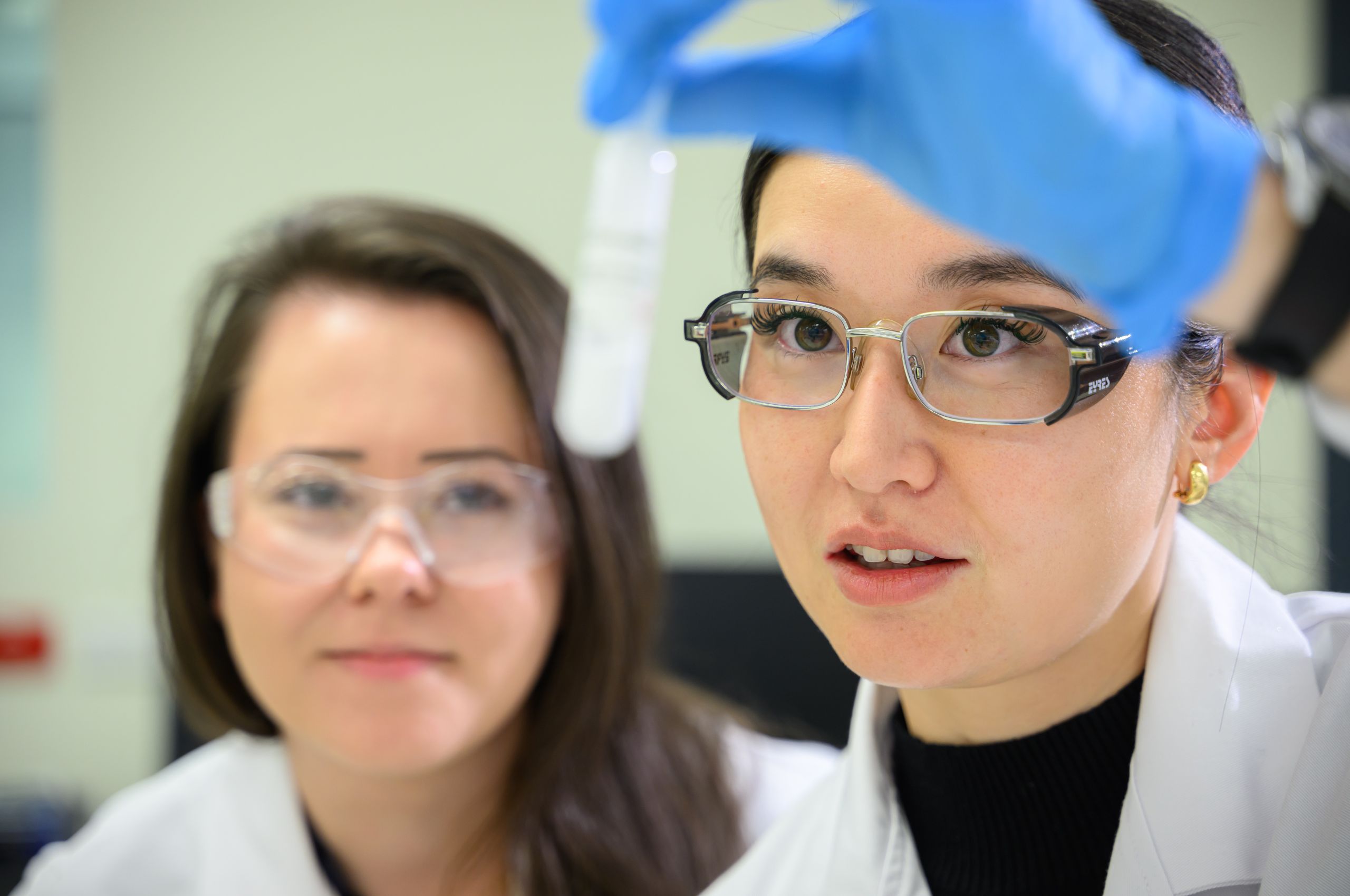
The Olivia Newton-John Cancer Research Institute (ONJCRI), affiliated with La Trobe University as the School of Cancer Medicine, is a leading medical research institute that focuses on all key areas of cancer research across its different laboratories.
This cross-collaboration means that our students have access to a variety of expert knowledge from our senior researchers, and an opportunity to learn advanced technologies useful to their work.
Our work spans pre-clinical and clinical research, as several of our researchers are also clinicians who work in the hospital. Their work at the bedside informs the research at the bench, a crucial part of our bedside-to-bench-to-bedside research model.
Research areas
Rather than concentrating on individual cancer types, we adopt a tumour-agnostic model – targeting shared biological mechanisms across cancers to accelerate the development of therapies with broad, scalable impact.
Our research is grouped into seven key areas:
We explore immune-tumour interactions to enhance immune cell responses against cancer. Our research includes developing advanced therapies like tumour-specific antibodies, CAR-T cells and immune checkpoint inhibitors.
We work on a variety of cancers, seeking potential immunotherapy candidates. We also look into how tumour microenvironment signalling impedes response to common cancer treatments that target the immune system.
Overall, our research is highly focused on immuno-oncology: improving immune system activation and overcoming treatment resistance to immunotherapies.
By creating robust preclinical models that mimic human cancer, we study tumour development and therapy resistance mechanisms, providing a foundation for new treatment strategies.
We investigate the origins and drivers of cancer, that are either tumour intrinsic or extrinsic, and reveal mechanisms by which healthy tissue transitions to cancerous tissue.
We track cells to monitor how individual tumour subpopulations spread, survive in distant organs and resist treatment.
Investigating tumour interactions with the surrounding environment, we aim to understand, and eventually disrupt, signalling pathways critical for tumour growth and immune evasion.
We have found that signalling in cells of the tumour microenvironment promotes tumour growth and represents new sites for cancer spread across many cancer types.
Our state-of-the-art microscopy platform, the ACRF Centre for Imaging the Tumour Environment, provides advanced microscopy and spatial proteomics technologies to study tumour–microenvironment interactions at high resolution.
Research in this area focuses on inducing cancer cell death and enhancing immune cell survival, underpinning innovative treatment approaches.
We investigate how cancer cells evade programmed cell death. Apoptosis is often disrupted in cancer, and certain cancer drugs aim to restore cell death pathways in haematopoietic and solid tumours. This work advances our understanding of survival pathways in tumours and supports the development of therapies that reinstate cell death mechanisms.
By studying genetic diversity within tumours, we aim to uncover common vulnerabilities that potentially represent therapies applicable across multiple cancer subtypes.
We additionally work on understanding the diverse cellular make up of tumours and how they spread (metastasis).
We label individual cancer cells from patient tumours, and apply next generation sequencing and high-end imaging techniques to follow the fate of the cancer cells within the primary as well as distant sites of growth. This approach helps identify new markers that can predict metastasis or treatment resistance.
We develop precision therapies that target cancer cells specifically, reducing off-target effects, and enhancing the quality of life for cancer patients.
We engineer antibodies that serve as therapies, and novel diagnostics when labelled with advanced molecular imaging tracers.
These studies are performed within our new state-of-the-art ACRF Centre for Precision Medicine, offering opportunities to learn advanced imaging and theranostic techniques.
With our third generation, long-read sequencing of DNA and RNA and computational expertise, we analyse complex datasets, such as genomic and proteomic profiles, to identify novel targets and therapeutic strategies.
We investigate how epigenetic DNA and RNA modifications influence genome function and become reprogrammed in cancer.
We integrate advanced computational tools, including artificial intelligence and machine learning to develop computational and molecular workflows for genome analysis.
Find a laboratory
Whether you’re a researcher seeking collaboration, a clinician looking for support, or you are a student exploring study opportunities, this tool helps you connect with the right team. Find out about the expertise driving our cutting-edge cancer research.