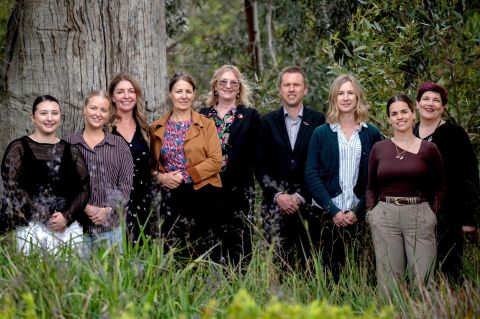
On February 20th, we marked the launch of our Directions 2026–2030 with a small gathering of past and present staff, partners, and family advisors. My reflections to the group traced my maternal ancestry in Cornwall and the journey to Australia by one of my bold great-great-grandmothers, who embarked on a robust challenge to become a wealthy landowner. While she was indeed trespassing on his property, he didn’t “own the view” from the hill. You can read an excerpt from that story, below, and my take-aways about what it takes to indeed ‘share the view”.
Our Directions 2026–2030 are a carefully built vision that renews our commitment to co-building systemic practice innovation, with a roadmap for quiet, steady impact. Download our Directions 2026–2030 here. These Directions mark an important milestone in shaping our future, grounded in the values and relationships that have defined our work for decades. Central to our next era’s strategy is our ongoing investments in purposeful partnerships—collaborations that strengthen capacity building across sectors and expand research that matters in the real world.
We then enjoyed a moving panel conversation, chaired by one of our Lived Experience members, and featuring lived experience and Industry views on “A vision for next generation family mental health care”. To close the morning, Professor Rob Pike dedicated a plaque to Bouverie staff, former, present and future, for their efforts, for their vision and dedication to systemic practice, research and translation.
Director’s speech for the launch of our Directions 2026–2030
We invite you to read an excerpt from the opening address by Professor Jenn McIntosh, Director, The Bouverie Centre.
Speech excerpt
Families…. Recently, my husband and I have been tracing our families’ origins—as you do when, at a certain point in life, you wonder not just where you come from, but who, and how their stories have threaded into the fabric of who you became. I found myself drawn to my eight great‑great‑grandmothers: what brought them here, over the seas from across the world, what kept them moving through hardship, what threads of courage, mischief, stubbornness, and resilience were knitted into them—and into me.
True to Bouverie fashion, my ancestors did not disappoint: None were wealthy. I come from a long line of sheep farmers, blacksmiths and bakers. And there is a convict or two, a rogue scoundrel, and more than a handful of astonishingly brave women.
One of them—my great‑great‑grandmother Sarah—was convicted of trespassing on lands of a neighbouring estate in Cornwall. She had been sitting on ‘his lordship’s’ hilltop, looking out to sea. When confronted, she spoke back with such spirit that she was sentenced to a trip to the then ‘Van Diemen’s Land’ — not for trespass, but for telling his Lordship exactly what she thought of him and his claim to owning the land. Her immortal words went something like this: “Screw you — you don’t own the view.”
That line—you don’t own the view—stayed with me. Not just because it’s cheeky, but because it names something larger: who gets to determine the view? whose experience counts? whose truth is seen? Entitlement has no place in answers to those questions. Long before “systemic” views of social justice entered a psychology textbook, she said something profoundly systemic, was punished for it and built an extraordinary life from it, which dug into my DNA.
You will see Bouverie’s DNA shining through our Strategic Directions. For 70 years Bouverie has followed the sight lines set by the extraordinary founding rebel Director, Geoff Godding and fellow rebel pioneers of the Bouverie Centre. From a social justice foundation, Bouverie has always worked hard to widen the view.
- We continue to privilege the collective view
- We seek the guidance of our First Nations team in deep listening.
- We hold space for multiple truths.
- We sit in complexity with compassion.
- We stay connected when connection is hardest.
- And we resist—gently, courageously—systems of care that by-pass families or flatten contexts into mono-types.
This past year, one of Bouverie’s beautiful examples of quiet revolution came from our Workin’ with the Mob cultural exchange clinic for non-Indigenous Australian families — where our First Nations therapists co-facilitate this powerful single session, teaching about trauma, healing, kinship and truth‑telling. It is reconciliation in action. It widens the view. And our research shows how helpful these wisdoms are to non-Indigenous families.
Our efforts to humanise mental health care include losing mechanistic language and constructs. We no longer hold a waitlist. We no longer “do intake”. A family’s first encounter here is with the Family Care Team, who wrap around them from entry to exit from the service.
Our pioneering single session thinking defines our clinical work. Every Bouverie family now begins with a single, rapid‑access telehealth conversation—two therapists, no waitlist. Simple. Human. And for one in five families, that first conversation is enough to help them rediscover their own resources for managing the complexity of their situation. This is the kind of innovation our sector needs—and it’s being noticed. Medibank funded research is nearing completion. Spoiler alert: the longitudinal clinical and health economics data will make headlines, in the right ways. Watch this space.
But beyond the data, it’s the heart of it that matters: through our work and partnerships, families—of origin, of procreation, and of choice—begin to see a view of themselves that is wider – kinder and more hopeful.
Beyond what we achieve with families directly, we are uplifting the capacity of workforces across the state to embed family inclusion. Last year alone, we trained more than 3,000 practitioners across multiple sectors. Slowly but surely, we are adding family inclusion like fluoride in the water of the mental health system—quietly strengthening it, making it foundational. We support practitioners at every stage of training—from one‑hour webinars to the three‑year Masters of Clinical Family Therapy.
We are creating new evidence about what works to promote safety and well-being across the life-course, and in the face of multiple challenges. As I speak, you’ll see examples from last year’s publications.
I’m proud to say one of our PhD graduates received extraordinary international acclaim—described by Dublin Professor Allan Carr - a leading global researcher in our field - as “simply the best PhD thesis I have read in 40 years.” That meticulous and brave doctoral work now forms the foundation of our upcoming e‑Family Hub. Funded by the Dept Health, this will be a safe, free, accessible online space where families can find resources and safely share ideas about connecting and communicating with one another, virtually.
Capstone to these recent developments, today we launch our 2026–2030 Strategic Directions. They are the product of months of whole‑staff collaboration. They are not just motherhood statements. They echo our fierce commitment to supporting families and systems in the face of challenge. They are real, and they matter.
The next era of Bouverie will be built—as the first seventy were—in partnership.These Directions need you, our partners and allies.
Today and every day, we invite you into partnership. Into creativity. Into collective stewardship of this next era of Bouverie. For example, we invite partners in expanding the rapid‑access model— “a family, one call, two therapists, no waitlist”. We hope to scale the model, train local teams, and evaluate outcomes, as we are doing already in cross cultural, autism and alcohol and drug spaces. More doorways open to more families, across regions, with greater cultural safety.
Partnership alters trajectories.
- It means more families get help when they ask for it, not in six months, and not never, regardless of where their family members live.
- It means practitioners feel less alone and more competent, with systemic tools in hand.
- It means we create knowledge that translates into improved lives.
There is a financial reality to partnership for us. As with the rest of the Victorian mental health system and as with many self-funding research centres, Bouverie is weathering tough financial times. You may have ideas that help us realise these Directions. A wealthy benefactor or two would be great! But seriously, you might introduce us to someone who we should have coffee with, because they just might be interested in giving a scholarship, funding a small study, or a devoted resource in the e‑Family Hub, or a collaborative training project. We need support to continue what is now unquestionably world leading systemic research.
Bouverie has weathered many hard seasons and kept heading for the horizon. We know hard seasons do not own the view either. Our people do. Our families do. Our community does.
So when I think of Sarah on that hill in Cornwall, looking out to sea, I imagine clouds and horizon. Maybe the feeling of a future she could sense but not yet see. When she said, “You don’t own the view,” she wasn’t just defying a landowner. She was freeing the horizon for the rest of us.
Seventy years in, Bouverie’s systemic stance is the same: no one owns the view. Not a profession. Not a service. Not a diagnosis. We share it. We widen it. We keep it open for the next person to see something new. And when we do, families catch sight of themselves—wider, kinder, more hopeful—and service systems bend toward connection.
Bouverie has always been at its best in the face of challenge, when we move together—practice, evidence, policy, lived experience—braided, not siloed. That is how views widen. That is how good ideas become game changers. That is how change sticks.
As we look to the next decade, we do so with gratitude for everything Bouverie has been to date—and everything it will become through partnerships in this room and beyond and through the brilliance and dedication of our staff.