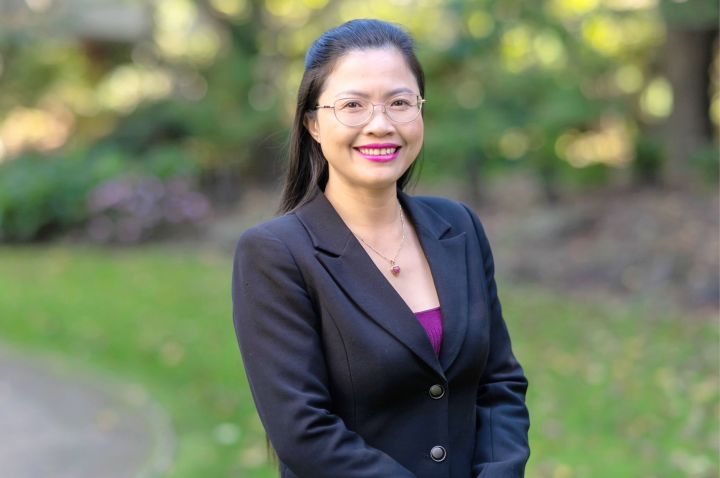
For Dr Huong Nguyen, questions of leadership, equity and inclusion are not abstract research topics – they reflect lived experience.
Now a Lecturer in Human Resources Management and Management at La Trobe Business School, Huong’s research focuses on leadership, gender equity and inclusion, with particular attention to how organisations identify, develop and promote talent. Her work examines the systems and practices that shape who progresses into leadership roles – and who does not.
“What drives my research started from my own personal experience,” she says.
At just 27, Huong became a faculty Dean in Vietnam, leading more than 130 staff. She was one of only three female Deans across a university with 30 faculties. While the institution itself was progressive, the broader social context was not.
“There were a lot of constraints in society – expectations of being a wife, a mum,” she says. “That influenced how people perceived you as a leader.”
At the time, Huong did not fully recognise the impact of those dynamics. “I found myself keeping quiet in meetings because I dared not speak up,” she recalls. “I was very young, and most of my peers were much older and mostly male.”
When she later moved to Australia, Huong expected those barriers to ease. Instead, her research revealed familiar patterns.
“We are considered a very multicultural society,” she says, noting that nearly half of Australia’s population was either born overseas or has at least one parent born overseas. “However, this diversity is not well reflected in senior levels of leadership.”
Her research highlights stark disparities. While around 25 per cent of Australians trace their heritage to non-European or Indigenous origins, only about 5 per cent appear as chief executives across major organisations. Women make up around half of the workforce, yet represent only a small fraction of chief executives, board chairs and senior executives. Huong’s work seeks to understand why.
“I study why capable women and ethnically diverse professionals are often overlooked for leadership opportunities,” she says, “and how organisational systems such as recruitment, promotion and succession planning shape those outcomes.”
If researchers and industry work together, we can build more inclusive workplaces where all kinds of talent are recognised and developed.
From good intentions to real change
One of Huong’s key findings is that many organisations genuinely want to promote diversity, but struggle to translate intention into action.
“Organisations often have very good intentions of promoting diverse leaders,” she says. “But in reality, there is a disconnection between their intentions and their actual practices.”
Too often, she argues, responsibility is placed on individuals rather than systems. “We need to shift attention from fixing the woman to fixing the system,” she says. “From who looks like a leader to who has the real capability, potential and commitment to lead.”
Huong’s research spans multiple contexts. Her early work focused on Vietnam, where she translated research into practice by building a community of practice for Australian-trained women leaders returning to the country. More recently, she has re-established her research program in Australia.
Current projects include comparative studies of women university leaders in Australia and Vietnam, in-depth research with ethnically diverse women leaders in two large corporate organisations, and an international collaboration examining migrant women’s leadership experiences in Australia and the United Kingdom.
Across all of this work, Huong takes a practice-driven approach. “Research alone is not enough,” she says. “We need to build knowledge and evidence, but we also need to translate research into real practice.”
That belief underpins her interest in industry collaboration. Huong is actively seeking partners in leadership development, inclusive recruitment, talent retention and workforce diversity.
“Each organisation has its own culture, history and workforce,” she explains. “Before you intervene, you need to understand what the real issues are in that organisation. That first step is very important if you want change to be sustainable.”
For organisations, the value of engaging with her research is both practical and strategic. “At its core, my work is about helping organisations make better leadership decisions – for people, for performance and for society,” she says.
Increasingly, this research moves beyond employability at graduation to focus on what happens after people enter organisations. It shows that career progression and recognition over time matter just as much as early preparation, and that organisational systems are a critical part of the employability ecosystem shaping career outcomes.
Huong is clear-eyed about the challenge ahead. Structural change takes time, and progress is rarely linear. But she remains optimistic.
“I’m a strong believer in collaboration,” she says. “If researchers and industry work together, we can build more inclusive workplaces where all kinds of talent are recognised and developed.”
Connect with Dr Huong Nguyen
La Trobe Profile: Dr Huong Nguyen
Email: H.Nguyen9@latrobe.edu.au
To stay up to date on future La Trobe Industry articles and news, subscribe to the Industry newsletter or Follow ‘La Trobe Industry’ on LinkedIn and Eventbrite.