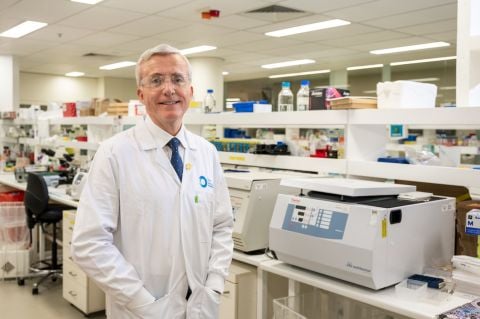
Flooded roads, soggy paddocks and gumboots were everyday challenges faced by the Farm-scale Natural Capital Accounting natural values research team.
The team is comprised of ecologists with skills in ornithology (aka the “birdos”), botany and entomology, with soil microbiologists and many enthusiastic and committed research assistants and volunteers joining for shorter stints.
Their task was an ambitious field program to sample birds, plants, invertebrates and soils on fifty working farms across Tasmania, Victoria and New South Wales, to understand how natural capital assets relate to biodiversity at a farm scale.
Bird Surveys
By early summer 2022, the bird team Fred Rainsford, Alex Maisey, Dr Jim Radford and Dr Will Mitchell, had conducted the fourth and final bird survey. Despite the soggy conditions, the team made it out to all farms—20 farms in NSW and 15 farms each in Victoria and Tasmania.
Many sites were accessible due to the generosity of farmers, who provided all-terrain vehicles along the muddy tracks. To access remote sites, the team trudged many kilometres across paddocks, up hills and down dales.
The effort resulted in 4,614 bird surveys across 259 sites on Victorian farms, 409 sites on Tasmanian farms and 488 sites on NSW farms.
In total, 227 bird species were detected across the three states (173 species in NSW, 123 species in Victoria and 96 species in Tasmania), nine of which are listed as nationally threatened.
This means more than one in three of all of Australia’s land birds and waterbirds (excluding vagrants and seabirds) are represented in our 50 farms! On average, the number of species detected per farm was ~65 in NSW, ~47 in Victoria and ~53 in Tasmania.
Plant surveys
PhD candidate Annette Cavanagh with her team of botanists, conducted detailed vegetation surveys at 259 sites on the 15 Victorian farms, 402 sites on the 15 Tasmanian farms and 429 sites on 18 NSW farms.
Two farms in NSW were inaccessible due to flooding (one kind farmer offered to collect the botanist team by boat, however, aquatic plants were not on the hit list!). Some sites on a few farms were inaccessible due to the wet conditions; given the sampling scale, this will have a negligible impact on data analysis (though Annette said the wet conditions substantially impacted the size and ferocity of the leeches in Tasmania).
The sheer diversity of plants across a broad region was a key challenge for species identification. Annette has spent many days in the lab behind a microscope, identifying diagnostic features of dry-pressed specimens.
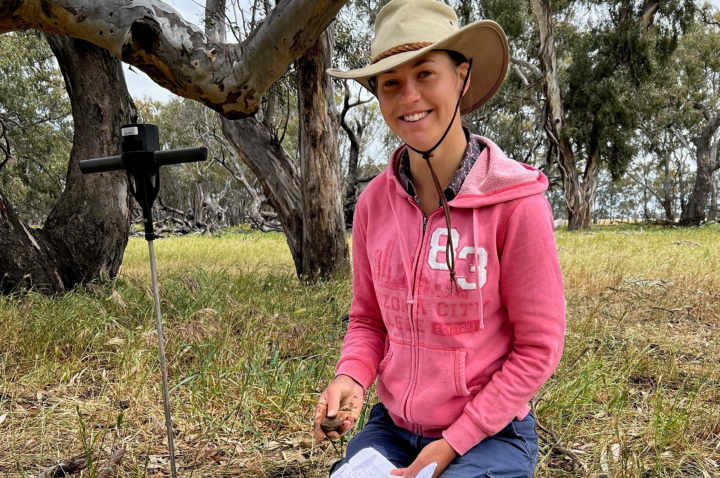
PhD candidate Annette Cavanagh identifying grasses and soil types at a biodiversity site.
Insect survey
Invertebrate samples were collected to inform our understanding of ecosystem services provided by beneficial insects (e.g., pollinators, predators and parasitoids that control pests). The nimble bird team pivoted from surveying birds in the morning to “bugs” in the afternoons.
Invertebrates were sampled using sweep nets in pastures and crops that were adjacent to the remnant or planted native vegetation. Assessing the role of vegetated areas in helping the beneficial invertebrates do their job.
Invertebrate surveys and associated habitat data were collected from 82 sites (410 samples) on the 15 Victorian farms (in 2021) and 27 sites (135 samples) on 12 Tasmanian farms, and 35 sites (173 samples) on 12 NSW farms.
Alex and placement student Georgie Glossop have been processing the samples in the lab for DNA sequencing, to identify those important groups. Tenzin and Lucas, talented research assistants, have led volunteers to tirelessly sort and count detritivores (tiny animals that play a primary role in decomposition) collected from Victorian farms.
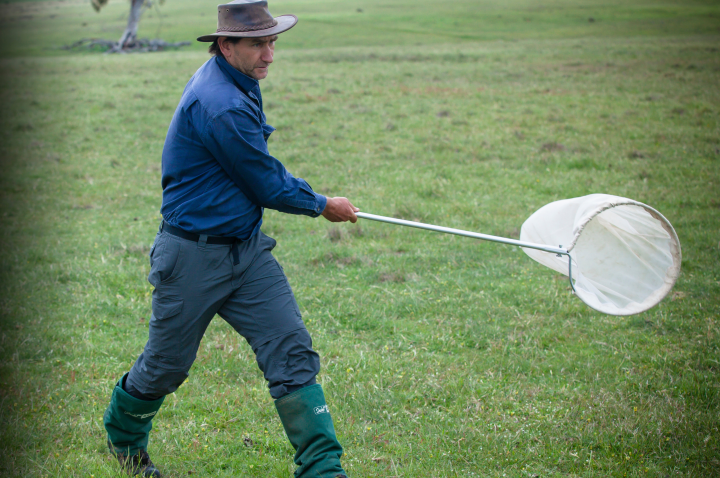
Project lead Jim Radford in full swing as he collects invertebrates in a Tasmanian pasture site.
Soil Survey
Soils sampled in the 2022 spring field program, complemented earlier samples from PhD candidate Berenice Della Porta during 2021 and early 2022.
A modified soil sampling regime was introduced. Samples taken from paddocks represent a gradient of pasture species diversity, remnant vegetation and revegetation sites. These soil samples are being processed in the lab by Josh Vido, a research assistant with expertise in soil microbiology.
A total of 64 samples were collected from 8 farms in Tasmania and nine farms in NSW. This adds to the 71 paddocks sampled by Berenice. In the lab, she extracted DNA from the soil microbial communities and ran sequencing to discover what these communities do in the soil.
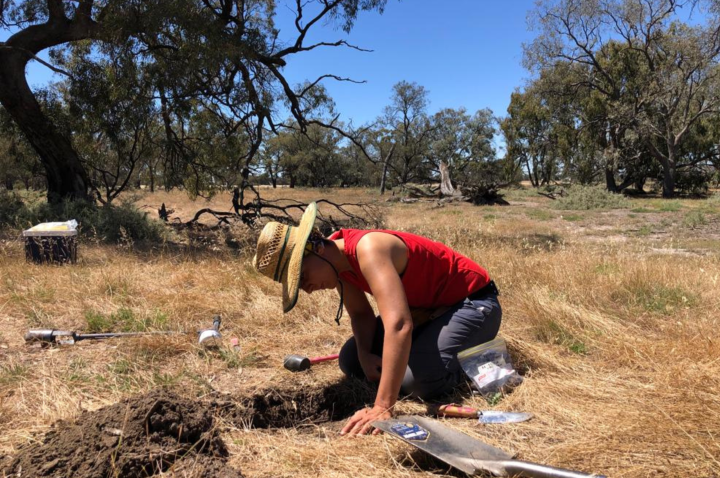
PhD candidate Berenice Della Porta collecting soil samples in a woodland site near Bendigo.
Despite the very wet seasons, the team enjoyed days of sunshine, sightings of plants and animals and lunch breaks overlooking magnificent views of stunning farmland.
Highlights for the field team included learning about farming in different landscapes. Sharing conversations with farmers about the plants and animals that live in the diverse habitats on farms across the country.
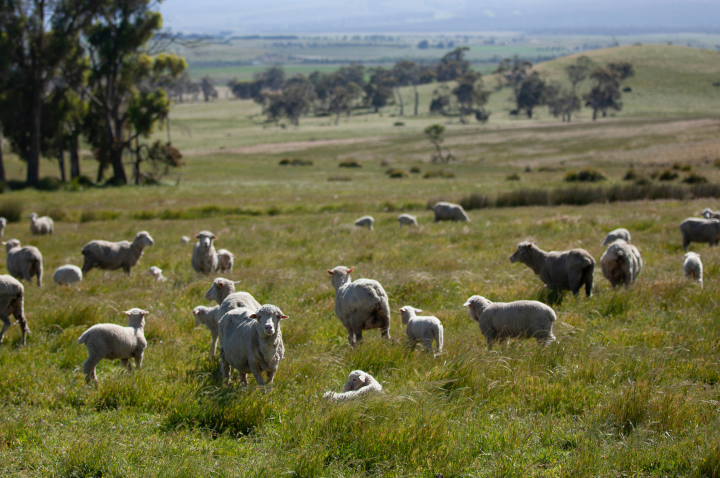
Biodiversity sites were located across all farm ecosystem types, including production areas.
Alex Maisey, NCA Research Fellow, La Trobe University