
Newly Positive

Recently diagnosed with HIV?
The Newly Positive study investigates the experiences of people recently diagnosed with HIV, including HIV infection, diagnosis, treatment, care/support, sex, relationships and living with HIV.
The study aims to:
- identify contexts and risk factors associated with HIV seroconversion in the current era
- describe current experiences of HIV diagnosis
- describe experiences of linkage to, and retention in, HIV clinical care, including treatment initiation
- better understand the specific experiences and needs of people diagnosed with HIV who are temporary residents and/or recent arrived in Australia
Australia has a 30-year history of conducting in-depth research into people’s experiences of HIV seroconversion and diagnosis, with the first study commencing in 1992. Using qualitative methods, these studies have provided insights into contexts of HIV infection, understandings of risk, experiences of diagnosis, linkage to care, and access to HIV treatment and support.
Findings from these studies have made important contributions to health promotion, policy, and service delivery.
Take part in the study
Who is eligible?
You can take part if you:
- Have been diagnosed with HIV in the past 12 months
- Are living in Australia (you don’t need to be a permanent resident)
- Are aged 18 years or over.
What is involved?
If you agree to take part in the study, we will arrange a time to do an in-depth interview. The interview will take 60–90 minutes. Interviews will be conducted via telephone or web-based video conferencing platform (such as Zoom). You will be compensated for your time.
View the Participant Information Statement.
Why take part?
Your personal story will help us understand the experience of being diagnosed with HIV today, and help influence the design of HIV care and support services.
Share the study
Reports
Newly Positive: 
Experiences of HIV acquisition and diagnosis in Australia today
Findings from the Newly Positive study (2023-2026)
This report presents findings from the Newly Positive study (2023–2026), a qualitative investigation of experiences of HIV acquisition, diagnosis, treatment and care, and identifies new opportunities to strengthen the national HIV response.
Newly Positive: Experiences of HIV seroconversion and diagnosis - 2025
This report presents findings up to June 2025 from the Newly Positive study. The study is investigating experiences of seroconversion, diagnosis, and treatment uptake among people living in Australia who have been recently diagnosed with HIV. Data for the Newly Positive study are collected via semi-structured in-depth interviews.
Newly Positive: Case studies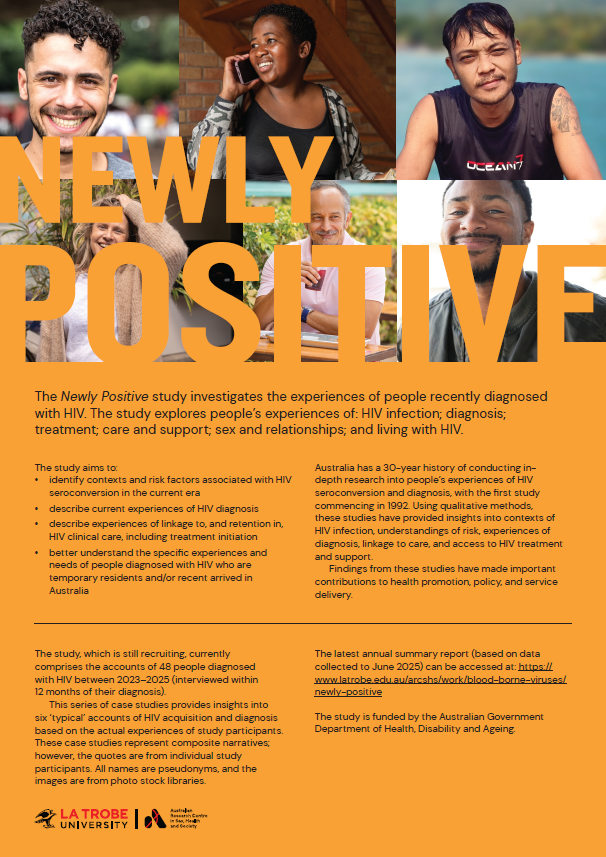
This series of composite case studies provides insights into six ‘typical’ accounts of HIV acquisition and diagnosis based on the actual experiences of participants in the Newly Positive study. These case studies represent composite narratives; however, the quotes are from individual study participants.
Conference presentations
2024
Murphy, D., Ellard, J. (2024). Rethinking ‘overseas-born’ men as queer migrants. Australasian HIV/AIDS conference, 16-18 September 2024, Sydney. Abstract
Ellard, J., Murphy, D., Wells, N. (2024) The ‘prevention logic’ of gay and bisexual men in the contemporary HIV epidemic Australia. Australasian HIV/AIDS conference, 16-18 September 2024, Sydney. Abstract
2025
Murphy, D. (2025) The undetectabilised body: Embodiment of undetectable viral load among people recently diagnosed with HIV. The 16th AIDSImpact Conference, Casablanca, Morocco, 26-28 May 2025. Abstract
The Research team
Project lead
Dr Dean Murphy is a Senior Research Fellow at ARCSHS. Dr Dean’s work focuses on HIV policy, experiences of HIV diagnosis, models of HIV care, HIV biomedical technologies, HIV-related stigma, sexual health and well-being, and drug consumption. Dean is currently leading an ARC Discovery project (DP250100183) 'Addressing the opportunities and risks of HIV elimination in Australia'.
Project coordinator
Dr Jeanne Ellard is a Research Fellow at ARCSHS. Jeanne has extensive experience conducting social research investigating understandings of HIV risk and prevention and experiences of diagnosis and treatment among people living with and affected by HIV in Australia. Jeanne has been an investigator on previous HIV seroconversion studies.
Other investigators
Dr Adam Bourne is Professor of Public Health and Director of ARCSHS He is an investigator on the HIV Futures project which explores the health and quality of life of people living with HIV in Australia. He is actively involved in HIV-related research, especially in low and middle-income contexts, including the Asia Pacific MSM Internet Survey (APMIS).
Dr Dion Kagan is a Research Associate at the Health + Law Partnership, Faculty of Law and Justice, UNSW. He is an expert on the social and cultural dimensions of HIV and hepatitis C, with significant experience in social research on Gay, bisexual and queer men’s sexual practices, injecting drug use, blood borne viruses, health and sexual wellbeing. He has published widely on social and cultural experiences of HIV.
Funding
The study is supported through a grant from the Commonwealth Department of Health, Disability and Ageing.
To find out more:
For more information, please view the Participant Information Statement.
If you want to take part, or to find out more, please email Jeanne Ellard or fill in our online form and we will contact you.
Sign up to the study results mailing list to hear more about the study.
La Trobe University ethics reference: HEC23423 | TEQSA PRV12132 - Australian University | CRICOS Provider 00115M and Alfred Hospital Ethics Committee project number 104316