

The first 72 hours after child sexual assault
Reporting children, young people and mothers’ experience of police, hospital, and psychosocial care in Victoria.
Authors: Whitehouse, C., McKenzie, P. & Hobbs, C.
Published by: Journal of Interpersonal Violence (2025)

Citation: Whitehouse, C., McKenzie, P., & Hobbs, C. (2025). The First 72 Hours After Child Sexual Assault: Reporting Children, Young People, and Mothers’ Experiences of Police, Hospital, and Psychosocial Care in Victoria. Journal of Interpersonal Violence, 08862605251324962.
Full text alternative
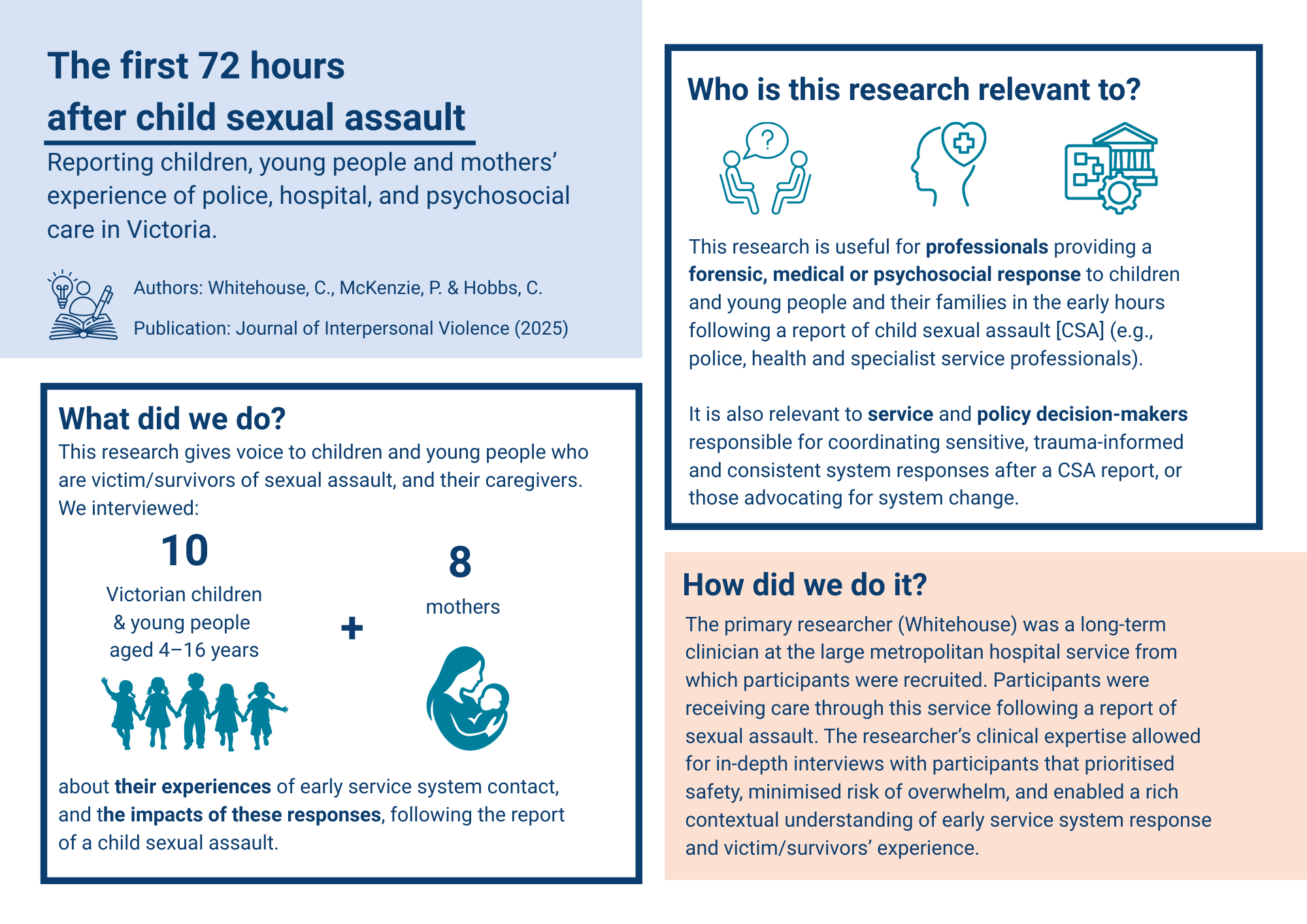
This research is useful for professionals providing a forensic, medical or psychosocial response to children and young people and their families in the early hours following a report of child sexual assault [CSA] (e.g., police, health and specialist service professionals).
It is also relevant to service and policy decision-makers responsible for coordinating sensitive, trauma-informed and consistent system responses after a CSA report, or those advocating for system change.
This research gives voice to children and young people who are victim/survivors of sexual assault, and their caregivers. Ten Victorian children and young people aged 4–16 years, and eight of their mothers, were interviewed about their experiences of early service system contact, and the impacts of these responses, following the report of a child sexual assault.
The primary researcher (Whitehouse) was a long-term clinician at the large metropolitan hospital service from which participants were recruited. Participants were receiving care through this service following a report of sexual assault. The researcher’s clinical expertise allowed for in-depth interviews with participants that prioritised safety, minimised risk of overwhelm, and enabled a rich contextual understanding of early service system response and victim/survivors’ experience.
Key stages emerged from the stories of participants, and within those stages, a set of themes. The below graphic represents the stages of the process, and related key themes that emerged:
1. Reaching out for help
- Feeling confused, distressed and minimised when reported
2. Entering Crisis Care:
- Experiences of processes and procedures
- Valuing a caring presence
- Feeling exposed, vulnerable and ashamed
- Being lost in space and time
3. Discharge from hospital
- Going home alone
Overall, the study found that child victim/survivors and their mothers often navigated unfamiliar acute responses with not enough support, which they experienced as harrowing and overwhelming. While the professionals supporting these families were committed in their roles, broader systemic constraints limited their ability to consistently provide trauma-informed care.
A ‘one size fits all’ approach often overlooked diversity, polyvictimisation, and intersectionality. System responses - particularly at the initial reporting stage - were found to prioritise ‘justice’ over holistic psychosocial care1.
The findings in this study align with international evidence that timely, streamlined, trauma-informed responses centring the child’s wellbeing following a report of sexual assault can reduce early trauma symptoms, improve safety, and support the collection of clear information for legal processes2 3.
[1] Families in this study indicated that while they too were seeking a justice response, this was not their only need or priority when reaching out for help.
[2] Shaffer C., Smith T., Ornstein A. (2018). Child and youth advocacy centres: A change in practice that can change a lifetime, Paediatrics & Child Health, 23(2), 116–118
[3] Hahn H., Oransky M., Epstein C., Stover C. S., Marans S. (2016). Findings of an early intervention to address children’s traumatic stress implemented in the Child Advocacy Centre setting following sexual abuse. Journal of Child & Adolescent Trauma, 9(1), 55–66
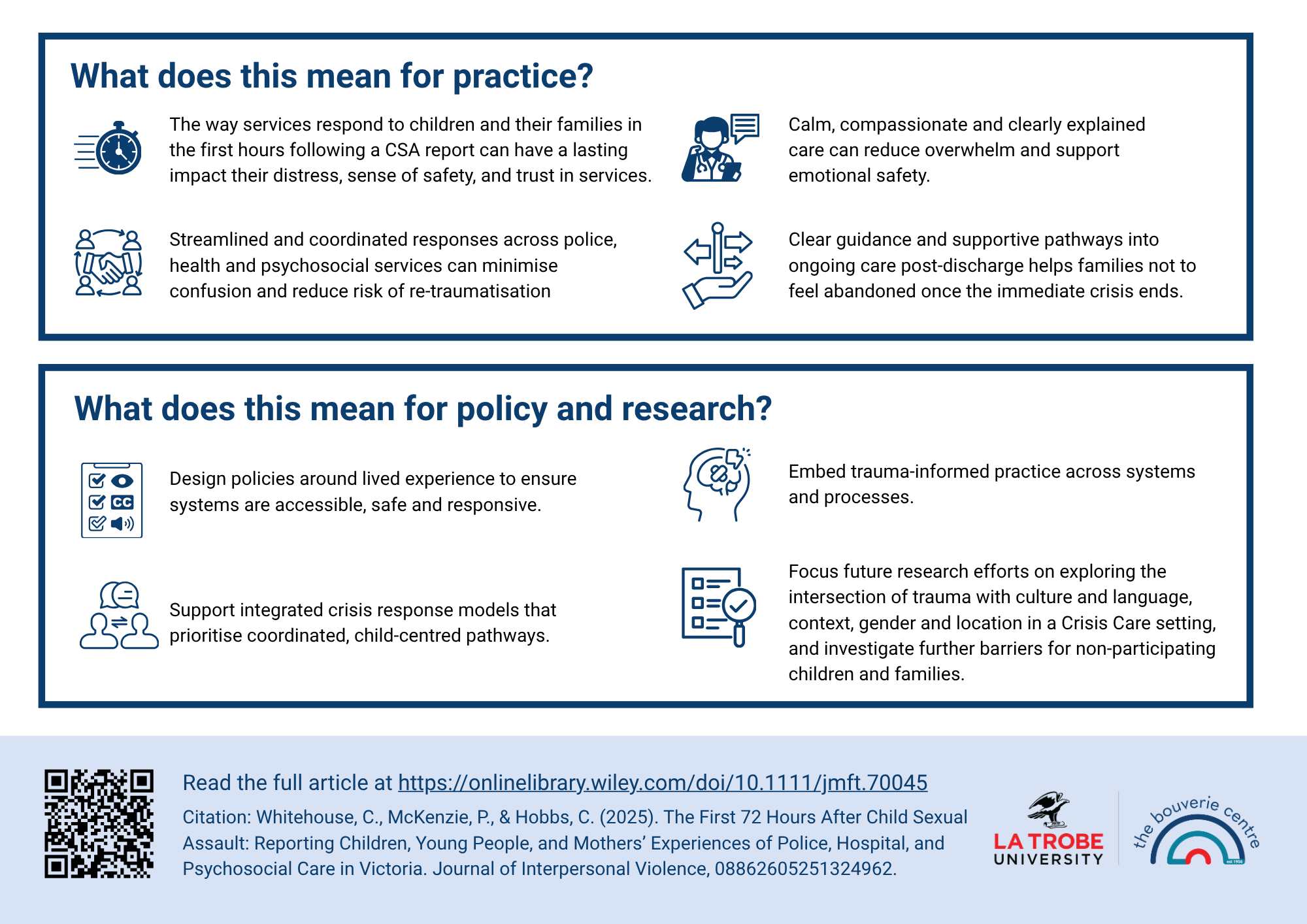
- The way services respond to children and their families in the first hours following a CSA report can have a lasting impact their distress, sense of safety, and trust in services.
- Calm, compassionate and clearly explained care can reduce overwhelm and support emotional safety.
- Streamlined and coordinated responses across police, health and psychosocial services can minimise confusion and reduce risk of re-traumatisation.
- Clear guidance and supportive pathways into ongoing care post-discharge helps families not to feel abandoned once the immediate crisis ends.
- Design policies around lived experience to ensure systems are accessible, safe and responsive.
- Embed trauma-informed practice across systems and processes.
- Support integrated crisis response models that prioritise coordinated, child-centred pathways.
- Focus future research efforts on exploring the intersection of trauma with culture and language, context, gender and location in a Crisis Care setting, and investigate further barriers for non-participating children and families.