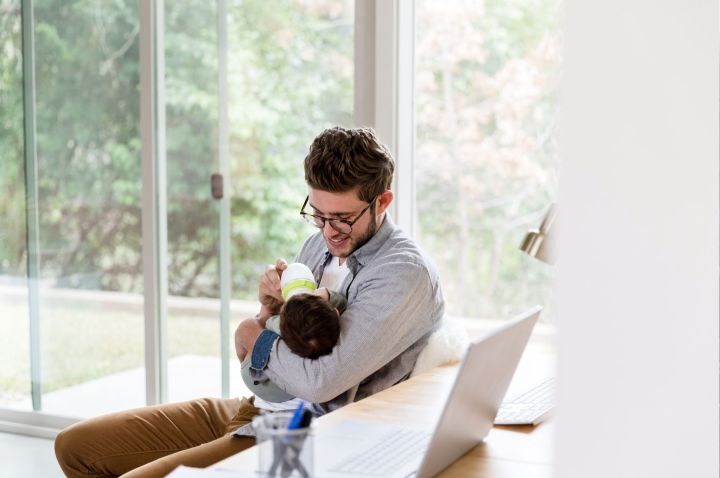
“I worked in construction and I was doing a 12-hour day every day ... I’d get home at 6pm, eat dinner, have a shower and my daughter was tucking me into bed,” one father recalled about a previous job.
Balancing work and family remains somewhat elusive for many fathers, despite the introduction of family-friendly workplace policies in Australia.
Fathers described the impact of competing priorities and parenting as a work in progress, a constant goal and ongoing negotiation.
“I’d love to be at home every night and every now and then pick the kids up from school ... I think it’s what every parent wants ... it’s what you strive for but know it’s slightly impossible,” one father said.
Published in the Journal of Family and Economic Issues, the La Trobe study explored the values and approaches to combining work and family care of 15 fathers across the nation between 2019 and 2021. They worked in a range of jobs and industries, with most having one to two children. Four were single parents.
All fathers in the study said they valued spending time with their children. The majority viewed their current workplace as supportive of parents and flexible working.
However, the study also revealed that fathers with high workloads, inflexible schedules, long hours or lengthy commutes faced difficult trade-offs between income, their wellbeing and family time.
“I can’t potentially see an ideal position that I can win ... I’ll be losing a bit financially or I’ll be losing time with the children,” another participant said.
Dr Stacey Hokke, lead author from the Judith Lumley Centre at La Trobe, said workplace culture was a critical factor in supporting fathers.
“When managers and colleagues prioritise family, it creates an environment where fathers can thrive both at work and at home,” Dr Hokke said.
Fathers who achieved a positive work-family balance said it gave them more reason to stay in their jobs and be more productive.
In contrast, some new fathers felt invisible in the workplace, with paternity leave likened to a holiday or their new parental role unacknowledged.
“... there was that whole, ‘why are you taking leave? You don’t need to take leave; you’ve got a wife’, kind of mentality,” one father, who had taken extended leave, said.
The research highlighted parental leave for fathers is often inadequate.
One father who had taken only two weeks’ parental leave felt like he had “walked away half done” upon their return to work. Others said they had “missed a fair bit” in the early stages of their child’s life and that their child’s bond wasn’t as strong as it could have been.
Changes to Australia's Paid Parental Leave in July 2025 granted parents up to four weeks’ leave each, doubling the previous limit of 10 days.
Dr Hokke said the updated policy was a welcome step but more needed to be done to support Australian families.
“Our research shows fathers want longer parental leave, ideally between three and six months, with the flexibility to use it in ways that meet the needs of their family,” she said.
“Normalising flexible work is essential. There’s no one-size-fits-all solution and workplaces need to recognise the diversity of fathers’ needs.”
- Case study of a Melbourne father is available on request.
- DOI: https://doi.org/10.1007/s10834-026-10078-8
Media Contact
media@latrobe.edu.au