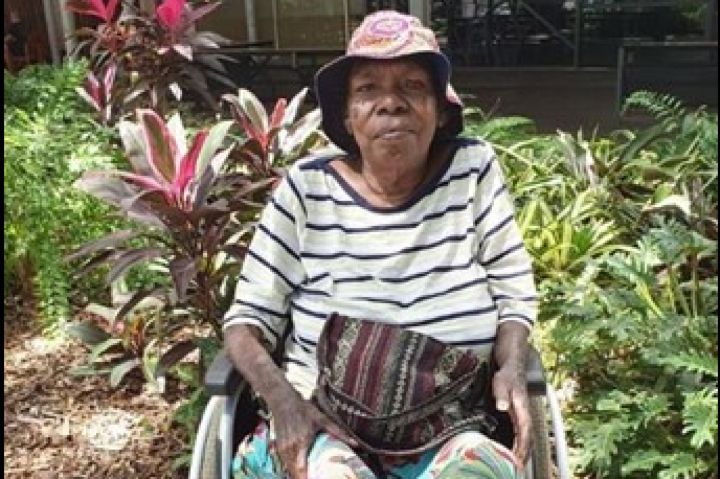
We feel great loss over the recent passing of Napaljarri Rose. It was our great privilege to have worked, travelled, and laughed with our passionate friend over many years. She will be sorely missed.
Napaljarri was a Warlpiri woman who hailed from Lajamanu community in the Northern Territory. At a young age, Napaljarri was unfairly denied the formal education she deserved. Despite this, her heart and resilience drove her to passionately pursue education and training opportunities by other means.
Napaljarri earned her education degree through the Batchelor Institute and went on to be a driving force in developing and delivering bilingual education across the Warlpiri communities during her years as a schoolteacher. She was very proud of her work as a teacher, which led her to become a powerful advocate for education and research that is appropriate for Warlpiri.
Napaljarri lived a remarkable life as an educator, mentor, linguist, changemaker, role model and researcher. In community she was known as a strong woman who was looked up to as a leader. She inspired many people to share knowledge and work together.
She was a founding member of the Warlpiri Education and Training Trust (WETT), working with the Central Land Council and advocating for education and training opportunities for Warlpiri people. Since its establishment, WETT has been a driving force for Aboriginal-led development in the Northern Territory and beyond, winning a Reconciliation Australia Australian Indigenous Governance Institute award in 2018.
In 2018, Napaljarri joined the Centre for Human Security and Social Change at La Trobe University as a senior researcher, where she played a critical role in bringing Warlpiri ways of knowing, being and doing into the work and enabling two-way learning between Yapa (Warlpiri people) and Kardiya (non-Aboriginal people).
During her time with the CHSSC, she oversaw the creation of the Yitakima-ninjaku, warrirninjaku, payirninjaku manu pina-jarrinjaku (YWPP) project tracking and learning framework for monitoring and evaluating the progress and impact of WETT programs. She was also central to the development of the ‘WETT map’ tracking tool and supported the YWPP team of Yapa and Kardiya practitioners to implement the project. This contributed to WETT winning a National NAIDOC education award in 2024. Napaljarri’s work, as part of the wider CHSSC team, was also recognised by the 2024 Vice Chancellor’s Research Excellence Award for Industry Engagement and Partnering.
Napaljarri was integral to the development of the CHSSC’s approach to Indigenous-led monitoring and evaluation, and particularly the ‘circles of change’ tracking tool used in the Lajamanu Good Life Project which seeks to centre Warlpiri ways of knowing and being in assessing community change.
Napaljarri often said that she wants to be a positive role model for her people. She brought what it means to be Warlpiri to her role at the CHSSC, not only to demonstrate that Warlpiri people can do research, but that they can do it in a Warlpiri way. This made research safer and more meaningful for Warlpiri. Napaljarri was passionate about Yapa and Karidya working together, that they work together equally, that Warlpiri ways of working are valued and that they are prioritised when working in Warlpiri communities. She was strong and graceful in maintaining this in her work. She reminded us:
“We have our own Yapa ways of watching closely to assess how things are going, giving encouragement and feedback so things can improve, and sharing information through stories and paintings. But Kardiya don’t see this or maybe they don’t understand it.”
In line with this, Napaljarri helped drive the creation of the WETT painting, which tells the story of WETT in a Warlpiri way.
Her approach has been key to growing the numbers of Warlpiri researchers supporting the design and delivery of the YWPP project and the Lajamanu Good Life project, with both now providing meaningful employment for Warlpiri.
In recent years, Napaljarri experienced health challenges that made life and work harder for her. Nevertheless, her goals of making her community a better place and being a positive role model drove her on. She continued to work as much as she could, bringing her passion, energy, and laughter to all those around her. She continued to shine right up until she passed away. Just a few weeks ago, she joined us in rethinking the future of our First Nations portfolio and provided wise, honest, and passionate counsel about the work ahead of us all.
[Photo used with permission of Napaljarri's family]