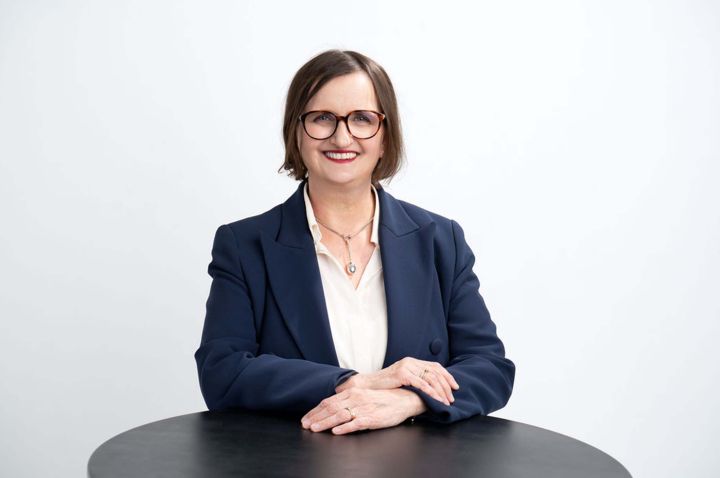
As Pro Vice-Chancellor, Education, Impact and Innovation and Dean of the School of Education, Professor Joanna Barbousas is leading a transformation of teacher education in Australia.
At the centre of this work is an ecosystem that brings together evidence-based teacher education, research innovation and strong partnerships, including initiatives such as the Science of Language and Reading (SOLAR) Lab, the Science of Mathematics Education (SOME) Lab, Nexus and Momentum Schools.
Alongside this, three new departments will be established in 2026 – Learning Sciences and Emerging Technologies, Professional Practice and Wellbeing, and Social Equity and Inclusive Education.
The result is a coordinated, evidence-informed approach designed to improve teaching quality, lift student outcomes and shape education policy at a national level.In her own words, Professor Barbousas explains how this approach is driving change across the education system.
Transforming teacher education
“We are very deliberate about the role we want to play in the system. For too long, education reform has been fragmented with strong evidence on one hand, practice on the other, and limited capacity to connect the two at scale. Our work is focused on closing that gap,” explains Professor Barbousas.
“That means putting explicit teaching, structured literacy, and strong curriculum design at the centre of teacher education and ensuring our graduates are classroom-ready from day one.”
“But, we’re not just redesigning programs, we’re building a system. Through initiatives like Nexus and Momentum Schools, we are working directly with schools to embed evidence into practice, while generating longitudinal data on what works. That allows us to move from debate to impact.”
“What drives me is the belief that every child deserves access to high-quality teaching. If we get teaching right, we change life trajectories. That’s the scale of responsibility, and opportunity, we’re working with.”
Research innovation
“We’ve been very intentional about moving beyond traditional models of research that sit at a distance from practice,” says Professor Barbousas.
“Our approach is to build a connected ecosystem where research, teacher education and school practice inform each other continuously.”
“Our SOLAR and SOME Labs give us deep expertise in literacy and mathematics – areas where the evidence base is strong and the need is urgent. Nexus and Momentum Schools allow us to take that evidence into classrooms at scale, working alongside teachers in real time.”
“The next step is the proposed national institute. It’s about building the infrastructure to sustain this work nationally. Not just producing research, but embedding it, scaling it, and tracking its impact over time.”
“For me, research excellence is not just about publication, it’s about consequence. Are we improving teaching? Are we lifting student outcomes? Are we informing policy in a meaningful way? That’s the standard we hold ourselves to.”
Building an AI-enabled culture
“We see AI as an accelerator, not a replacement, for great teaching,” says Professor Barbousas.
“Our focus is on how AI can strengthen pedagogy, not sidestep it. That means using AI to provide real-time insights into student learning, support formative assessment and free up teacher time so they can focus on what matters most: teaching, feedback and relationships.”
“Within our programs, we are preparing graduates to be confident, critical users of AI. They need to understand both its potential and its limitations, and how to use it responsibly in classrooms.”
“For our staff, we are building an AI-enabled culture by supporting them to experiment, innovate, and integrate AI into both teaching and research.”
“And at a system level, we want to help set the standard. The use of AI in education must be human-centred, evidence-informed, and grounded in how students learn. That’s the space we’re stepping into.”
Looking ahead
“Our priority is to continue strengthening the quality and coherence of our programs to ensure that every graduate experiences a rigorous, evidence-informed curriculum, regardless of where or how they study,” says Professor Barbousas.
“We are focused on expanding our partnerships, particularly through Nexus and our work with schools and systems. We are also progressing the national institute and building the capability, governance and funding model that will allow us to operate as a truly national platform.”
“And underpinning all of this is our commitment to people. We want to develop our staff, support leadership at all levels, and build a culture that is both ambitious and collaborative.”
“Our new School structure will strengthen this commitment. It will allow us to bring together expertise in a more coherent way, strengthen leadership, and ensure that our teaching, research and partnerships are all pulling in the same direction.”
“Importantly, it also positions us for the future. Education is being reshaped by advances in cognitive science and AI, alongside an ongoing imperative to address inequity. This structure reflects that reality – it’s designed not just for where we are, but for where we need to go.”
“Ultimately, I’m proud that we are not just talking about change, we are doing the work to make it happen.”