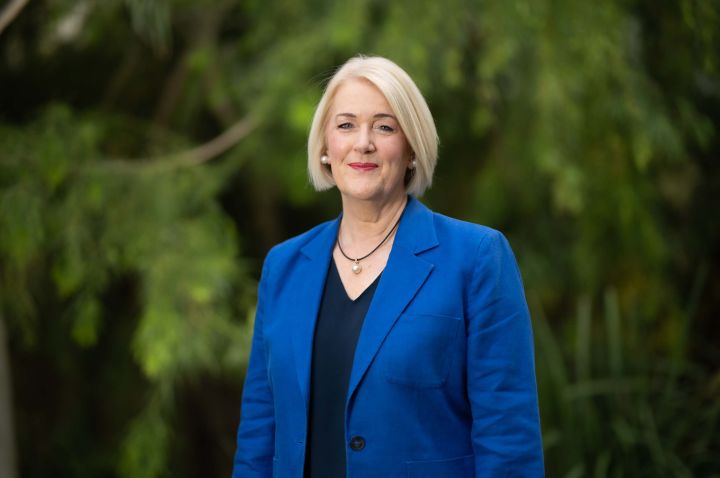
As Pro-Vice Chancellor of Health Innovation Regional and Dean of the La Trobe Rural Health School, Professor Jane Mills is taking La Trobe University’s Health Innovation Strategy to the regions.
A $170 million investment in teaching, research and infrastructure to boost Australia’s healthcare workforce by an extra 4000 professionals by 2030, Health Innovation has, according to Professor Mills, delivered equity to the rural student experience.
The centrepiece of the rural infrastructure upgrade – La Trobe’s $21 million Rural Dentistry and Oral Health Clinical School in Bendigo – has already enabled closer integration between teaching, research and student placement.
But it is just one part of the story, with new clinical simulation facilities at La Trobe’s Mildura, Albury-Wodonga and Shepparton campuses, and a $23 million upgrade to the nursing, midwifery and allied health facilities underway at La Trobe’s Bendigo campus.
The result: an investment that graduates work-ready health and human services and biomedical science professionals to promote better outcomes for rural populations.
In her own words, Professor Mills tells us more about the unprecedented opportunities of health innovation at La Trobe.
Transforming the student experience
“La Trobe University’s Health Innovation Strategy in the regions focuses on increasing student numbers in nursing, occupational therapy, dentistry and physiotherapy,” explains Professor Mills.
“To encourage students to choose La Trobe, we have redesigned our curriculum so that the pathways into our degrees are more easily articulated. There is a segue now for students who want to come in, for example, to nursing through the Diploma of Rural Health. We've managed to create a one-year credit pathway, which has given them greater access to that degree.”
“For our current students, Health Innovation has created equity across our four regional campuses with new student learning environments.”
“The Rural Dental and Oral Health Clinical School opened in Bendigo in mid-2025 and is now the largest pre-clinical simulation centre in the southern hemisphere for dental and oral health education. Our students have access to a range of contemporary experiences that were previously only available on clinical placement. It makes them practice ready, with exposure to state-of-the-art technology, such as digital printing of dental prosthetics and a 360-degree x-ray machine.”
“And, to further improve our placement offerings, we are collaborating closely with partners to build educator capability across disciplines. This commitment has resulted in the launch of an online professional certificate in clinical teaching, which gives partner staff who supervise our students on placement the opportunity to increase their own knowledge and skills.”
Building AI expertise
“In the La Trobe Rural Health School, we are already building AI capability with our current staff. That will increase over time as the University’s AI-first strategy evolves,” says Professor Mills.
“We are also exploring AI with discipline-specific focus. We will be benchmarking the use of AI in other rural universities around the world to identify best practice in a regional, rural or remote context.”
“Then there are the healthcare impacts. How do we integrate AI into the clinical environment? It's an emerging issue that hospitals and health services in Australia are now grappling with. We need to identify ways that AI can better support organisations to increase productivity, improve the patient experience and achieve better health outcomes.”
“The final issue is how to prepare our students for this rapidly evolving world. AI is being introduced into things like undertaking an assessment conversation between a patient and a clinician. So how do you manage that? Then there's AI as a clinical resource. So how do you access evidence-based information safely using AI in practice?”
“It’s important for us to prepare students to use AI on clinical placement, so that they are equipped with the necessary skills and knowledge to use it responsibly in a healthcare environment.”
Research impact
“Influence through impact is one of the ways we support and invest in research in the La Trobe Rural Health School,” says Professor Mills.
“The Violet Vines Marshman Centre for Rural Health is our largest research centre and we encourage all members of the School to connect in with one of the research groups there, or the John Richards Centre for Rural Ageing Research if they are interested in rural ageing, or the Holsworth Biomedical Research Centre if they've got an interest in cellular science, or sport and exercise.”
“It’s important that staff belong to a research team so that they see themselves as part of the greater whole. As a School, it's about making sure that we connect in everybody – be they an early career researcher, a mid-career researcher, or a very experienced researcher – in with a research team, and that they're working together for greater impact in the rural communities we serve.”
“Recognising transferable knowledge and skills is another important focus. Our academics often come with up to 20 years’ clinical and senior leadership experience. Recognising transferable skills, working to people's strengths and creating a team environment is key.”
View to 2026
“Along with Health Innovation and AI, this year we are focusing on staff wellbeing,” explains Professor Mills. “One of the strategies that we are introducing is regular 15-minute catch-ups with staff to check in on how they are feeling, find out if they have some interesting ideas they want to share, and work with them on their career aspirations and progressions.”
“I commenced as Dean of La Trobe Rural Health School in 2020 and I am proud to see how we have grown and evolved over that time. We have a higher proportion of students of rural origin. We also have one of the largest Aboriginal and Torres Strait Islander student cohorts in the University, which is the result of building trust with communities.”
“We believe in access that is well supported to lead to success. One of the best moments of the year is graduation when I get to see students coming across the stage before making the transition to practice in the rural health workforce. It’s the culmination of everything we do and everything we stand for.”