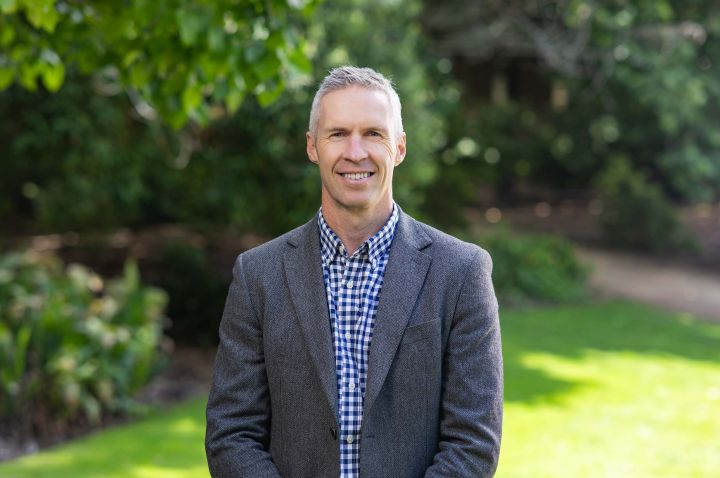
Professor Matthew McGuire, Dean of La Trobe University’s School of Humanities and Social Sciences, has a bold vison: “To redefine what it means to study humanities and social sciences in Australia.”
A successful researcher with an international reputation as a literary studies scholar, Professor McGuire is the author of five books, more than 25 peer-reviewed outputs and two critically acclaimed crime novels.
He believes that the disciplines of humanities and social sciences are needed now more than ever; to help society navigate a time marked by political conflict, climate change and technological advancement.
With plans to further embed employability into courses, and with a renewed academic focus on real-world challenges, Professor McGuire wants to take the School’s longstanding international reputation in teaching and research to the next level.
The result: Students who have the “skills, confidence and insight to build meaningful careers and to lives of passion and purpose”, and academics who “push the boundaries of conventional approaches to scholarship and embrace diversity in all its forms.”
In his own words, Professor McGuire explains how La Trobe’s School of Humanities and Social Sciences is building upon its strengths to carve out new relevance in a changing world.
Future-focused education
“What’s distinctive about the School of Humanities and Social Sciences is the range of disciplines and our deliberately future-focused, employability-driven experience,” Professor McGuire explains.
“Students learn to be curious, creative, critical thinkers, and then apply those capabilities through curriculum that embeds Work Integrated Learning and capstone-style authentic assessments.”
“Flexible online/asynchronous options broaden access across campuses, including at our regional locations. And employability is embedded through industry and community engagement, ethical awareness and by creating clear pathways from study to meaningful careers.”
“We are also embedding AI and digital literacy into all our courses, so that graduates can use AI tools confidently and responsibly, not just technically. For staff, we are developing an AI-mindset through curriculum renewal and shared practice based on ethical uses of the technology.”
Deep cultural learning
“Humanities and Social Sciences aim for scale and credibility in Indigenous curriculum,” Professor McGuire says.
“We teach La Trobe University’s flagship Indigenous Studies major and a groundbreaking Certificate IV in Aboriginal Cultural Heritage Management. Indigenous knowledges feature in more than 20 subjects each year in disciplines such as history, archaeology, anthropology and linguistics. This enables deep cultural learning.”
“Our ambition is to lead La Trobe’s work of embedding and valuing Indigenous knowledges across the curriculum, moving beyond ‘inclusion’ toward genuine graduate capability where there is respectful engagement, informed judgement and a stronger understanding of First Nations perspectives.”
Social justice impact
“In the research space, our academics help the public make sense of rapid change by translating scholarship into accessible, timely commentary and community-facing work,” explains Professor McGuire.
“We lift debate on social justice and the ‘human dimensions’ of major challenges. These include digital disruption, climate resilience, wellbeing, multiculturalism, global security in the Asia-Pacific and Indigenous cultures.”
“When it comes to AI, our School is focusing on the social, ethical and cultural dimensions of this emerging technology – what it means for work, democracy, politics and wellbeing.”
“We link evidence to real policy questions. We also try to strengthen public engagement so that our expertise reaches a wide range of audiences. The goal is practical impact; stronger communities, better-informed decisions and advancing an agenda that serves the public good.”
Focus on 2026
“This year, we will focus on the School’s core goals,” says Professor McGuire. “In education, this means embedding AI and Work Integrated Learning into all our courses, improving employability outcomes and growing enrolments through online/asynchronous study. We aim to increase the visibility of our subjects for all La Trobe students.”
“In research we are seeking to lift income and outputs, and build interdisciplinary partnerships aligned to key themes including health and wellbeing, climate adaptation, security, multiculturalism, digital disruption and Indigenous culture.”
“Public engagement is key for us this year. This will incorporate profile-raising and thought leadership that showcases impact and updates our social justice tradition for new contexts like AI.”
“Humanities and Social Sciences has led La Trobe’s drive for educational quality, with outstanding student satisfaction over decades,” he adds. “We help students in every discipline develop their critical judgement, creativity and cultural understanding.”
“I’m proud of our central role in advancing La Trobe’s long tradition around social justice and our passion for changing peoples' lives through the power of education.”