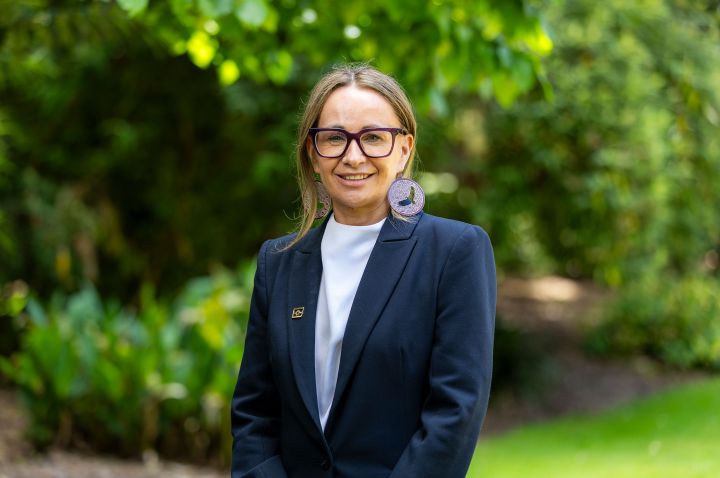
When Sue-Anne Hunter stepped into the role of National Commissioner for Aboriginal and Torres Strait Islander Children and Young People on 1 September 2025, she became the first person to hold this groundbreaking position.
“It’s an honour I don’t take lightly,” she says. “In many ways I can see that the work I did for decades as a social worker has helped prepare me – because I know what it’s like for kids in out-of-home care and in detention. And that makes me even more committed to helping change things.”
A graduate of La Trobe’s Master of Social Work program, Sue-Anne's appointment follows decades of work in social services, mental health care and the child and family sector. “I grew up seeing what systems did to our families – the removals and the trauma that passed through generations. I knew early on that I wanted to be part of changing things – not from the outside, but from within.”
The degree that strengthened her practice and identity
A Wurundjeri and Ngurai Illum Wurrung woman, Sue-Anne is a proud descendant of Annie Borate, sister of William Barak. Barak was a respected leader of the Wurundjeri people and an important figure in Victoria's history – a history Sue-Anne carries into every space she enters.
Her career has been shaped by a deep understanding of systemic inequities and a commitment to cultural integrity. “Social work in Australia is very white, in its workforce, its knowledge base, its ways of operating. You can’t transform a system if you don’t understand how it works and who it serves.”
Completing her Master of Social Work at La Trobe University was a pivotal step. “Completing my Masters was about equipping myself with the tools to be effective. I wanted the qualifications and the knowledge so that I could hold my own in rooms where decisions were being made about our kids and families,” she says. “But I also had to hold on to who I am. My culture, my community, my ways of knowing. La Trobe gave me the space to do both.”
That balance has been central to her career. Today, she leads a small team tackling big problems, many of them systemic issues that have persisted for generations.
The National Commission
The role of National Commissioner was created to promote and protect the rights, interests and wellbeing of Aboriginal and Torres Strait Islander children and young people. For Sue-Anne, that means listening to them, amplifying their voices, and ensuring systems treat them fairly.
“We know that children and young people are experts in their own lives. They know what they need to grow up feeling safe, happy and strong in their culture. That’s why we get better results when we listen to them.”
However, many might be surprised at the scale of what the Commission is up against. First Nations children are more than 10 times more likely to be in out-of-home care than non-Indigenous children. They are 27 times more likely to be in youth detention. “These aren’t just statistics. They are our children, our families, our communities.”
“This role was barely an idea only a little over a year ago,” she says. “My work at the Yoorrook Justice Commission helped prepare me for a role that was more public and more bureaucratic, but it’s different again. It’s centering the kids first and foremost, and I am so proud and privileged to do that.”
Advice for future changemakers
Her message to aspiring social workers is clear: “Know your why and hold onto it. This work is hard. You will see things that break your heart and you will come up against systems that don’t want to change. But if you are grounded in your purpose, in your community, in the people you are doing this for, you can keep going.”
Despite the challenges, Sue-Anne remains hopeful. “The possibilities that are provided by belief. It’s good to hope for the future, but belief is even more important. Believing something is possible means we are more readily prepared to work on it.”
As the inaugural National Commissioner, Sue-Anne is clear-eyed and committed to shaping a better future. And she’s in it for the long haul.