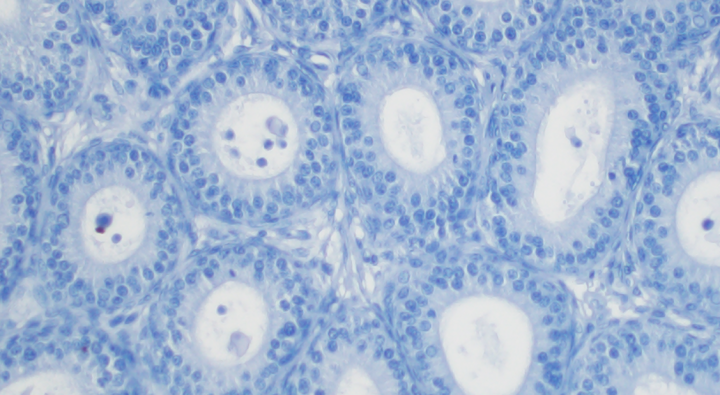
Under the supervision of Dr Cathryn Hogarth, Eliza is investigating how blocking the activity of vitamin A in the male reproductive system affects the development and function of the epididymis, a little-known but essential organ that enables sperm to mature and become capable of fertilisation.
"Many people don't even know the epididymis exists," Eliza said. "One of the things I find most rewarding about my research is being able to educate others about its important role in male fertility."
Eliza's research focuses on understanding the biological mechanisms behind male infertility, an issue affecting increasing numbers of Australians. While infertility is often perceived as a women's health issue, male factors contribute to a significant proportion of infertility cases.
"Male infertility remains under-researched," Eliza said. "More open conversations and greater investment in research could lead to life-changing outcomes for many individuals and families."
Her work is particularly timely as rates of infertility continue to rise, with factors such as untreated urinary tract infections, sexually transmitted infections and other lifestyle-related issues playing a role in some cases.
Using transgenic mouse models, Eliza has already uncovered findings that challenge current scientific understanding. Her research has shown that preventing vitamin A activity in the epididymis leads to the development of holes in the organ's lining before puberty. Previously, researchers believed these changes only occurred during puberty.
"This finding suggests there is still much we don't understand about how the epididymis develops and functions," Eliza said.
The next phase of her research will investigate why these structural changes occur and what they reveal about the role of vitamin A in fertility.

Conducting biomedical research from a regional campus presents unique challenges, but Eliza has embraced the opportunity to build her expertise while contributing to an important area of health research.
"Being based on a regional campus can sometimes be challenging because there are fewer students undertaking similar research projects nearby," she said. "Staying motivated can be difficult at times, but the experience has also helped me develop resilience and independence."
Eliza credits her supervisor, Dr Hogarth, for inspiring her research journey. "Dr Cathryn Hogarth has spent much of her career working in this field, and her passion and guidance have been a constant source of inspiration."
Eliza has presented her research at both the 2025 and 2026 La Trobe Rural Health School Conference, using these opportunities to share her findings, develop her communication skills and receive feedback from fellow researchers.
She hopes her work will ultimately contribute to a better understanding of male reproductive health and support the development of future approaches to prevent or reverse acquired male infertility.
"Our understanding of male infertility still has many gaps," Eliza said. "The more we learn about how these systems work, the better positioned we'll be to improve health outcomes in the future."
Dr Cathryn Hogarth said she is proud to see Eliza developing into a confident and capable researcher. "Male infertility remains a relatively under-researched area of health, despite its impact on many individuals and families. Eliza's research is uncovering new information about the biological processes that support fertility and has already revealed findings that challenge existing scientific thinking. We're excited about the potential impact of this work."
Eliza Keady is conducting her research through the Holsworth Biomedical Research Centre, a key part of La Trobe Rural Health School, supporting world class research in regional Victoria.