
How to respond to an overdose

Overdose response resources for people who use drugs.
As part of our project exploring women’s perspectives on take-home naloxone (THN), and how gender affects people's engagement with THN programs, we're pleased to present our collaboration with Harm Reduction Victoria and artist Sam Wallman - a suite of resources to provide information on naloxone and how to use it.
Designed for display and distribution in Victorian health services, these resources provide information on how to use naloxone - a drug that can temporarily reverse opioid overdose - in an overdose emergency, and where to access it.
Naloxone is now available through Victoria's Take-Home Naloxone Program, with people able to access free naloxone from select needle and syringe program providers, the Medically Supervised Injecting Room in North Richmond, and through selected pharmacies registered with the Take-Home Naloxone Program.
With input from one of Australia’s key consumer representative organisations, Harm Reduction Victoria, the project team collaborated with local artist Sam Wallman to create posters, flyers and resources with information on how to respond to overdose, where to get naloxone, and how to get free overdose response training from Harm Reduction Victoria.
To download, long press or right-click an image and choose 'Save image as'.


Digital copies of these resources are available at no cost. If you work in an alcohol and other drug-related service, or are affected by opioid overdose, email Dr Nyssa Ferguson to find out more (n.ferguson@latrobe.edu.au).
These resources were produced by the DruGS (Drugs, Gender and Sexuality) Team at the Australian Research Centre in Sex, Health and Society (ARCSHS), led by Dr Nyssa Ferguson and Dr Adrian Farrugia, as part of an innovative project exploring women’s perspectives on take-home naloxone, and how gender affects people's engagement with take-home naloxone programs.
Understanding women’s perspectives on take-home naloxone to support equitable overdose prevention efforts 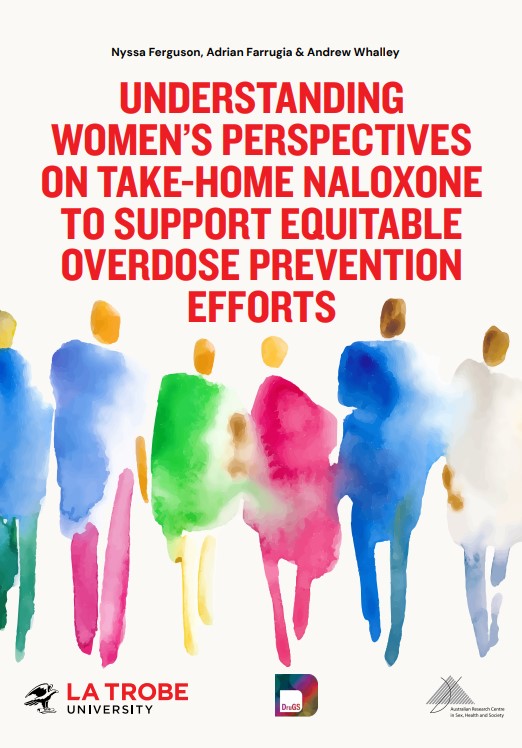
This broadsheet presents a summary of findings from a qualitative project about how gender shapes engagement with take-home naloxone initiatives and how we can develop gender-sensitive overdose prevention.
For example, the research found women felt exhausted by routinely taking on caring roles, such as administering naloxone, and looking after people who have overdosed. The project's research broadsheet above also documents participant suggestions to better support women to engage with overdose prevention efforts.
As researcher Dr Nyssa Ferguson explains, "Very little is known about how gender shapes overdose prevention efforts including take-home naloxone programs, especially in an Australian context. This project gave us an opportunity to critically explore issues relating to care, responsibility and gender and to consider how service provision and policy can improve take-home naloxone initiatives in ways that better support women’s safety."