Law
Why study Law?
We offer an innovative and high-quality legal education. There is a strong commitment to social justice, interdisciplinary enquiry, an international perspective and practical experience that links learning with legal practice. You will be prepared for employment in a global legal economy. Study the law in its broad social, political and economic context. Develop analytical, problem-solving and critical research skills. Choose from eleven professionally accredited law programs, with nine leading to double degrees. Top students can go on to do an Honours year. This involves close supervision, access to a research and writing skills program, and a 10,000 word thesis.
Career opportunities
Graduates can work in legal practice and beyond. Roles include solicitor, barrister, judge's associate, litigation manager, patent attorney, law librarian, lecturer, equal opportunities officer, intelligence analyst, industrial relations officer, immigration officer, taxation officer, ministerial, legal or policy adviser, and in dispute resolution and compliance.
Visit our Career Development Centre website and start planning your career.
Courses
Local students
2013
Bachelor of Laws
- Duration :
- 4 years full-time or part-time equivalent
- Semester starts :
- Semester 1 and 2 (February and July)
- Campus/ATAR:
- Melbourne 93.05
- Bendigo n/a
- Year
- 2013
- Course description
- Giving graduates an accredited professional qualification in law, this course offers an innovative, high-quality legal education with a strong global and social justice perspective and strong emphasis on practical experience. It includes all the compulsory subjects required by the Council of Legal Education for admission to legal practice in Victoria, as well as a broad range of electives - many with a practical skills component (e.g. Clinical Legal Education, Communication and Advocacy Skills, and Negotiation).
After completing first year, students can apply to transfer into a five-year double degree to extend knowledge and skills in a particular area of interest (see descriptions of law double degrees for more).
Please note, students commencing at Bendigo must transfer to the Melbourne campus after completing second year. - Prerequisite
- VCE Units 3 & 4: Study score of at least 35 in English (ESL) or 30 in English (any other).
- Year 12 and non-year 12 extra requirements
- Non-Year 12 applicants must complete and submit a VTAC Personal History online if they wish other information to be considered during the selection process. This may include information such as work experience or reasons for applying. Applicants may wish to provide other documentation in support of their application.
For more information about VTAC Personal History online please visit our Extra Requirements page. - Middle band
- Consideration is given to performance in prerequisite studies and humanities (any), and to Special Entry Access Scheme (SEAS) criteria.
- How to apply
- Apply direct to the University for Semester 1 or Semester 2, 2013.
- Professional recognition
- All La Trobe University Law courses include the subjects required by the Victorian Council of Legal Education to qualify for admission to legal practice. Admission to practice as a barrister and solicitor of the Supreme Court of Victoria usually requires the completion of a traineeship (formerly referred to as articles of clerkship) or an approved practical legal training course (for example, the Leo Cussen Institute or the College of Law Victoria).
- Full course details
- Laws (Undergraduate Entry)Melbourne
Laws (Undergraduate Entry)Bendigo
Bachelor of Laws/Bachelor of Accounting
- Duration :
- 5 years full-time or part-time equivalent
- Semester starts :
- Semester 1 and 2 (February and July)
- Campus/ATAR:
- Melbourne 93.05
- Year
- 2013
- Course description
- This program offers an innovative, high-quality legal education with a strong global and social justice perspective and a real emphasis on hands-on experiences. It includes all the compulsory law subjects required by the Council of Legal Education for admission to practice in Victoria and a wide range of electives. The course also includes compulsory specialised subjects relevant to business such as Banking and Finance Law and Competition Policy and Law.
The accounting component aims to provide a professional accounting qualification comprising the skills and knowledge for accounting practice and management of large and small enterprises in the government and private sectors. Electives are available in a range of areas including financial management, financial planning, and management. - Prerequisite
- VCE Units 3 & 4: study score of at least 35 in English (ESL) or 30 in English (any) .
- Year 12 and non-year 12 extra requirements
- Non-Year 12 selection may involve: ENTER/ATAR, VTAC Personal History online, GPA, STAT Multiple Choice.
Non-Year 12 applicants must complete and submit a VTAC Personal History online if they wish other information to be considered during the selection process. This may include information such as work experience or reasons for applying. Applicants may wish to provide other documentation in support of their application.
For more information about VTAC Personal History online please visit our Extra Requirements page. - Middle band
- Consideration is given to performance in prerequisite studies, Business Studies (any) and Humanities (any), and Special Entry Access Scheme (SEAS) criteria.
- How to apply
- Apply direct to the University for Semester 1 or Semester 2, 2013.
- Professional recognition
- All La Trobe University Law courses include the subjects required by the Victorian Council of Legal Education to qualify for admission to legal practice. Admission to practice as a barrister and solicitor of the Supreme Court of Victoria usually requires the completion of a traineeship (formerly referred to as articles of clerkship) or an approved practical legal training course (for example, the Leo Cussen Institute or the College of Law Victoria).Successful completion of the appropriate choice of subjects qualifies graduates for membership of the following professional accounting bodies: CA Australia, Institute of Chartered Accountants in Australia (ICAA), National Institute of Public Accountants (IPA), and the Association of Chartered Certified Accountants (ACCA).
- Full course details
- Laws/AccountingMelbourne
Bachelor of Laws/Bachelor of Arts
- Duration :
- 5 years full-time or part-time equivalent
- Semester starts :
- Semester 1 and 2 (March and July)
- Campus/ATAR:
- Bendigo n/a
- Melbourne 93
- Year
- 2013
- Course description
- See the Bachelor of Laws (Undergraduate Entry) for a description of the law component of this degree. For the arts component, students can select a major from a wide range of disciplines, including languages and the performing arts. Students may also complete law electives that complement arts specialisations.
Please note, students commencing Bendigo must transfer to the Melbourne campus after second year. - Prerequisite
- VCE Units 3 and 4: Study score of at least 35 in English (ESL) or 30 in any other English.
- Year 12 and non-year 12 extra requirements
- Non-Year 12 selection may involve: ENTER/ATAR, VTAC Personal History online, GPA, STAT Multiple Choice.
Non-Year 12 applicants must complete and submit a VTAC Personal History online if they wish other information to be considered during the selection process. This may include information such as work experience or reasons for applying. Applicants may wish to provide other documentation in support of their application.
For more information about VTAC Personal History online please visit our Extra Requirements page. - Middle band
- Consideration is given to study scores in prerequisite studies and in Classical Societies and Cultures, History (any), International Politics, International Studies, Literature, LOTE (any), and International Politics. Consideration is given to Special Entry Access Scheme (SEAS) criteria. In addition, a regional bonus may apply.
- Additional information
- Please note: Bendigo students must transfer to Melbourne after 2 years (full-time). Bendigo students must normally select their arts major from one of the following: English, history, Indonesian, politics, religion and spirituality studies, sociology, gender and diversity studies.
- How to apply
- Apply direct to the University for Semester 1 or Semester 2, 2013.
- Professional recognition
- All La Trobe University Law courses include the subjects required by the Victorian Council of Legal Education to qualify for admission to legal practice. Admission to practice as a barrister and solicitor of the Supreme Court of Victoria usually requires the completion of a traineeship (formerly referred to as articles of clerkship) or an approved practical legal training course (for example, the Leo Cussen Institute or the College of Law Victoria).
- Full course details
- Laws/Arts Melbourne
Laws/Arts Bendigo
Bachelor of Laws/Bachelor of Business
- Duration :
- 5 years full-time or part-time equivalent
- Semester starts :
- Semester 1 and 2 (February and July)
- Campus/ATAR:
- Bendigo n/a
- Melbourne 93.15
- Year
- 2013
- Course description
- See Bachelor of Laws (Undergraduate Entry) for a general description of the law component. This double degree also includes law subjects complementary to business, such as Banking and Finance Law, Income Taxation Law and International Business Law.
As well as aiming to provide an accredited law qualification, it allows students to complete a business major in business economics, financial management, financial planning, human resource management, macroeconomics, management information systems, international management, management or marketing.
Please note: students commencing at Bendigo must transfer to the Melbourne campus after second year. - Prerequisite
- VCE Units 3 & 4: study score of at least 35 in English (ESL) or 30 in any other English.
- Year 12 and non-year 12 extra requirements
- Non-Year 12 applicants must complete and submit a VTAC Personal History online if they wish other information to be considered during the selection process. This may include information such as work experience or reasons for applying. Applicants may wish to provide other documentation in support of their application.
For more information about VTAC Personal History online please visit our Extra Requirements page. - Middle band
- Re-ranking is based on results in prerequisite studies, Business (any), and Humanities (any). Consideration is also given to Special Entry Access Scheme (SEAS) criteria. In addition, a regional bonus may apply.
- Additional information
- Please note: Bendigo students must transfer to Melbourne after 2 years (full-time). Bendigo students who want to major in accounting can apply to transfer into the Bachelor of Laws/Bachelor of Accounting at Melbourne.
- How to apply
- Apply direct to the University for Semester 1 or Semester 2, 2013.
- Professional recognition
- All La Trobe University Law courses include the subjects required by the Victorian Council of Legal Education to qualify for admission to legal practice. Admission to practice as a barrister and solicitor of the Supreme Court of Victoria usually requires the completion of a traineeship (formerly referred to as articles of clerkship) or an approved practical legal training course (for example, the Leo Cussen Institute or the College of Law Victoria).Graduates with a marketing major are eligible for associate membership of the Australian Marketing Institute or the Australian Market and Social Research Society. Graduates with a human resource management major are eligible for admission to the Australian Human Resource Institute (subject to relevant work experience).
- Full course details
- Laws/BusinessMelbourne
Laws/BusinessBendigo
Bachelor of Laws/Bachelor of Economics
- Duration :
- 5 years full-time or part-time equivalent.
- Semester starts :
- Semester 1 and 2 (February and July)
- Campus/ATAR:
- Melbourne 94.55
- Year
- 2013
- Course description
- See the Bachelor of Laws (Undergraduate Entry) for details on the law component. The law curriculum also includes compulsory specialised subjects relevant to economics such as Competition Law and Policy, Banking and Finance Law, or an approved subject from the Master of Laws in Global Business Law.
See the Bachelor of Economics for details on the economics component. - Prerequisite
- VCE Unit 3 & 4: study score of at least 35 in English (ESL) or 30 in any other English, and at least 20 in Mathematics (any).
- Year 12 and non-year 12 extra requirements
- Non-Year 12 selection may involve: ENTER/ATAR, VTAC Personal History online, GPA, STAT Multiple Choice.
Non-Year 12 applicants must complete and submit a VTAC Personal History online if they wish other information to be considered during the selection process. This may include information such as work experience or reasons for applying. Applicants may wish to provide other documentation in support of their application.
For more information about VTAC Personal History online please visit our Extra Requirements page. - Middle band
- Consideration is given to study scores in prerequisite studies, Business (any), and Humanities (any).
- How to apply
- Apply direct to the University for Semester 1 or Semester 2, 2013.
- Professional recognition
- See Bachelor of Laws for information re the law component. The appropriate choice of subjects in the Bachelor of Economics can lead to membership of the Australasian Institute of Banking and Finance.
- Full course details
- Laws/EconomicsMelbourne
Bachelor of Laws/Bachelor of Finance
- Duration :
- 5 years full-time or part-time equivalent
- Semester starts :
- Semester 1 and 2 (February and July)
- Campus/ATAR:
- Melbourne 95.2
- Year
- 2013
- Course description
- The Bachelor of Laws/Bachelor of Finance is a five-year combined degree providing an accredited professional qualification in law, as well as a degree in finance. See the Bachelor of Laws (Undergraduate Entry) for details on the law component of this double degree. This double degree also includes compulsory specialised law subjects relevant to finance, such as Banking and Finance Law, Competition Law and Policy or an approved subject from the Master of Laws in Global Business Law.
The finance component is a largely fixed, giving students comprehensive studies in four major areas: corporate finance, international finance, investment and portfolio management and risk management. - Prerequisite
- VCE Units 3 & 4: study score of at least 35 in English (ESL) or 30 in any other English, and at least 20 in Mathematics (any).
- Year 12 and non-year 12 extra requirements
- Non-Year 12 selection may involve: ENTER/ATAR, VTAC Personal History online, GPA, STAT Multiple Choice.
Non-Year 12 applicants must complete and submit a VTAC Personal History online if they wish other information to be considered during the selection process. This may include information such as work experience or reasons for applying. Applicants may wish to provide other documentation in support of their application.
For more information about VTAC Personal History online please visit our Extra Requirements page. - Middle band
- Consideration is given to study scores achieved in prerequisite studies, Business (any), and Humanities (any).
- How to apply
- Apply direct to the University for Semester 1 or Semester 2, 2013.
- Professional recognition
- All La Trobe University Law courses include the subjects required by the Victorian Council of Legal Education to qualify for admission to legal practice. Admission to practice as a barrister and solicitor of the Supreme Court of Victoria usually requires the completion of a traineeship (formerly referred to as articles of clerkship) or an approved practical legal training course (for example, the Leo Cussen Institute or the College of Law Victoria). The appropriate choice of subjects in the Bachelor of Finance can lead to membership of the Financial Services Institute of Australia .
- Full course details
- Laws/Finance Melbourne
Bachelor of Laws/Bachelor of International Relations
- Duration :
- 5 years full-time or part-time equivalent
- Semester starts :
- Semester 1 and 2 (February and July)
- Campus/ATAR:
- Melbourne 93.15
- Year
- 2013
- Course description
- This course aims to give graduates the skills to work with and for prominent organisations within international politics or as a lawyer in the public, private or community sector. See the Bachelor of Laws (Undergraduate Entry) for details on the law component.
The curriculum also includes subjects complementary to international relations, such as Human Rights Law, Public International Law and Organised and International Crime. The international relations component combines core subjects in politics, international public policy and professional competency in transition to the workplace. It offers electives from politics and other disciplines, including economics, history, sociology, anthropology and sociology. - Prerequisite
- VCE Units 3 & 4: study score of at least 35 in English (ESL) or 30 in any other English.
- Year 12 and non-year 12 extra requirements
- Non-Year 12 applicants must complete and submit a VTAC Personal History online if they wish other information to be considered during the selection process. This may include information such as work experience or reasons for applying. Applicants may wish to provide other documentation in support of their application.
For more information about VTAC Personal History online please visit our Extra Requirements page. - Middle band
- Consideration is given to performance in prerequisite studies and Humanities (any), and to Special Entry Access Scheme (SEAS) criteria.
- How to apply
- Apply direct to the University for Semester 1 or Semester 2, 2013.
- Professional recognition
- All La Trobe University Law courses include the subjects required by the Victorian Council of Legal Education to qualify for admission to legal practice. Admission to practice as a barrister and solicitor of the Supreme Court of Victoria usually requires the completion of a traineeship (formerly referred to as articles of clerkship) or an approved practical legal training course (for example, the Leo Cussen Institute or the College of Law Victoria).
- Full course details
- Laws/International Relations Melbourne
Bachelor of Laws/Bachelor of Psychological Science
- Duration :
- 5 years full-time or part-time equivalent
- Semester starts :
- Semester 1 and 2 (February and July)
- Campus/ATAR:
- Bendigo n/a
- Melbourne 94.5
- Year
- 2013
- Course description
- See the Bachelor of Laws (Undergraduate Entry) for details on the law component of this double degree, which includes compulsory specialised law subjects relevant to psychology, such as Psychology and Criminal Law, and Mental Disorder and Criminal Responsibility.
The Bachelor of Psychological Science aims to provide students with broad knowledge and skills in psychology as well as biological and social aspects of behaviour. However, it does not qualify gradutes for registration/work as a psychologist - this requires specific postgraduate studies.
Please note, students commencing Bendigo must transfer to the Melbourne campus after second year. - Prerequisite
- VCE Units 3 & 4: study score of at least 30 in English (any).
- Year 12 and non-year 12 extra requirements
- Non-Year 12 selection may involve: ENTER/ATAR, VTAC Personal History online, GPA, STAT Multiple Choice.
Non-Year 12 applicants must complete and submit a VTAC Personal History online if they wish other information to be considered during the selection process. This may include information such as work experience or reasons for applying. Applicants may wish to provide other documentation in support of their application.
For more information about VTAC Personal History online please visit our Extra Requirements page. - Middle band
- Consideration is given to study scores in prerequisite studies, Humanities (any) Biology, Psychology, and to Special Entry Access Scheme (SEAS) criteria..
- How to apply
- Apply direct to the University for Semester 1 or Semester 2, 2013.
- Professional recognition
- All La Trobe University Law courses include the subjects required by the Victorian Council of Legal Education to qualify for admission to legal practice. Admission to practice as a barrister and solicitor of the Supreme Court of Victoria usually requires the completion of a traineeship (formerly referred to as articles of clerkship) or an approved practical legal training course (for example, the Leo Cussen Institute or the College of Law Victoria). Eligibility for membership of Australian Psychological Society and Victorian registration as a psychologist requires at least two more years' study beyond fourth year, such as a Master of Psychology or a Doctor of Psychology professional training program.
- Full course details
- Laws/Psychological Science Melbourne
Laws/Psychological Science Bendigo
Bachelor of Laws/Bachelor of Science
- Duration :
- 5 years full-time or part-time equivalent
- Semester starts :
- Semester 1 (March)
- Campus/ATAR:
- Bendigo n/a
- Melbourne 93.1
- Year
- 2013
- Course description
- Combined expertise in law and a specific science discipline is likely to give students outstanding career options across many fields, including policy development, regulatory affairs, environmental protection, patents, and the expanding field of scientific/industrial ethics.
This double degree offers an accredited law qualification (see the Bachelor of Laws for details) that includes science-related electives like Intellectual Property Law, Law and Medicine, and Psychology and Law, and specialisations in chemistry, computer science, electronics, genetics, psychology, and mathematics.
Please note students commencing at Bendigo must transfer to the Melbourne campus after second year; their science subjects must lead to majors in biological sciences, chemistry, computer science, mathematics, physics, psychological science and statistics. - Prerequisite
- VCE Units 3 & 4: study scores of at least 35 in English (ESL) or 30 in English (any other) and at least 30 in either Mathematical Methods or Specialist Mathematics.
- Year 12 and non-year 12 extra requirements
- Non-Year 12 selection may involve: ENTER/ATAR, VTAC Personal History online, GPA, STAT Multiple Choice.
Non-Year 12 applicants must complete and submit a VTAC Personal History online if they wish other information to be considered during the selection process. This may include information such as work experience or reasons for applying. Applicants may wish to provide other documentation in support of their application.
For more information about VTAC Personal History online please visit our Extra Requirements page.
Non-Year 12 applicants may be asked to complete a maths test. - Middle band
- Consideration is given to study scores in prerequisite studies, Chemistry, Physics, and Humanities (any). Consideration is also given to Special Entry Access Scheme (SEAS) criteria. In addition, a regional bonus may apply.
- Costs
- Depending on subjects , approximate costs include: laboratory coat - A$30, dissecting kit - A$40. Students can purchase these items from any supplier; they remain students' personal property.
- Additional information
- Please note: Bendigo students must transfer to Melbourne after 2 years (full-time).
Major studies include biological sciences, chemistry, computer science, mathematics, physics, psychological science and statistics.
Graduates can have their academic record and testament annotated according to specialisation (e.g. Bachelor of Science (Statistics). - How to apply
- Apply direct to the University for Semester 1 or Semester 2, 2013.
- Professional recognition
- All La Trobe University Law courses include the subjects required by the Victorian Council of Legal Education to qualify for admission to legal practice. Admission to practice as a barrister and solicitor of the Supreme Court of Victoria usually requires the completion of a traineeship (formerly referred to as articles of clerkship) or an approved practical legal training course (for example, the Leo Cussen Institute or the College of Law Victoria). Science graduates can apply for membership of professional associations as determined by their major studies.
- Full course details
- Laws/ScienceMelbourne
Laws/ScienceBendigo
Bachelor of Laws (Graduate Entry)
- Duration :
- 3 years full-time or part-time equivalent
- Semester starts :
- Semester 1 and 2 (February and July)
- Campus/ATAR:
- Bendigo n/a
- Melbourne n/a
- Year
- 2013
- Course description
- Designed especially for people with existing degrees, this degree offers a similarly rigorous program as Bachelor of Laws (Undergraduate Entry), and is also an accredited professional law qualification. It has a global and social justice perspective and an emphasis on developing skills. It also offers a broad range of electives, many with a practical skills component such as clinical legal education, communication and advocacy skills, and negotiation.
The core component of the program is highly structured. In first year, students undertake the core subjects Dispute Resolution, Torts, Criminal Law and Principles of Public Law. Second and third years address other areas such as Property Law, Equity and Trusts and Remedies. Students also examine key aspects of statutory regulation.
Please note, students commencing at Bendigo transfer must transfer to the Melbourne campus after completing eight core subjects. - Prerequisite
- Successful completion of an Australian Bachelors degree or equivalent. Applicants who have completed an undergraduate degree in a language other than English must submit an IELTS (or equivalent) test result with a minimum overall band score of 6.5 with no individual score less than 6.0.
- Year 12 and non-year 12 extra requirements
- Non-Year 12 applicants must complete and submit a VTAC Personal History online if they wish other information to be considered during the selection process. This may include information such as work experience or reasons for applying. Applicants may wish to provide other documentation in support of their application. Some applicants only: applicants who have completed a degree in a language other than English must submit a certified hardcopy of their IELTS (or equivalent) test results to VTAC by 13 December.
For more information about VTAC Personal History online please visit our Extra Requirements page. - How to apply
- Apply direct to the University for Semester 1 or Semester 2, 2013.
- Professional recognition
- All La Trobe University Law courses include the subjects required by the Victorian Council of Legal Education to qualify for admission to legal practice. Admission to practice as a barrister and solicitor of the Supreme Court of Victoria usually requires the completion of a traineeship (formerly referred to as articles of clerkship) or an approved practical legal training course (for example, the Leo Cussen Institute or the College of Law Victoria).
- Full course details
- Laws (Graduate Entry)Melbourne
Laws (Graduate Entry)Bendigo
Want to know more?
Feel free to ask us a question about any course for local students.
Fees and scholarships
Undergraduate courses are Commonwealth Supported Places (CSP) for eligible Australian and New Zealand citizens. The domestic fee calculator can be used to calculate the cost of subjects this year.
There is also a wide range of scholarships available for local students.
International students
2013
Bachelor of Laws (075236D)
- Duration :
- 4 years
- Semester starts :
- Semester 1 and 2 (March and July)
- Annual Tution Fee (AUD) :
- 22 830
- Campus
- Melbourne
- Year
- 2013
- Course description
- Giving graduates an accredited professional qualification in law, this course offers an innovative, high-quality legal education with a strong global and social justice perspective and strong emphasis on practical experience. It includes all the compulsory subjects required by the Council of Legal Education for admission to legal practice in Victoria, as well as a broad range of electives - many with a practical skills component (e.g. Clinical Legal Education, Communication and Advocacy Skills, and Negotiation).
After completing first year, students can apply to transfer into a five-year double degree to extend knowledge and skills in a particular area of interest (see descriptions of law double degrees for more).
Please note, students commencing at Bendigo must transfer to the Melbourne campus after completing second year. Melbourne - English Language Requirements
- IELTS (Academic): minimum score of 6.5 with no individual band score less than 6.0.
TOEFL Paper-based Test: minimum score of 575 (minimum score of 5 in the Test of Written English).
TOEFL Internet-based Test: minimum score of 80 with minimum overall for SLR 18; W 22.
La Trobe Melbourne (ELICOS): completion of English for Further Studies Advanced Stage 5B Certificate at postgraduate (EFS5 (70 per cent) PG1) level. For more information please visit the La Trobe Melbourne website.
La Trobe Melbourne Foundation Studies: 70 per cent final result in a course.
English as the language of instruction in tertiary studies may be accepted.
Please note: English as the language of instruction in previous study will not be accepted as a basis of admission (English)
for courses where the approved test score requirement is above an IELTS 6.5 with no band score lower than 6.0.
Pearson Test of English (Academic) (PTE): minimum score of 64 with no communicative skill score less than 59.
Cambridge Certificate of Advanced English (CAE): a grade of B or higher.
Cambridge Certificate of Proficiency in English (CPE): a grade of C or higher.
or approved international equivalent.
Melbourne - Academic entry requirements
- LTM Foundation Studies - 95
Aust. Yr 12 (ATAR) 2012 (indicative only) - Melbourne: 93, Bendigo: 89.
International Baccalaureate - Melbourne: 35, Bendigo: 33.
GCE A Levels - 14
Hong Kong A Levels - 10
HKDSE - 2 x Level 5
Sri Lankan A Levels - AAB
STPM - 11
MICSS (UEC) - 2.5
Canada Secondary School (or CPU) - 85
Norway Upper Secondary Certificate - 4.5
Sweden Slutbetyg - VG
All Indian Sen SC (Best 5 Subjects) - 85
Vietnam (Year 12) - 9
Indonesia (SMA) - not eligible
GAC Cert. IV - GPA 3.6
GAOKAO - see: the website
If you do not meet these entry requirements you might be interested in La Trobe's Foundation Studies and Diploma Programs, which provide an alternative pathway to La Trobe's undergraduate program. For more information please visit the La Trobe Melbourne website. Melbourne - Professional recognition
- All La Trobe University Law courses include the subjects required by the Victorian Council of Legal Education to qualify for admission to legal practice. Admission to practice as a barrister and solicitor of the Supreme Court of Victoria usually requires the completion of a traineeship (formerly referred to as articles of clerkship) or an approved practical legal training course (for example, the Leo Cussen Institute or the College of Law Victoria).
International applicants are advised to obtain assurance of recognition of the course by relevant professional bodies in their preferred country of practice. Melbourne - Full course details
- Laws (Undergraduate Entry)Melbourne
Laws (Undergraduate Entry)Bendigo
Bachelor of Laws/Bachelor of Accounting (075233G)
- Duration :
- 5 years
- Semester starts :
- Semester 1 and 2 (March and July)
- Annual Tution Fee (AUD) :
- 23 550
- Campus
- Melbourne
- Year
- 2013
- Course description
- This program offers an innovative, high-quality legal education with a strong global and social justice perspective and a real emphasis on hands-on experiences. It includes all the compulsory law subjects required by the Council of Legal Education for admission to practice in Victoria and a wide range of electives. The course also includes compulsory specialised subjects relevant to business such as Banking and Finance Law and Competition Policy and Law.
The accounting component aims to provide a professional accounting qualification comprising the skills and knowledge for accounting practice and management of large and small enterprises in the government and private sectors. Electives are available in a range of areas including financial management, financial planning, and management. Melbourne - English Language Requirements
- IELTS (Academic): minimum score of 6.5 with no individual band score less than 6.0.
TOEFL Paper-based Test: minimum score of 575 (minimum score of 5 in the Test of Written English).
TOEFL Internet-based Test: minimum score of 80 with minimum overall for SLR 18; W 22.
La Trobe Melbourne (ELICOS): completion of English for Further Studies Advanced Stage 5B Certificate at postgraduate (EFS5 (70 per cent) PG1) level. For more information please visit the La Trobe Melbourne website.
La Trobe Melbourne Foundation Studies: 70 per cent final result in a course.
English as the language of instruction in tertiary studies may be accepted.
Please note: English as the language of instruction in previous study will not be accepted as a basis of admission (English)
for courses where the approved test score requirement is above an IELTS 6.5 with no band score lower than 6.0.
Pearson Test of English (Academic) (PTE): minimum score of 64 with no communicative skill score less than 59.
Cambridge Certificate of Advanced English (CAE): a grade of B or higher.
Cambridge Certificate of Proficiency in English (CPE): a grade of C or higher.
or approved international equivalent.
Melbourne - Academic entry requirements
- LTM Foundation Studies - 95
Aust. Yr 12 (ATAR) 2012 (indicative only) - 93
International Baccalaureate - 35
GCE A Levels - 14
Hong Kong A Levels - 10
HKDSE - 2x Level 5
Sri Lankan A Levels - AAB
STPM - 11
MICSS (UEC) - 2.5
Canada Secondary School (or CPU) - 85
Norway Upper Secondary Certificate - 4.5
Sweden Slutbetyg - VG
All Indian Sen SC (Best 5 Subjects) - 85
Vietnam (Year 12) - 9
Indonesia (SMA) - not eligible
GAC Cert. IV - GPA 3.6
GAOKAO - see: the website
If you do not meet these entry requirements you might be interested in La Trobe's Foundation Studies and Diploma Programs, which provide an alternative pathway to La Trobe's undergraduate program. For more information please visit the La Trobe Melbourne website. Melbourne - Additional information
- Applicants should seek assurance of recognition of the course by relevant professional bodies in their country of intended practice. Melbourne
- Professional recognition
- All La Trobe University Law courses include the subjects required by the Victorian Council of Legal Education to qualify for admission to legal practice. Admission to practice as a barrister and solicitor of the Supreme Court of Victoria usually requires the completion of a traineeship (formerly referred to as articles of clerkship) or an approved practical legal training course (for example, the Leo Cussen Institute or the College of Law Victoria).
Successful completion of the appropriate choice of subjects qualifies graduates for membership of the following professional accounting bodies: CA Australia, Institute of Chartered Accountants in Australia (ICAA), National Institute of Public Accountants (IPA), and the Association of Chartered Certified Accountants (ACCA). Melbourne - Full course details
- Laws/AccountingMelbourne
Bachelor of Laws/Bachelor of Arts (075232G)
- Duration :
- 5 years
- Semester starts :
- Semester 1 and 2 (March and July)
- Annual Tution Fee (AUD) :
- 23 550
- Campus
- Melbourne
- Year
- 2013
- Course description
- See the Bachelor of Laws (Undergraduate Entry) for a description of the law component of this degree. For the arts component, students can select a major from a wide range of disciplines, including languages and the performing arts. Students may also complete law electives that complement arts specialisations.
Please note, students commencing Bendigo must transfer to the Melbourne campus after second year. Melbourne - English Language Requirements
- IELTS (Academic): minimum score of 6.5 with no individual band score less than 6.0.
TOEFL Paper-based Test: minimum score of 575 (minimum score of 5 in the Test of Written English).
TOEFL Internet-based Test: minimum score of 80 with minimum overall for SLR 18; W 22.
La Trobe Melbourne (ELICOS): completion of English for Further Studies Advanced Stage 5B Certificate at postgraduate (EFS5 (70 per cent) PG1) level. For more information please visit the La Trobe Melbourne website.
La Trobe Melbourne Foundation Studies: 70 per cent final result in a course.
English as the language of instruction in tertiary studies may be accepted.
Please note: English as the language of instruction in previous study will not be accepted as a basis of admission (English)
for courses where the approved test score requirement is above an IELTS 6.5 with no band score lower than 6.0.
Pearson Test of English (Academic) (PTE): minimum score of 64 with no communicative skill score less than 59.
Cambridge Certificate of Advanced English (CAE): a grade of B or higher.
Cambridge Certificate of Proficiency in English (CPE): a grade of C or higher.
or approved international equivalent.
Melbourne - Academic entry requirements
- LTM Foundation Studies - 95
Aust. Yr 12 (ATAR) 2012 (indicative only) - Melbourne: 93, Bendigo: 89.
International Baccalaureate - Melbourne: 35, Bendigo: 33.
GCE A Levels - 14
Hong Kong A Levels - 10
HKDSE - 2 x Level 5
Sri Lankan A Levels - AAB
STPM - 11
MICSS (UEC) - 2.5
Canada Secondary School (or CPU) - 85
Norway Upper Secondary Certificate - 4.5
Sweden Slutbetyg - VG
All Indian Sen SC (Best 5 Subjects) - 85
Vietnam (Year 12) - 9
Indonesia (SMA) - not eligible
GAC Cert. IV - GPA 3.6
GAOKAO - see: the website
If you do not meet these entry requirements you might be interested in La Trobe's Foundation Studies and Diploma Programs, which provide an alternative pathway to La Trobe's undergraduate program. For more information please visit the La Trobe Melbourne website. Melbourne - Additional information
- The relevant visa is required to complete a supervised workplace traineeship in Australia. Graduates should seek assurance or recognition of the course by relevant professional bodies in their preferred country of practice. Melbourne
- Professional recognition
- All La Trobe University Law courses include the subjects required by the Victorian Council of Legal Education to qualify for admission to legal practice. Admission to practice as a barrister and solicitor of the Supreme Court of Victoria usually requires the completion of a traineeship (formerly referred to as articles of clerkship) or an approved practical legal training course (for example, the Leo Cussen Institute or the College of Law Victoria). Melbourne
- Full course details
- Laws/Arts Melbourne
Laws/Arts Bendigo
Bachelor of Laws/Bachelor of Business (075229C)
- Duration :
- 5 years
- Semester starts :
- Semester 1 and 2 (March and July)
- Annual Tution Fee (AUD) :
- 23 550
- Campus
- Melbourne
- Year
- 2013
- Course description
- See Bachelor of Laws (Undergraduate Entry) for a general description of the law component. This double degree also includes law subjects complementary to business, such as Banking and Finance Law, Income Taxation Law and International Business Law.
As well as aiming to provide an accredited law qualification, it allows students to complete a business major in business economics, financial management, financial planning, human resource management, macroeconomics, management information systems, international management, management or marketing.
Please note: students commencing at Bendigo must transfer to the Melbourne campus after second year. Melbourne - English Language Requirements
- IELTS (Academic): minimum score of 6.5 with no individual band score less than 6.0.
TOEFL Paper-based Test: minimum score of 575 (minimum score of 5 in the Test of Written English).
TOEFL Internet-based Test: minimum score of 80 with minimum overall for SLR 18; W 22.
La Trobe Melbourne (ELICOS): completion of English for Further Studies Advanced Stage 5B Certificate at postgraduate (EFS5 (70 per cent) PG1) level. For more information please visit the La Trobe Melbourne website.
La Trobe Melbourne Foundation Studies: 70 per cent final result in a course.
English as the language of instruction in tertiary studies may be accepted.
Please note: English as the language of instruction in previous study will not be accepted as a basis of admission (English)
for courses where the approved test score requirement is above an IELTS 6.5 with no band score lower than 6.0.
Pearson Test of English (Academic) (PTE): minimum score of 64 with no communicative skill score less than 59.
Cambridge Certificate of Advanced English (CAE): a grade of B or higher.
Cambridge Certificate of Proficiency in English (CPE): a grade of C or higher.
or approved international equivalent.
Melbourne - Academic entry requirements
- LTM Foundation Studies - 95
Aust. Yr 12 (ATAR) 2012 (indicative only) - Melbourne: 93, Bendigo: 89.
International Baccalaureate - Melbourne: 35, Bendigo: 33.
GCE A Levels - 14
Hong Kong A Levels - 10
HKDSE - 2 x Level 5
Sri Lankan A Levels - AAB
STPM - 11
MICSS (UEC) - 2.5
Canada Secondary School (or CPU) - 85
Norway Upper Secondary Certificate - 4.5
Sweden Slutbetyg - VG
All Indian Sen SC (Best 5 Subjects) - 85
Vietnam (Year 12) - 9
Indonesia (SMA) - not eligible
GAC Cert. IV - GPA 3.6
GAOKAO - see: the website
If you do not meet these entry requirements you might be interested in La Trobe's Foundation Studies and Diploma Programs, which provide an alternative pathway to La Trobe's undergraduate program. For more information please visit the La Trobe Melbourne website. Melbourne - Additional information
- The relevant visa is required to complete a supervised workplace traineeship in Australia. Graduates should seek assurance or recognition of the course by relevant professional bodies in their preferred country of practice. Melbourne
- Professional recognition
- All La Trobe University Law courses include the subjects required by the Victorian Council of Legal Education to qualify for admission to legal practice. Admission to practice as a barrister and solicitor of the Supreme Court of Victoria usually requires the completion of a traineeship (formerly referred to as articles of clerkship) or an approved practical legal training course (for example, the Leo Cussen Institute or the College of Law Victoria).
International graduates: the relevant visa is required to complete a supervised workplace traineeship in Australia. You should seek assurance of recognition of the course by relevant professional bodies in the country of intended practice.
Graduates with a marketing major: associate membership of the Australian Marketing Institute or the Marketing Research Society of Australia. Graduates with a human resource management major: admission to the Australian Human Resource Institute (subject to relevant work experience). Melbourne - Full course details
- Laws/BusinessMelbourne
Laws/BusinessBendigo
Bachelor of Laws/Bachelor of Economics (075230K)
- Duration :
- 5 years
- Semester starts :
- Semester 1 and 2 (March and July)
- Annual Tution Fee (AUD) :
- 23 550
- Campus
- Melbourne
- Year
- 2013
- Course description
- See the Bachelor of Laws (Undergraduate Entry) for details on the law component. The law curriculum also includes compulsory specialised subjects relevant to economics such as Competition Law and Policy, Banking and Finance Law, or an approved subject from the Master of Laws in Global Business Law.
See the Bachelor of Economics for details on the economics component. Melbourne - English Language Requirements
- IELTS (Academic): minimum score of 6.5 with no individual band score less than 6.0.
TOEFL Paper-based Test: minimum score of 575 (minimum score of 5 in the Test of Written English).
TOEFL Internet-based Test: minimum score of 80 with minimum overall for SLR 18; W 22.
La Trobe Melbourne (ELICOS): completion of English for Further Studies Advanced Stage 5B Certificate at postgraduate (EFS5 (70 per cent) PG1) level. For more information please visit the La Trobe Melbourne website.
La Trobe Melbourne Foundation Studies: 70 per cent final result in a course.
English as the language of instruction in tertiary studies may be accepted.
Please note: English as the language of instruction in previous study will not be accepted as a basis of admission (English)
for courses where the approved test score requirement is above an IELTS 6.5 with no band score lower than 6.0.
Pearson Test of English (Academic) (PTE): minimum score of 64 with no communicative skill score less than 59.
Cambridge Certificate of Advanced English (CAE): a grade of B or higher.
Cambridge Certificate of Proficiency in English (CPE): a grade of C or higher.
or approved international equivalent.
Melbourne - Academic entry requirements
- LTM Foundation Studies - 95
Aust. Yr 12 (ATAR) 2012 (indicative only) - 93
International Baccalaureate - 35
GCE A Levels - 14
Hong Kong A Levels - 10
HKDSE - 2 x Level 5
Sri Lankan A Levels - AAB
STPM - 11
MICSS (UEC) - 2.5
Canada Secondary School (or CPU) - 85
Norway Upper Secondary Certificate - 4.5
Sweden Slutbetyg - VG
All Indian Sen SC (Best 5 Subjects) - 85
Vietnam (Year 12) - 9
Indonesia (SMA) - not eligible
GAC Cert. IV - GPA 3.6
GAOKAO - see: the website
If you do not meet these entry requirements you might be interested in La Trobe's Foundation Studies and Diploma Programs, which provide an alternative pathway to La Trobe's undergraduate program. For more information please visit the La Trobe Melbourne website. Melbourne - Subject prerequisite
- Mathematics equivalent to Australian VCE (Year 12) Units 3 & 4 (any), with a minimum study score of 20. Melbourne
- Professional recognition
- Law, business, economics, business economics, business models and forecasting, international trade and finance, macroeconomic analysis and policy, microeconomic analysis and policy, resource and environmental economics. International graduates would need the relevant visa to complete a supervised workplace traineeship in Australia. International applicants are advised to obtain assurance of recognition of the course by relevant professional bodies in their preferred country of practice. The appropriate choice of subjects in the Bachelor of Economics can lead to membership of the Australasian Institute of Banking and Finance. Melbourne
- Full course details
- Laws/EconomicsMelbourne
Bachelor of Laws/Bachelor of Finance (075228D)
- Duration :
- 5 years
- Semester starts :
- Semester 1 and 2 (March and July)
- Annual Tution Fee (AUD) :
- 23 550
- Campus
- Melbourne
- Year
- 2013
- Course description
- The Bachelor of Laws/Bachelor of Finance is a five-year combined degree providing an accredited professional qualification in law, as well as a degree in finance. See the Bachelor of Laws (Undergraduate Entry) for details on the law component of this double degree. This double degree also includes compulsory specialised law subjects relevant to finance, such as Banking and Finance Law, Competition Law and Policy or an approved subject from the Master of Laws in Global Business Law.
The finance component is a largely fixed, giving students comprehensive studies in four major areas: corporate finance, international finance, investment and portfolio management and risk management. Melbourne - English Language Requirements
- IELTS (Academic): minimum score of 6.5 with no individual band score less than 6.0.
TOEFL Paper-based Test: minimum score of 575 (minimum score of 5 in the Test of Written English).
TOEFL Internet-based Test: minimum score of 80 with minimum overall for SLR 18; W 22.
La Trobe Melbourne (ELICOS): completion of English for Further Studies Advanced Stage 5B Certificate at postgraduate (EFS5 (70 per cent) PG1) level. For more information please visit the La Trobe Melbourne website.
La Trobe Melbourne Foundation Studies: 70 per cent final result in a course.
English as the language of instruction in tertiary studies may be accepted.
Please note: English as the language of instruction in previous study will not be accepted as a basis of admission (English)
for courses where the approved test score requirement is above an IELTS 6.5 with no band score lower than 6.0.
Pearson Test of English (Academic) (PTE): minimum score of 64 with no communicative skill score less than 59.
Cambridge Certificate of Advanced English (CAE): a grade of B or higher.
Cambridge Certificate of Proficiency in English (CPE): a grade of C or higher.
or approved international equivalent.
Melbourne - Academic entry requirements
- LTM Foundation Studies - 95
Aust. Yr 12 (ATAR) 2012 (indicative only) - 93
International Baccalaureate - 35
GCE A Levels - 14
Hong Kong A Levels - 10
HKDSE - 2 x Level 5
Sri Lankan A Levels - AAB
STPM - 11
MICSS (UEC) - 2.5
Canada Secondary School (or CPU) - 85
Norway Upper Secondary Certificate - 4.5
Sweden Slutbetyg - VG
All Indian Sen SC (Best 5 Subjects) - 85
Vietnam (Year 12) - 9
Indonesia (SMA) - not eligible
GAC Cert. IV - GPA 3.6
GAOKAO - see: the website
If you do not meet these entry requirements you might be interested in La Trobe's Foundation Studies and Diploma Programs, which provide an alternative pathway to La Trobe's undergraduate program. For more information please visit the La Trobe Melbourne website. Melbourne - Subject prerequisite
- Mathematics determined to be equivalent to VCE Units 3 & 4 (any) with a minimum score of 20. Melbourne
- Professional recognition
- All La Trobe University Law courses include the subjects required by the Victorian Council of Legal Education to qualify for admission to legal practice. Admission to practice as a barrister and solicitor of the Supreme Court of Victoria usually requires the completion of a traineeship (formerly referred to as articles of clerkship) or an approved practical legal training course (for example, the Leo Cussen Institute or the College of Law Victoria). International graduates would need the relevant visa to complete a supervised workplace traineeship in Australia. International students are advised to obtain assurance of recognition of the course by relevant professional bodies in their preferred country of practice. International graduates would need the relevant visa to complete a supervised workplace traineeship in Australia. The appropriate choice of subjects in the Bachelor of Finance can lead to membership of the Financial Services Institute of Australasia (FINSIA).
- Full course details
- Laws/Finance Melbourne
Bachelor of Laws/Bachelor of International Relations (075231J)
- Duration :
- 5 years
- Semester starts :
- Semester 1 and 2 (March and July)
- Annual Tution Fee (AUD) :
- 23 550
- Campus
- Melbourne
- Year
- 2013
- Course description
- This course aims to give graduates the skills to work with and for prominent organisations within international politics or as a lawyer in the public, private or community sector. See the Bachelor of Laws (Undergraduate Entry) for details on the law component.
The curriculum also includes subjects complementary to international relations, such as Human Rights Law, Public International Law and Organised and International Crime. The international relations component combines core subjects in politics, international public policy and professional competency in transition to the workplace. It offers electives from politics and other disciplines, including economics, history, sociology, anthropology and sociology. Melbourne - English Language Requirements
- IELTS (Academic): minimum score of 6.5 with no individual band score less than 6.0.
TOEFL Paper-based Test: minimum score of 575 (minimum score of 5 in the Test of Written English).
TOEFL Internet-based Test: minimum score of 80 with minimum overall for SLR 18; W 22.
La Trobe Melbourne (ELICOS): completion of English for Further Studies Advanced Stage 5B Certificate at postgraduate (EFS5 (70 per cent) PG1) level. For more information please visit the La Trobe Melbourne website.
La Trobe Melbourne Foundation Studies: 70 per cent final result in a course.
English as the language of instruction in tertiary studies may be accepted.
Please note: English as the language of instruction in previous study will not be accepted as a basis of admission (English)
for courses where the approved test score requirement is above an IELTS 6.5 with no band score lower than 6.0.
Pearson Test of English (Academic) (PTE): minimum score of 64 with no communicative skill score less than 59.
Cambridge Certificate of Advanced English (CAE): a grade of B or higher.
Cambridge Certificate of Proficiency in English (CPE): a grade of C or higher.
or approved international equivalent.
Melbourne - Academic entry requirements
- LTM Foundation Studies - 95
Aust. Yr 12 (ATAR) 2012 (indicative only) - 93
International Baccalaureate - 35
GCE A Levels - 14
Hong Kong A Levels - 10
HKDSE - 2x Level 5
Sri Lankan A Levels - AAB
STPM - 11
MICSS (UEC) - 2.5
Canada Secondary School (or CPU) - 85
Norway Upper Secondary Certificate - 4.5
Sweden Slutbetyg - VG
All Indian Sen SC (Best 5 Subjects) - 85
Vietnam (Year 12) - 9
Indonesia (SMA) - not eligible
GAC Cert. IV - GPA 3.6
GAOKAO - see: the website
If you do not meet these entry requirements you might be interested in La Trobe's Foundation Studies and Diploma Programs, which provide an alternative pathway to La Trobe's undergraduate program. For more information please visit the La Trobe Melbourne website. Melbourne - Additional information
- International students are advised to obtain assurance of recognition of the course by relevant professional bodies in their preferred country of practice. Melbourne
- Professional recognition
- All La Trobe University Law courses include the subjects required by the Victorian Council of Legal Education to qualify for admission to legal practice. Admission to practice as a barrister and solicitor of the Supreme Court of Victoria usually requires the completion of a traineeship (formerly referred to as articles of clerkship) or an approved practical legal training course (for example, the Leo Cussen Institute or the College of Law Victoria). International graduates would need the relevant visa to complete a supervised workplace traineeship in Australia. Melbourne
- Full course details
- Laws/International Relations Melbourne
Bachelor of Laws/Bachelor of Psychological Science (075227E)
- Duration :
- 5 years
- Semester starts :
- Semester 1 and 2 (March and July)
- Annual Tution Fee (AUD) :
- 25 660
- Campus
- Melbourne
- Year
- 2013
- Course description
- See the Bachelor of Laws (Undergraduate Entry) for details on the law component of this double degree, which includes compulsory specialised law subjects relevant to psychology, such as Psychology and Criminal Law, and Mental Disorder and Criminal Responsibility.
The Bachelor of Psychological Science aims to provide students with broad knowledge and skills in psychology as well as biological and social aspects of behaviour. However, it does not qualify gradutes for registration/work as a psychologist - this requires specific postgraduate studies.
Please note, students commencing Bendigo must transfer to the Melbourne campus after second year. Melbourne - English Language Requirements
- IELTS (Academic): minimum score of 6.5 with no individual band score less than 6.0.
TOEFL Paper-based Test: minimum score of 575 (minimum score of 5 in the Test of Written English).
TOEFL Internet-based Test: minimum score of 80 with minimum overall for SLR 18; W 22.
La Trobe Melbourne (ELICOS): completion of English for Further Studies Advanced Stage 5B Certificate at postgraduate (EFS5 (70 per cent) PG1) level. For more information please visit the La Trobe Melbourne website.
La Trobe Melbourne Foundation Studies: 70 per cent final result in a course.
English as the language of instruction in tertiary studies may be accepted.
Please note: English as the language of instruction in previous study will not be accepted as a basis of admission (English)
for courses where the approved test score requirement is above an IELTS 6.5 with no band score lower than 6.0.
Pearson Test of English (Academic) (PTE): minimum score of 64 with no communicative skill score less than 59.
Cambridge Certificate of Advanced English (CAE): a grade of B or higher.
Cambridge Certificate of Proficiency in English (CPE): a grade of C or higher.
or approved international equivalent.
Melbourne - Academic entry requirements
- LTM Foundation Studies - 95
Aust. Yr 12 (ATAR) 2012 (indicative only) - Melbourne: 93, Bendigo: 89.
International Baccalaureate - Melbourne: 35, Bendigo: 33.
GCE A Levels - 14
Hong Kong A Levels - 10
HKDSE - 2 x Level 5
Sri Lankan A Levels - AAB
STPM - 11
MICSS (UEC) - 2.5
Canada Secondary School (or CPU) - 85
Norway Upper Secondary Certificate - 4.5
Sweden Slutbetyg - VG
All Indian Sen SC (Best 5 Subjects) - 85
Vietnam (Year 12) - 9
Indonesia (SMA) - not eligible
GAC Cert. IV - GPA 3.6
GAOKAO - see: the website
If you do not meet these entry requirements you might be interested in La Trobe's Foundation Studies and Diploma Programs, which provide an alternative pathway to La Trobe's undergraduate program. For more information please visit the La Trobe Melbourne website. Melbourne - Subject prerequisite
- Australian VCE Units 3 and 4, a study score of at least 35 in English (ESL) or 30 in any other English. Melbourne
- Additional information
- International students are advised to obtain assurance of recognition of the course by relevant professional bodies in their preferred country of practice. Melbourne
- Professional recognition
- All La Trobe University Law courses include the subjects required by the Victorian Council of Legal Education to qualify for admission to legal practice. Admission to practice as a barrister and solicitor of the Supreme Court of Victoria usually requires the completion of a traineeship (formerly referred to as articles of clerkship) or an approved practical legal training course (for example, the Leo Cussen Institute or the College of Law Victoria).
Graduates can complete a suitable fourth-year program (e.g. Honours) to qualify for associate membership of the Australian Psychological Society (APS), such as specialised Postgraduate Diploma courses. Eligibility for membership of the APS and for Victorian registration as a psychologist require at least two more years of appropriate study beyond fourth year, such as a Master's or Doctorate in psychology. Melbourne - Full course details
- Laws/Psychological Science Melbourne
Laws/Psychological Science Bendigo
Bachelor of Laws/Bachelor of Science (075226F)
- Duration :
- 5 years
- Semester starts :
- Semester 1 and 2 (March and July)
- Annual Tution Fee (AUD) :
- 25 660
- Campus
- Melbourne
- Year
- 2013
- Course description
- Combined expertise in law and a specific science discipline is likely to give students outstanding career options across many fields, including policy development, regulatory affairs, environmental protection, patents, and the expanding field of scientific/industrial ethics.
This double degree offers an accredited law qualification (see the Bachelor of Laws for details) that includes science-related electives like Intellectual Property Law, Law and Medicine, and Psychology and Law, and specialisations in chemistry, computer science, electronics, genetics, psychology, and mathematics.
Please note students commencing at Bendigo must transfer to the Melbourne campus after second year; their science subjects must lead to majors in biological sciences, chemistry, computer science, mathematics, physics, psychological science and statistics. Melbourne - English Language Requirements
- IELTS (Academic): minimum score of 6.5 with no individual band score less than 6.0.
TOEFL Paper-based Test: minimum score of 575 (minimum score of 5 in the Test of Written English).
TOEFL Internet-based Test: minimum score of 80 with minimum overall for SLR 18; W 22.
La Trobe Melbourne (ELICOS): completion of English for Further Studies Advanced Stage 5B Certificate at postgraduate (EFS5 (70 per cent) PG1) level. For more information please visit the La Trobe Melbourne website.
La Trobe Melbourne Foundation Studies: 70 per cent final result in a course.
English as the language of instruction in tertiary studies may be accepted.
Please note: English as the language of instruction in previous study will not be accepted as a basis of admission (English)
for courses where the approved test score requirement is above an IELTS 6.5 with no band score lower than 6.0.
Pearson Test of English (Academic) (PTE): minimum score of 64 with no communicative skill score less than 59.
Cambridge Certificate of Advanced English (CAE): a grade of B or higher.
Cambridge Certificate of Proficiency in English (CPE): a grade of C or higher.
or approved international equivalent.
Melbourne - Academic entry requirements
- LTM Foundation Studies - 95
Aust. Yr 12 (ATAR) 2012 (indicative only) - 93
International Baccalaureate - 35
GCE A Levels - 14
Hong Kong A Levels - 10
HKDSE - 2 x Level 5
Sri Lankan A Levels - AAB
STPM - 11
MICSS (UEC) - 2.5
Canada Secondary School (or CPU) - 75
Norway Upper Secondary Certificate - 4.5
Sweden Slutbetyg - VG
All Indian Sen SC (Best 5 Subjects) - 85
Vietnam (Year 12) - 9
Indonesia (SMA) - 9
GAC Cert. IV - GPA 3.6
GAOKAO - see: the website
If you do not meet these entry requirements you might be interested in La Trobe's Foundation Studies and Diploma Programs, which provide an alternative pathway to La Trobe's undergraduate program. For more information please visit the La Trobe Melbourne website. Melbourne - Subject prerequisite
- Mathematics determined to be equivalent to VCE Units 3 & 4 (Mathematical Methods or Specialist Mathematics) with a study score of at least 20. Units 3 and 4, a study score of at least 35 in English (ESL) or 30 in any other English. Melbourne
- Additional costs
- Depending on subjects , approximate costs include: laboratory coat - A$30, dissecting kit - A$40. Students can purchase these items from any supplier; they remain students' personal property. Melbourne
- Additional information
- International students are advised to obtain assurance of recognition of the course by relevant professional bodies in their preferred country of practice. Melbourne
- Professional recognition
- All La Trobe University Law courses include the subjects required by the Victorian Council of Legal Education to qualify for admission to legal practice. Admission to practice as a barrister and solicitor of the Supreme Court of Victoria usually requires the completion of a traineeship (formerly referred to as articles of clerkship) or an approved practical legal training course (for example, the Leo Cussen Institute or the College of Law Victoria). International graduates would need the relevant visa to complete the articles of clerkship in Australia. Melbourne
- Full course details
- Laws/ScienceMelbourne
Laws/ScienceBendigo
Bachelor of Laws (Graduate Entry) (075233G)
- Duration :
- 3 years
- Semester starts :
- Semester 1 and 2 (March and July)
- Annual Tution Fee (AUD) :
- 22 830
- Campus
- Melbourne
- Year
- 2013
- Course description
- Designed especially for people with existing degrees, this degree offers a similarly rigorous program as Bachelor of Laws (Undergraduate Entry), and is also an accredited professional law qualification. It has a global and social justice perspective and an emphasis on developing skills. It also offers a broad range of electives, many with a practical skills component such as clinical legal education, communication and advocacy skills, and negotiation.
The core component of the program is highly structured. In first year, students undertake the core subjects Dispute Resolution, Torts, Criminal Law and Principles of Public Law. Second and third years address other areas such as Property Law, Equity and Trusts and Remedies. Students also examine key aspects of statutory regulation.
Please note, students commencing at Bendigo transfer must transfer to the Melbourne campus after completing eight core subjects. Melbourne - English Language Requirements
- IELTS (Academic): minimum score of 6.5 with no individual band score less than 6.0.
TOEFL Paper-based Test: minimum score of 575 (minimum score of 5 in the Test of Written English).
TOEFL Internet-based Test: minimum score of 80 with minimum overall for SLR 18; W 22.
La Trobe Melbourne (ELICOS): completion of English for Further Studies Advanced Stage 5B Certificate at postgraduate (EFS5 (70 per cent) PG1) level. For more information please visit the La Trobe Melbourne website.
La Trobe Melbourne Foundation Studies: 70 per cent final result in a course.
English as the language of instruction in tertiary studies may be accepted.
Please note: English as the language of instruction in previous study will not be accepted as a basis of admission (English)
for courses where the approved test score requirement is above an IELTS 6.5 with no band score lower than 6.0.
Pearson Test of English (Academic) (PTE): minimum score of 64 with no communicative skill score less than 59.
Cambridge Certificate of Advanced English (CAE): a grade of B or higher.
Cambridge Certificate of Proficiency in English (CPE): a grade of C or higher.
or approved international equivalent.
Melbourne - Academic entry requirements
- Successful completion of an Australian Bachelor's degree or approved international equivalent.
- Subject prerequisite
- Selection based on prior studies and experience. Melbourne
- Additional information
- Students with strong academic ability, and who commence in Semester 2 (July), may be able to complete the course in two and a half years full-time by undertaking electives in summer and winter school.
- Professional recognition
- All La Trobe University Law courses include the subjects required by the Victorian Council of Legal Education to qualify for admission to legal practice. Admission to practice as a barrister and solicitor of the Supreme Court of Victoria usually requires the completion of a traineeship (formerly referred to as articles of clerkship) or an approved practical legal training course (for example, the Leo Cussen Institute or the College of Law Victoria). International graduates would need the relevant visa to complete a supervised workplace traineeship in Australia. International applicants are advised to obtain assurance of recognition of the course by relevant professional bodies in their preferred country of practice. Melbourne
- Full course details
- Laws (Graduate Entry)Melbourne
Laws (Graduate Entry)Bendigo
How to apply?
Enquire now about any course for international students or find out how to apply.
Fees and scholarships
Estimated fees for international students are indicated for each course above. Fees are indicative only and set at 120 credit points per course, unless otherwise stated, and may vary depending on the number of credit points in which students enrol. Some courses may vary in credit point load and fees will be adjusted accordingly.
There is also a range of scholarships available for international students to assist students.
Your study experience
Law honours information
The School of Law offers a unique honours program in Victoria. Theses of exceptional quality have been published in key national journals and some have been cited in Australian law reform measures. Within the Bachelor of Laws program, honours is generally undertaken as part of the final year of law studies. The honours year is by application and includes the research and writing of a 10,000 word thesis (which counts as two law electives).
For further information, please consult the document: Guide to studying honours in Law [PDF 262KB].
Law placement opportunities
You can shadow a magistrate or judge for a semester through our judicial mentoring program. An internship subject lets students organise a placement interstate or overseas. Five Clinical Legal Education (CLE) programs allow you to work under supervision in a range of legal environments with real clients and real legal work. You can work for Victoria Legal Aid, West Heidelberg Community Legal Service, the Environmental Defender’s Office, the Public Interest Law Clearinghouse, the Consumer Action Law Centre, and the Office of the Public Advocate or the Federation of Community Legal Centres.
Our communication and advocacy subject gives you hands-on experience in court appearance work. To learn more about our Clinical Legal Education program, download the CLE flyer [PDF 505KB].
Overseas study opportunities
Gain valuable overseas experience by taking part in the student exchange program for 6-12 months. We have over 22 exchange partners in Canada, the US, South America, Europe and the UK. Students in double degrees can complete a combination of law and non law subjects. See student exchange.
We also offer a winter school program in Shanghai, Introduction to Chinese Law, led by Professor Jianfu Chen. Study in Hong Kong or Geneva as part of the Duke University Summer School program. There are four half-fee remission scholarships each year.
Skills training and mooting
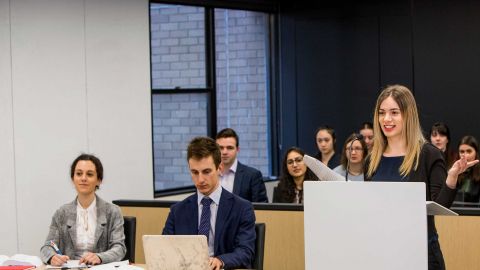
There are opportunities to participate in simulated legal activities, such as client interviewing, witness examinations and negotiation. The School has an outstanding record in competitive mooting at both national and international levels.
The School of Law placed first in the prestigious 2009 International Investment Arbitration moot in Frankfurt; first and second in the 2009 Castan Centre for human rights moot; and third equal in the International Willem C Vis (Far East) Commercial Arbitration moot in Hong Kong.
Law Students’ Association
Our Law Students’ Association (LSA) runs activities, careers, competitions, education and marketing. The LSA provides students with the opportunity to take on leadership roles within the School and to engage with the wider legal community.
LSA members run an orientation and mentoring program for first year students, organise competitions, career and social events and publish a Careers Guide.
Dedicated Careers and Placement officer
The School of Law has a highly experienced Careers and Placement officer who works to assist with obtaining seasonal clerkships, internships and supervised workplace traineeships. Assistance with preparation and development of resumes, applications and interview skills is also available.
Alternative pathways
Going straight from school to university isn’t an option for everyone. There may be other pathways to help you gain entry into this course. See alternative course pathways.
Student and graduate profiles
Find out about the experiences of one of our Law students.
The La Trobe environment is relaxed with students from all types of cultural backgrounds.
Christina Kouppi, Business, Economics and Law