
The Secret Reefs of Western Port
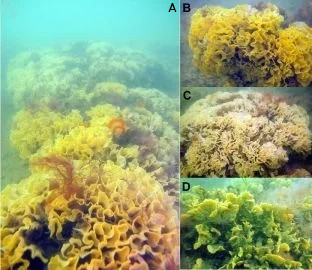
Long concealed by Western Port’s typically poor visibility, a globally significant reef system had gone undocumented and unrecognised in decisions about the bay’s ecological future.
In the turbid, fast-moving water, colonies of bryozoans - tiny filter-feeding animals – join together to form delicate, fragile reefs. Although the structures resemble coral, bryozoans are only distantly related. As researcher Dr Travis Dutka explains, “a microbat and a blue whale are more closely related to each other than coral is to bryozoans”.
The reefs first came to scientific attention in 2016, when Dr Dutka and industry partner Dr Adrian Flynn from Fathom Pacific revisited old seabed imagery from an area fishers call ‘The Corals’. High-resolution mapping confirmed a unique 1.74 square kilometre bryozoan reef system in the Eastern Arm, featuring tall linear rows and patch reefs not recorded anywhere else in the world making them of state, national, and international significance.
These reefs create vital biodiversity hotspots, supporting marine worms, crustaceans, molluscs, sponges, and juvenile fish that would not normally occur on the surrounding silty sediments. However, their fragile structure means that once damaged, recovery is may be limited.
Western Port has been a Ramsar-listed wetland since 1982, recognised for its extensive mudflats, seagrass, and saltmarsh. Historically, however, this recognition primarily included what could be seen above the waterline.
Following the discovery of the reefs, they were formally recommended in 2022 for listing under the Flora and Fauna Guarantee Act 1988 due to their rarity and vulnerability. By 2025, new underwater surveys revealed different additional bryozoan habitats in the North Arm and Western Arm.
In 2025, the Western Port Ramsar Information Sheet received its first major update in three decades, now incorporating bryozoan reefs into monitoring. Through the Ramsar Awareness Project, the Western Port Biosphere now engages boaters and local clubs about responsible anchoring.
Education Lead Lucy Kyriacou explains: “We regularly raise awareness of the Bryozoan Reef at community and corporate events, inspired by the work of both Travis and Adrian. We also teach schools about the coastal wetlands and the Ramsar Convention throughout the year.”
Dr Dutka is also serving as one of the scientific advisors to an upcoming documentary called Western Port Down Under, which features the bryozoan reefs and is due to be released next summer (2026-7).
With new discoveries and growing recognition in Ramsar monitoring, these once-unseen reefs are emerging as a vital part of Western Port’s natural heritage and ongoing management.
Image: A) Shows linear growth pattern which is a unique feature to the reef complex and B, C, D are the three dominant species that make up the reef. Triphyllozoon munitum (B), Triphyllozoon moniliferum (C) and Celleporaria foliata (D).
Published May 2026