For millions of Australians living in rural and remote areas, life-saving health care and diagnostics can be difficult to access due to vast distances, fewer clinicians, and stretched resources.
But a multidisciplinary team led by La Trobe University experts are focused on finding ways to involve communities to help develop simple, affordable, and accurate point-of-care sensors. This approach could be key to closing this gap.
Published in Nature Sensors, a new perspectives piece authored by Dr Saimon Moraes Silva, Distinguished Professor Brian Abbey and Professor Kylie Lee with Associate Professor Liz Dale (University of Wollongong), explores a holistic framework to ensure that from the beginning, sensor devices are designed to best serve regional and rural communities.
The framework considers key areas including community priorities, local infrastructure, clinical workflows, cultural safety, and long-term sustainability. These collectively ensure that diagnostic devices not only provide accurate results, but can fit with the systems which are already in place. In turn, this aims to enable patients to receive timely treatment, referrals, or follow-up care.
Dr Moraes Silva said that the key message is that these technologies should not be considered ready for rural healthcare simply because they work well in a laboratory. For example, a sensor might perform exceptionally well in a laboratory but struggle in a remote health clinic due to extreme temperatures; or the value of the result might be limited if there is no follow-up pathway.
“Technologies developed must also be shown to work reliably in the community where it will be used,” he said.
“By bringing together engineering, healthcare delivery and community expertise, we believe this approach could help turn promising diagnostic technologies into practical tools that improve healthcare access and reduce health inequalities across rural and remote Australia.”
Professor Lee said that the holistic framework will place community first in the development of much-needed technologies and help foster community trust and understanding in how the technology can add value to community life.
“Designing technologies from the start with communities and local health professionals will prioritise community expertise and ensure they suit the people they are intended to serve,” she said.
The Perspective emphasises how it is essential to work closely with rural communities, including Aboriginal and Torres Strait Islander communities, to ensure technologies are responsive to local priorities, and have a meaningful approach to support community leadership and build local capacity.
Distinguished Professor Abbey said that the team believes the Perspective’s approach could offer a practical pathway to more reliable and sustainable diagnostic services, ultimately helping ensure that a postcode does not determine their access to quality healthcare.
He said that the article highlights how rethinking the way point-of-care sensors are designed and introduced into rural healthcare could help reduce the equity gap.
“By developing technologies that are reliable, affordable, easy to use and suited to local conditions, we could make essential medical testing more accessible to people who currently face long travel distances and delays in receiving results,” Professor Abbey said.
“This could support earlier disease detection, faster clinical decisions and more timely treatment, while reducing the need for patients to travel to distant hospitals or laboratories.”
About the authors
- Dr Saimon Moraes Silva is the Director of the Biomedical and Environmental Sensor Technology (BEST) Research Centre, a Co-Theme Leader at the ARC Research Hub for Molecular Biosensors at Point-of-Use (MOBIUS), and a member of the La Trobe Institute for Molecular Science (LIMS) and La Trobe University’s School of Agriculture, Biomedicine and Environment (SABE).
- Distinguished Professor Brian Abbey is the Deputy Director of the La Trobe Institute for Molecular Science (LIMS), a Chief Investigator at the ARC Research Hub for Molecular Biosensors at Point-of-Use (MOBIUS), and a member of the Biomedical and Environmental Sensor Technology (BEST) Research Centre, the ARC Research Hub for Molecular Biosensors at Point-of-Use (MOBIUS), and La Trobe University’s School of Computing, Engineering and Mathematical Sciences (SCEMS).
- Professor Kylie Lee leads the Priority Populations Research Stream at the Centre for Alcohol Policy Research, and is a Professor of Public Health at La Trobe University’s School of Psychology and Public Health (SPPH).
The piece was co-authored with Associate Professor Elizabeth Dale (University of Wollongong).
---
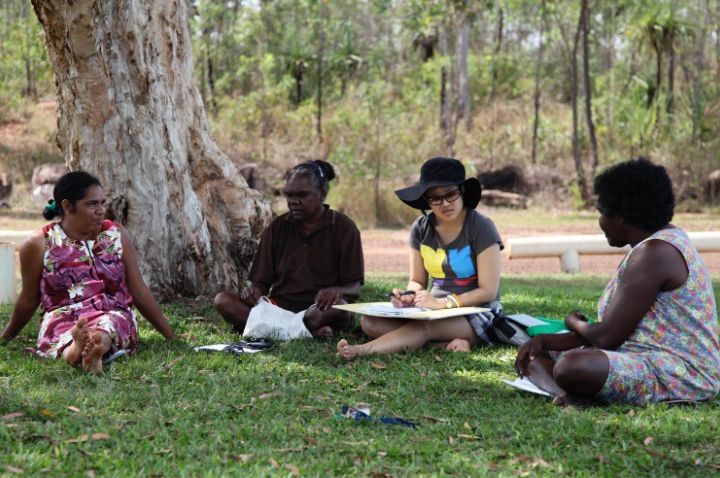
Image: Working out what the amarda (cannabis) study findings mean - Aboriginal health and mental health workers and Kylie Lee (2006). Photo credit: David Hansen.