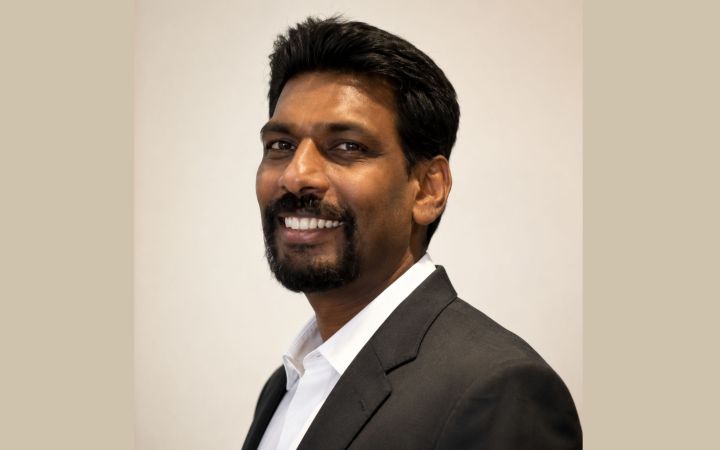
Artificial intelligence (AI) is advancing quickly, but Dr Nishan Mills is focused on a more complex question: how can AI systems adapt to real people, real organisations and real-world constraints?
As a Senior Lecturer in AI and Analytics at La Trobe Business School and Principal Technical Architect at La Trobe’s Centre for Data Analytics and Cognition, Dr Mills’ research bridges both fundamental AI research and real-world application. His research looks at: how AI systems can become more adaptive; how different AI systems can work together; and how future AI can require fewer computational resources. He also works with organisations to translate those advances into practical systems they can use responsibly.
“There is a lot of focus on what AI can do,” Dr Mills says. “Integrating it into people’s lives responsibly is a very different challenge and one that extends beyond the technology itself.”
That perspective is shaped by more than two decades working in designing and delivering software systems across multinational organisations, not-for-profits and technology ventures before moving into academia.
Traditional enterprise software is usually built around defined processes and workflows. As organisations change, those systems often need to be reconfigured, redeveloped or connected to other tools. Dr Mills’ research asks how AI can provide a more adaptive layer, allowing technology to respond to changing people, processes and organisational contexts while keeping the right governance and human oversight in place.
“Software has traditionally provided structured, deterministic solutions,” he says. “AI gives us the opportunity to make those systems more adaptive, more personalised and, ultimately, more useful without sacrificing responsibility.”
At the fundamental research level, Dr Mills is investigating how specialised AI agents can work together on complex tasks. Instead of relying on one model to do everything, these systems bring together different AI components that can reason, plan and adjust as circumstances change.
He is also exploring energy-efficient AI. Today’s large AI models have shown what the technology can do, but they often require enormous computing power. Dr Mills is interested in alternative approaches inspired by the brain’s ability to process information efficiently and adapt using comparatively little energy.
“We’ve come a long way with large language models,” he says. “The next challenge is building AI that is not only capable, but efficient, adaptable and sustainable.”
Turning research into systems
Dr Mills’ research programs provide the foundation for a range of industry partnerships.
One example is the La Trobe Energy Analytics Platform, known as LEAP, developed through the Centre for Data Analytics and Cognition. The platform analyses energy use across university buildings, identifies unusual operating patterns and supports evidence-based decisions that contribute to La Trobe’s net zero strategy. Its open data has also allowed other researchers to pursue sustainability research.
Dr Mills has applied similar principles with AFAC, the national council for fire and emergency services in Australia and New Zealand, helping emergency services draw insights from years of incident data through conversational AI.
In a current collaboration with facilities management company Cirka, his team is developing adaptive AI systems to help planners estimate and manage complex facilities projects. A building cleaning project, for example, may involve site size, human traffic, equipment, client requirements and similar past projects. AI can bring that information together, identify comparable projects, benchmark estimates and support decision-making through a conversational interface.
“The objective isn’t to replace expertise,” Dr Mills says. “It’s to make the right information available at the right time so people can make better decisions.”
For Dr Mills, the success of AI also depends on the people using it. His work in AI literacy explores how students, professionals and organisations can evaluate AI critically rather than simply adopt it.
That means asking better questions. Is AI the right solution? What evidence supports its recommendation? What data should be collected, or refused? Where should human judgement remain? Is the system achieving what it was designed to do?
In his teaching across AI in Business, Cloud Platforms and Big Data Analytics, Dr Mills connects technical knowledge with the capabilities students and future leaders will need. His AI literacy work with secondary school students, postgraduate students and industry professionals encourages learners to understand how AI tools work, in what context, and what responsible use looks like.
Looking ahead, Dr Mills believes the future of AI will be defined not only by more capable technology, but by AI that people can trust and use responsibly. “We are not just looking at profit or efficiency,” Dr Mills says. “We’re looking at how AI can responsibly amplify human capability while remaining aligned with human values.”
Connect with Dr Nishan Mills
La Trobe Profile: Nishan Mills
Email: N.Mills@latrobe.edu.au
Dr Mills spoke at a recent La Trobe Innovation Series event, AI Innovation to Impact. To stay up to date on future La Trobe Industry events, articles, and news, subscribe to the Industry newsletter or Follow ‘La Trobe Industry’ on LinkedIn and Eventbrite.