
Champion Data
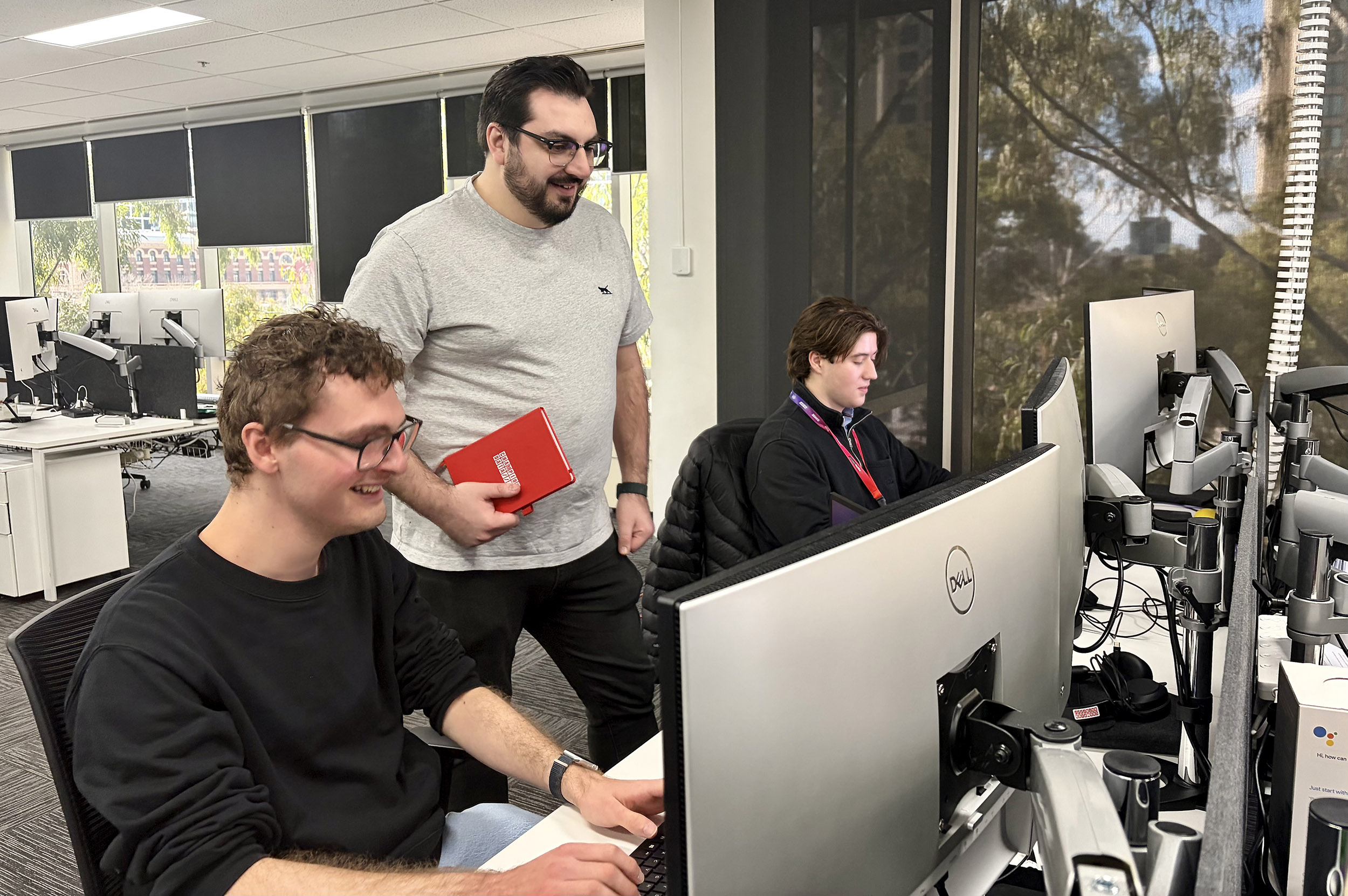
Champion Data’s first student placements with La Trobe have given two media students hands-on roles in sports broadcasting while helping the company develop talent for a specialised industry.
Partnership at a glance
- Champion Data is a sports data and technology company best known as the AFL’s official statistics provider and the team behind many of its on-air graphics.
- Recently, they wanted a better way to bring new talent into specialist broadcast design and technical roles.
- In 2026, it partnered with La Trobe to host Bachelor of Media and Communication students Jack Williams and Lucas Clayton.
- Across placements of 200 and 100 hours, the students contributed to graphics and technical work used in live sports broadcasting.
- Champion Data has retained Lucas as a casual technician and plans to continue the La Trobe partnership.
Case Study
Every graphic that appears during an AFL broadcast relies on careful preparation. Teams link player images to live data, build and test graphics packages, and ready equipment at studios, broadcast hubs and venues hours before coverage begins.
In 2026, La Trobe University students Jack Williams and Lucas Clayton became part of that process through Champion Data’s first La Trobe student placements.
Champion Data has been the AFL’s official statistics provider since 1999. It has since expanded across sports data, technology and broadcasting in Australia and internationally, with its broadcast operation growing from five people to around 30.
That growth has sharpened a longstanding challenge: finding people with the unusual mix of creative, technical and practical skills the work demands.
“We’ve spoken for years about the fact that it’s very hard to bring new talent into this industry,” says Champion Data Design Team Lead Jerome Guzzo. “It’s niche. And we reached a point where we said, ‘Enough’s enough. We can’t keep using that as an excuse.’”
Broadcast designers combine creative skills with the technical ability to build graphics that change as live data flows into them. Technicians need IT, networking and audiovisual skills, along with the ability to work hands-on with equipment and cabling. Few recruits know Champion Data’s specialised systems, so much of the work must be learned on the job.
Real work from the start
Williams and Clayton brought skills from their Bachelor of Media and Communication studies, including experience in newsroom and production environments through La Trobe’s upstart program.
Williams began a 200-hour placement in July, working in Champion Data’s Design team under Guzzo’s supervision and spending much of his time with the Fox Footy team.
He had pictured himself pursuing video production and was initially unsure about taking a graphic design placement. That changed once he began producing work for broadcast.
For AFL 360, Williams used Photoshop to prepare newspaper material requested by producers, adjusting its presentation, colour and dimensions before it appeared on screen. He also created showreels, worked on augmented-reality graphics and prepared player headshots ahead of the AFLW season.
“I get to make graphics that are aired on some of the Fox shows,” he says. “It’s extended my technical production abilities beyond video editing and into graphics.”
By taking responsibility for essential production tasks, Williams freed permanent staff to focus on the broader graphics packages in the lead-up to the busy AFLW season.
“Jack’s been great. He has come in and smashed it,” Guzzo says. “Once he’s nailed a basic task, we give him something new.”
The experience also expanded Williams’ career options. “I’ve always wanted to be on the technical side of media production,” he says. “In my head, that was more video. Now I have these graphical skills too.”
Clayton took a different route through his 100-hour placement, working with Steve Arcaro in Champion Data’s Broadcast Operations team, which prepares and maintains the portable graphics systems used onsite.
Clayton learned to set up, maintain and troubleshoot the equipment. At headquarters, he also helped rework aspects of the kits’ power distribution and cabling. Around 40 hours of his placement took place at venues, studios and broadcast hubs.
On match days, he could arrive five hours before the broadcast to set up, stay throughout the coverage to troubleshoot problems, then pack down the equipment. By the end of his placement, Champion Data had retained him as a casual broadcast technician.
“Before I did the placement, I knew I wanted to work in broadcast, but I didn’t know what role I wanted,” Clayton says. “Now, because of the placement, I want to be a broadcast technician.”
A clearer pathway into specialist work
The placements gave Champion Data support during busy production periods and time to teach skills that can be difficult to cover through its usual onboarding. Instead of expecting Clayton to absorb everything in one or two sessions, Arcaro and his team could introduce him to the equipment gradually and repeat training where needed.
“We had weeks, not one or two training sessions,” Arcaro says. “If he didn’t get something, we could teach it again the next day. He came out the other end much more confident.”
Supporting Clayton also prompted the team to review what a new technician needs to know and how those skills should be taught. Williams’ longer placement showed the value of giving students time to move beyond basic tasks and understand the wider broadcast environment.
For Champion Data, the benefits include extra capacity, stronger training and a new casual technician. Both Williams and Clayton contributed to work seen on screen while gaining a clearer view of where their skills could take them.
With Champion Data working across sports throughout the year, Guzzo sees plenty of opportunities for future La Trobe students.
“We’re not stopping,” he says. “There are plenty of opportunities for students to work across different sports, and we’re hoping the partnership with La Trobe continues.”