Released by Federal Minister for Health and Aged Care Mark Butler on 6 August, the strategy outlines a national approach to nursing workforce planning, education, retention and career development.
Dean of La Trobe Rural Health School, Professor Jane Mills, said the strategy recognised addressing Australia's nursing workforce challenges begins with investing in education and creating stronger pathways into rural practice.
"This is an important milestone for rural nursing education. Building a sustainable nursing workforce starts with investment in education, clinical training and rural career pathways," Professor Mills said.
Dean of La Trobe’s School of Nursing and Midwifery, Professor Marie Gerdtz, said the strategy aligned strongly with priorities already informing the University’s approach to nursing education, research and workforce development.
"The strategy recognises the importance of strengthening transition-to-practice pathways, supporting professional development, enabling nurses to work to their full scope of practice and fostering positive learning and working environments,” Professor Gerdtz said.
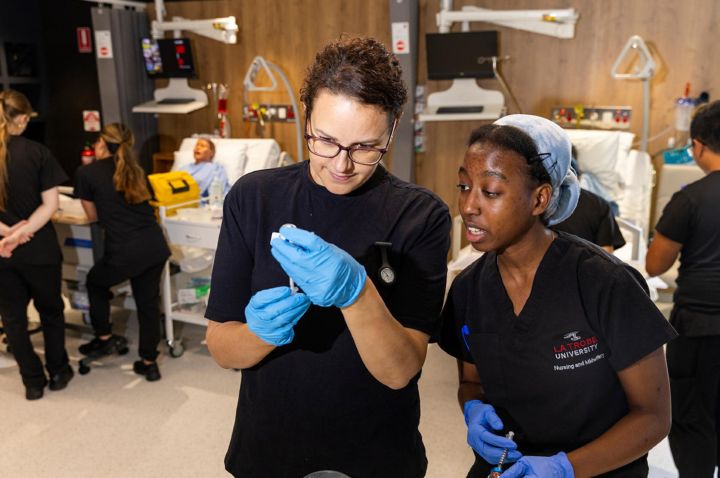
Through the Australian Government's Rural Health Multidisciplinary Training (RHMT) program, La Trobe Rural Health School provides nursing students with immersive rural and regional placements and works closely with local health services to build a pipeline of future health professionals.
La Trobe’s nursing programs are underpinned by a longstanding commitment to place-based learning, supporting students to study and train in the communities they serve. In Melbourne, this is complemented by La Trobe’s distinct clinical school model, which has connected education and practice for more than 30 years.
These initiatives are assisted by the Australian Government's Commonwealth Prac Payments, which provide financial support to eligible nursing students undertaking mandatory placements.
"We know that positive rural placement experiences influence where graduates choose to work. Programs like RHMT connect students with communities, build their confidence and help develop the skilled workforce that rural Australia needs,” Professor Mills said.
“It is essential that the RHMT funding is directed to students studying in the regions who then go on to graduate into the regional and rural health workforce.”
Professor Gerdtz said the strategy's focus on workforce development and stronger connections between education and practice would help support the future nursing workforce.
“Our partnerships across the health sector, including our work in the Parkville health precinct, help strengthen the connection between education, research and clinical practice, ensuring graduates can meet the changing needs of healthcare,” Professor Gerdtz said.
Professor Gerdtz said La Trobe looked forward to working with governments, health services and communities to help implement the strategy.
"We are committed to preparing nurses who are clinically capable, intellectually curious and equipped to contribute to the future of healthcare.”
Media Contact
Jess Garbutt - media@latrobe.edu.au, 0481 383 817