By Phil Laufenberg, Pro Vice Chancellor (AI) and Chief AI Officer
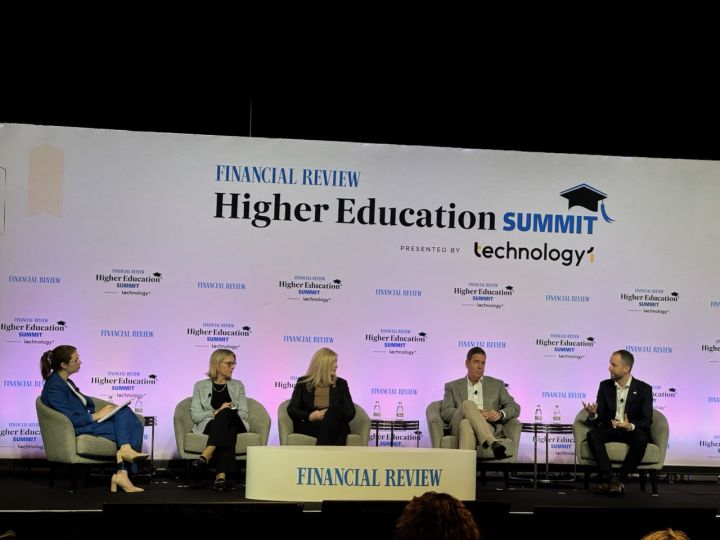
As a panelist at the Australian Financial Review (AFR) Higher Education Summit’s “The AI University” discussion, I spoke about the value of a university education, the types of graduate’s employers will need, how assessment must evolve and what an AI-first university should look like in practice.
The value of university education
Generative AI has made the plausible answers cheap. But that was never the full value of university. The real value lies in disciplinary depth, professional practice, expert challenge, critical thinking, mentoring, and networks. It also lies in verification: credible evidence that a graduate can act responsibly.
In an AI-enabled world, successful graduates will not simply be those who know how to operate an AI tool. They will be people who can identify a problem, decide whether AI can help, evaluate its output and apply the result responsibly.
For generations, graduates have learned through routine early career tasks such as researching a problem, creating a draft or preparing a presentation. These tasks were never the whole job, but they helped graduates build expertise and understand how professional decisions are made in the workplace.
Generative AI is now changing that pathway. As AI can complete many routine tasks quickly, universities have an opportunity to rethink how students gain those early experiences.
Preparing students to enter the workplace
At La Trobe, this thinking is informing our engagement with employers and offerings such as the Bachelor of Artificial Intelligence Engineering. It is also reflected in the AI Business Studio, where students work with small and medium-sized businesses on real challenges, including AI readiness, literacy, workflow redesign and the development of practical AI applications.
These experiences help students build capabilities that cannot be developed through another written assignment alone. They must apply judgement, think critically, explain their reasoning and work within real world constraints.
What it means to be an AI-first university
Our AI-first strategy is also informing the development of AI-focused award courses, short courses and industry learning opportunities, as well as the integration of AI into curricula and work-integrated learning. The aim is to build capability across disciplines, rather than limiting AI expertise to students studying technology or AI specific subjects.
An AI-first ambition aims to unlock immense value of responsible AI adoption at institutional scale across education, research, student services and university operations. To be successful, it needs to be supported by four foundations:
- Capability building, collaboration and a culture of co-design across schools, professional teams, employers and students,
- State of the art technology and data platforms,
- Robust governance and assurance to move fast with confidence and
- Strong delivery and partnerships across technology, cybersecurity and infrastructure.
At La Trobe University, we have successfully built those foundations since the launch of our AI strategy in 2024. Becoming an AI-first university is also not about using AI everywhere. It is about starting with the outcome we want to achieve and making a deliberate choice about whether AI can help us achieve it.
Through our collaboration with OpenAI, La Trobe committed to providing frontier AI capabilities through ChatGPT Edu access to all approx. 45,000 students and staff with the initial rollout already underway. This builds on our Responsible AI Adoption Strategy and reflects our commitment to making AI capability a shared benefit rather than an individual advantage and provide equitable access, guidance and safe environments in which students can learn how to use these systems responsibly.
Access is only the starting point. The real goal is ensuring every student can participate with meaning and impact in an AI enabled world, and transition, or accelerate, a successful career.
Looking ahead
AI is changing the first steps of professional life, and the conference indicated that these steps are everchanging. Our response should be to give students better opportunities to practise judgement, solve real problems and contribute with confidence. That is how universities can ensure that AI does not diminish the value of education but helps us deliver it more powerfully.
Ultimately these initiatives need to be judged by their impact. Stronger student success and confidence, accelerated research, confidence in workforce productivity and improved service quality.
For information on how to join our AI Business Studio or to find out more about La Trobe’s AI initiatives, visithttps://www.latrobe.edu.au/ai or email us at aiinstitute@latrobe.edu.au.