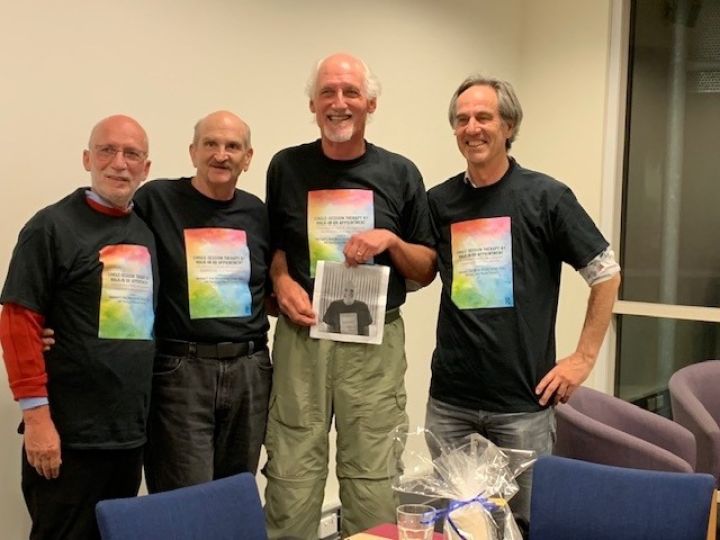
By Jeff Young, Pam Rycroft and Colin Riess
Moshe Talmon passed away with his family at his side on August 21st. He was 76 years old.
The Bouverie Centre first came across Moshe Talmon via his 1990 seminal text, Single Session Therapy: Maximising the effect of the first (and often only) therapeutic encounter, which Pat Boyhan, (an honours psychology student on placement at Bouverie at the time) introduced to us. This book had a profound impact on the mental health field. Moshe, as he clearly stated, was not the first therapist to discover that many clients chose to only attend one session, but he initiated the world’s first prospective Single Session Therapy (SST) study with his Californian Kaiser Permanente colleagues Bob Rosenbaum and Michael Hoyt and then pulled together all the existing research in his 1990 book.
Moshe’s book became an international best seller, which led to him travelling the world, presenting Single Session Therapy - a disruptive but ethical therapeutic approach - to large audiences. It was during one of these presentations in London, that Pam Rycroft first meet Moshe in person and invited him to visit Bouverie. Moshe visited Melbourne several times, conducting single session therapy demonstrations and workshops at Bouverie and, along with Bob Rosenbaum, recording interviews with Jeff Young in 2006 supporting our first major project implementing single session therapy into Community Health Counselling services across Victoria. The video attached demonstrates what an original thinker he was.
The inaugural International Single Session and Walk-In Services symposium, co-convened by Jeff Young, Pam Rycroft and Moshe Talmon at Phillip Island in 2012, reconnected the Kaiser Permanente single session team, re-energised their commitment to promoting SST, and stimulated single session work worldwide. The symposium also brought together original members of the Walk-In Services approach in Canada with single session practitioners and interested clinicians around Australia. The sixth international SST symposium, due to be held in Exeter, Devon, in September 2027, will sadly be the first one in which Moshe will not be a keynote speaker and active behind-the-scenes supporter.
Moshe’s 1990 book provided the research that many groups around the world needed to justify, teach and implement the single session approach, including our original single session team at Bouverie (Pat Boyhan, Colin Riess, Pam Rycroft and Jeff Young).
Moshe was a fearless explorer of new ways of working. Leading up to conducting the first prospective SST study he bravely followed up 200 of his own clients who had ‘dropped out’ after only one session and to his surprise found 88% were happy with the single session. This personal research along with discovering that the modal number of sessions for every counsellor at the large Kaiser Permanente health service, irrespective of experience and discipline, was one, encouraged him to thoroughly explore the single session approach and its capacity to provide accessible and efficient help to the world’s clients. In another innovative exploration, his second 1993 book, Single Session Solutions: A guide to practical, effective and affordable therapy, focussed on how clients can make the most of their time with therapists. The ideas of transparency and of therapist-client collaboration in this less successful book are only now being rediscovered.
Moshe always did things thoroughly. He trained and connected professionally with the best. In a further connection with Bouverie, he studied with the internationally renowned family therapist Salvador Minuchin, who, during a visit to Melbourne in 1976 was instrumental in Bouverie transitioning to a specialist family therapy service.
Despite Moshe’s extraordinary international impact and influence, he was not interested in fame or fortune. He resisted lucrative invitations to standardise the SST approach, fearing it would limit its creative development.
Moshe was a shining example of being a ‘mensch’: a warm and thoroughly decent human being. Although he was a gentle, softly spoken man he was never timid or lacking in courage in his professional, personal or political dealings. He took on authorities and spoke out against abuses of power with little regard for his own welfare or reputation. Yet he was surprisingly simple and direct with clients, openly sharing his own vulnerability as he intuitively and gently connected to what was most important to them. This was not a strategic intervention - he was the same in his dealings with his friends, colleagues, and family.
Moshe grew up on a Kibbutz Beit Alfa during the idealistic socialist 1950s where children were raised by the community rather than in nuclear family groups. He valued the experience but made it clear he did not want to replicate it with his own family. He loved Israel but became increasingly concerned by the impact of Israel occupation of Lebanon and its dealings with Gaza on Israel’s political and cultural priorities. He specifically worried about the impact of the policing role and brutality shouldered by youth serving in Israel’s conscripted military.
Moshe lived fearlessly, ethically and selflessly until he died. Following the October 7 attack and Israel’s reprisals, he redoubled his commitment to his therapeutic work, and continued even through the pain associated with his own illness. Moshe will be remembered not only for challenging traditional ideas about psychotherapy but also for his warmth, the love for and belief in his clients, his extraordinary presence and his unassuming generosity to colleagues.
His legacy will live on in Bouverie, in Australia and around the world.