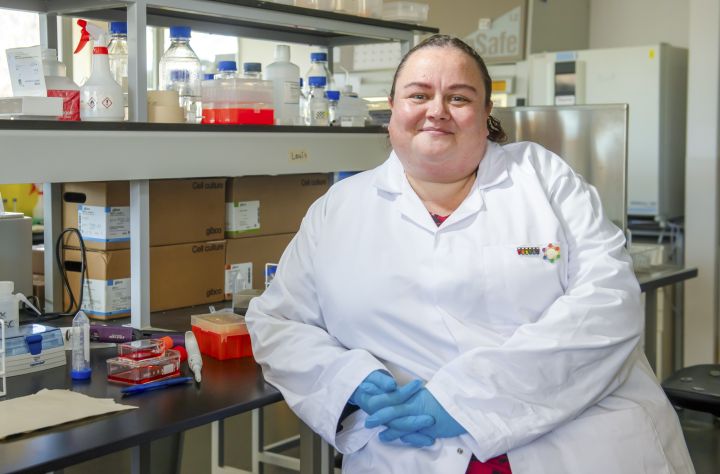
Using advanced microscopes, her team studies the individual molecules involved in protecting our genetic information. The work could help explain why these protective processes fail and inform future approaches to cancer treatment.
“Rather than simply identifying which molecules are involved, we want to understand how they are organised, how they interact, how they move and how their behaviour changes in response to damage or disease,” Associate Professor Whelan said.
Her laboratory develops and uses super-resolution fluorescence microscopy and single-molecule imaging. These techniques allow researchers to examine biological processes in much finer detail than conventional light microscopes can reveal.
Many cancer treatments exploit weaknesses in cancer cells’ DNA repair systems. Understanding how repair molecules work together could help researchers identify new treatment targets and understand why some cancers resist treatment.
Associate Professor Whelan emphasised that her research investigates the underlying biology, with potential benefits that may take years to emerge.
“We’re not developing a cancer treatment that will be available next year. Instead, we’re investigating the molecular mechanisms that future treatments may depend upon.”
Her path to this work included a second degree in Arts, with a double major in philosophy, after completing her undergraduate science degree.
Philosophy helped her question assumptions, assess evidence and build arguments. A subsequent year away from university confirmed that she wanted to return to science.
“What I discovered was that I missed science. Not the assessments, the deadlines or the qualifications, but the actual process of asking questions and trying to understand how the world works.”
Her Honours and PhD research took her through chemistry, physics and biology, eventually leading to biophysics and advanced microscopy.
After her PhD, she moved to New York to continue her research at NYU School of Medicine. Alongside her laboratory work, she pursued her love of live theatre, attending more than 100 productions on and off Broadway.
In 2018, she returned to Australia to establish her laboratory at La Trobe’s Bendigo campus.
Today, her team also collaborates with researchers in immunology, microbiology and drug development, applying imaging techniques to questions across these fields.
Over the next decade, she wants to investigate how the physical organisation of cells affects their ability to detect and repair DNA damage.
“My ambition is not simply to produce better images of biological systems, but to use those images to discover fundamental principles of how those systems work.”
She is equally committed to developing research opportunities in regional Australia and helping students become independent scientists.
Associate Professor Whelan said Bendigo has the researchers, infrastructure and collaborations to contribute to internationally competitive biomedical research.
She said scientific excellence is not inherently metropolitan. Regional cities such as Bendigo can build research programs that compete internationally, supported by strong teams, infrastructure and collaboration.
Growing that capability in Bendigo also means giving students the opportunity to pursue ambitious scientific careers close to home. Regional universities can contribute to discoveries with global reach while serving their local communities.
“I’d like to see a future where talented students don’t feel they need to leave regional Australia to pursue ambitious scientific careers, and where regional universities are recognised not only for the communities they serve, but for the discoveries they contribute to the world.”