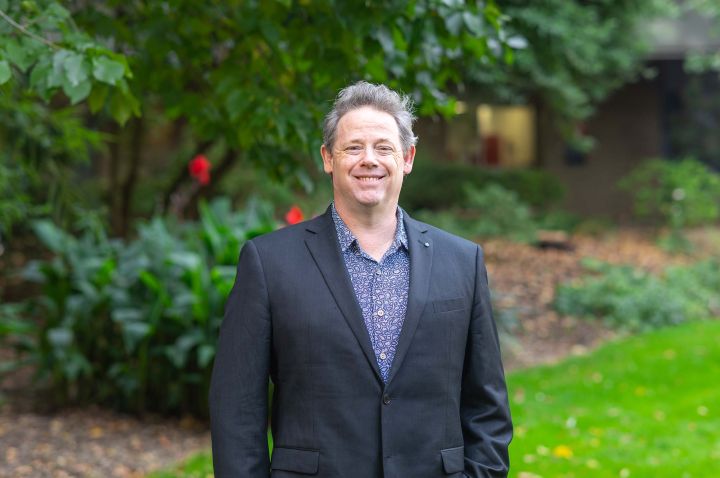
Professor Andy Herries has long been fascinated by human evolution.
“By the age of six, I was already telling people I wanted to be an archaeologist,” he says, recalling childhood travels with his family to archaeological sites in Greece, Egypt and Sri Lanka.
This early curiosity led Professor Herries to the University of Liverpool, where he became captivated by a 1.8-million-year-old Paranthropus robustus fossil from Swartkrans Cave in South Africa. He spent the next 30 years of his career studying it at a several sites in South Africa.
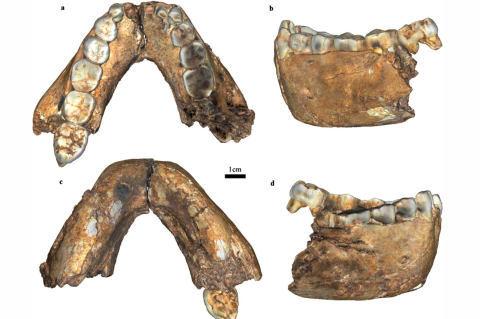
It was at one of these sites, Drimolen, that Professor Herries and a team of La Trobe students discovered one of the most complete specimens of the Paranthropus robustus, as well as the oldest fossil of Homo erectus at 2 million years.
Professor Herries’ current research explores how multiple ancient human species once coexisted on the South African landscape.
“We used to think that human evolution was a straight line,” he explains. “Now we know it’s more like a braided river, with populations separating, evolving and sometimes interbreeding.”
“For example, for a long time, researchers thought that the fossils of Paranthropus at Drimolen were females and those at Swartkrans were male. In 2018, however, we discovered a new male fossil of Paranthropus from Drimolen that looked a lot more like the female from Drimolen than the males from Swartkrans.”
This discovery, together with the first accurate dating of Drimolen to between 2.04 and 1.95 million years ago, showed that the differences were not simply about sex. Instead, they reflected small-scale evolutionary change, known as microevolution – something that is difficult to detect without many well-dated fossils from closely spaced time periods.
Using advanced techniques, Professor Herries and his team can now also uncover very specific details from fossils, such as how long children were breastfed and the age at which they died.
“We can do lots of cool stuff with fossil specimens these days, particularly with technology like the Australian Synchrotron,” he says. “We recently exported some hominin teeth from South Africa and were able to count the number of layers inside the teeth to estimate the age at which they died.”
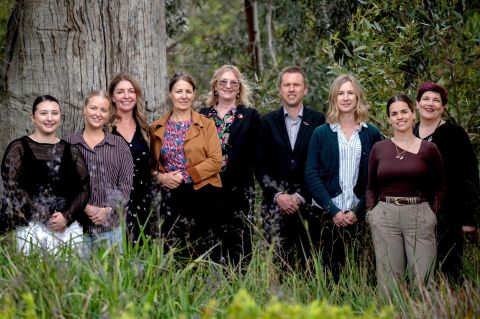
Professor Herries is now Co-Director of a newly funded Australian Research Council Centre of Excellence in Transforming Human Origins Research. The Centre explores how our species Homo sapiens arose in Africa and spread across Asia and into Australia.
The centre aims to change the way Palaeoanthropology is practiced across the globe, putting Indigenous and local knowledge at the centre of research, and supporting global partners through student scholarships and exchange programs.