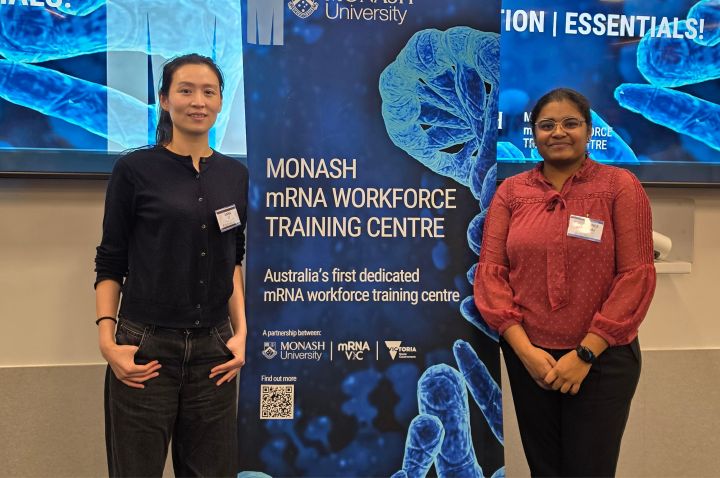
Whether investigating vascular therapeutics or the mechanisms underlying ischaemic stroke, PhD researchers are constantly building new knowledge and skills to advance their research.
For LIMS and CCBDR PhD researchers Pooja Shree Rangaraj (Okuda Group) and Xiaoya Li (Kim Group), that meant spending three days immersed in the fundamentals of mRNA therapeutics through EMBL Australia's mRNA Design and Optimisation Essentials program. We spoke with them about what they learnt, what surprised them most, and how they're hoping to apply these new skills to their research.
Tell us a bit about yourselves and your research.
Pooja: I am Pooja Shree Rangaraj, a second-year PhD student in the Vascular Therapeutics and Regeneration Lab (Okuda Group) at LIMS and the Centre for Cardiovascular Biology and Disease Research (CCBDR). My research focuses on "Identifying and characterising vascular therapeutics using zebrafish".
Xiaoya: I am Xiaoya Li, a first-year PhD candidate in CCBDR and LIMS. My research investigates the mechanistic drivers of ischaemic stroke and develops targeted therapeutic interventions.
What did you learn about at the EMBL Australia “mRNA Design and Optimisation Essentials” training program?
Xiaoya: The training equipped us with foundational expertise in mRNA therapeutics. The curriculum encompassed critical design parameters including cap structures, untranslated regions (UTRs), codon optimisation, modified nucleotides, and lipid nanoparticle (LNP) delivery systems.
Pooja: It was an intensive, hands-on short course covering the fundamentals of mRNA construct design. We dove into coding sequence optimisation, UTR and poly A tail engineering, mRNA capping strategies, and the computational tools used for rational mRNA design in both research and therapeutic contexts
What’s the most exciting thing you learnt that you want to explore further in your research?
Pooja: The most exciting part for me was seeing how sequence and UTR optimisation directly influence mRNA stability and translation at a cellular level. We also explored recent mRNA modalities that can be tailored for specific target genes. I’m really looking forward to applying these new mRNA modalities to my research.
Xiaoya: For me, the most exciting discovery was learning how strategic mRNA design choices can dramatically enhance protein expression, stability, and safety, with potentials to reach therapeutic target more precisely and efficiently. I am particularly keen to explore how these RNA-based platforms could be tailored to address neuroinflammatory mechanisms in ischaemic stroke, potentially enabling novel neuroprotective therapies or preventing recurrent events.
What’s the most unexpected thing you learnt during the training?
Xiaoya: I was surprised by the dramatic impact of seemingly minor mRNA design optimisations such as UTR refinement and nucleotide modification on both therapeutic efficacy and immune responses. It underscored an important principle: that precision engineering at the molecular level is fundamental to mRNA therapeutic development, not merely a cosmetic refinement.
Pooja: I honestly didn’t realise how powerful computer modelling had gotten at predicting different components of mRNA structure. It’s amazing that we can plan out and guide our design choices in-silico before even touching a pipette in the lab.
What did you most enjoy about the week?
Pooja: I enjoyed the interactive learning style and the chance to solve real world mRNA design problems in a team. Learning directly from world experts in RNA therapeutics was most rewarding, as it allows me to explore cutting edge developments and practical considerations that extend well beyond textbook.
Xiaoya: I really enjoyed the collaborative environment, with 18 PhD students from across Australia bringing diverse research backgrounds. Hearing how others approached mRNA therapeutics in their projects was exciting. The careers and networking session was another huge highlight. Getting academic insights from ARMI (Australian Regenerative Medicine Institute), together with perspectives from experts at Moderna, BioNTech and Cell Therapies, made the training feel connected to real world mRNA applications and future career pathways.
--
Pooja Shree Rangaraj (Okuda Group) and Xiaoya Li (Kim Group) are PhD researchers at LIMS and in the Centre for Cardiovascular Biology and Disease Research. We thank EMBL Australia for supporting their attendance at the course.
Find out more about their labs’ research and work:
Pooja and Xiaoya are also members of La Trobe University’s School of Agriculture, Biomedicine and Environment (SABE).