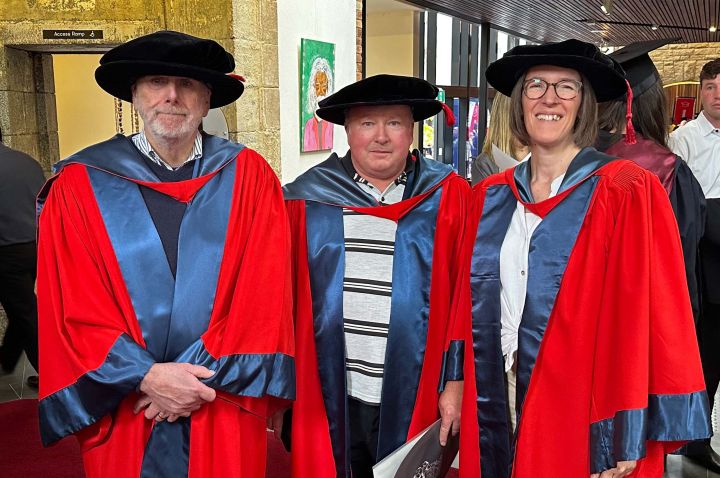
Dr Stephen Conway’s PhD research sheds new light on the settlement and economic development of Tasmania’s King Island, examining how remote agricultural communities survived between 1888 and 1955.
His thesis explored three major waves of settlement, including two significant soldier settlement schemes following the First and Second World Wars, as well as the development of the island’s dairy industry, transport networks and scheelite mine.
Dr Conway’s research grew out of more than a decade studying and writing about King Island and its history.
“King Island provided a kind of laboratory in which to study these settlement schemes in an enclosed environment,” he says. “My thesis provides the only in-depth analysis of the earning capacity of the island’s early farmers and the development of the dairy industry.”
Completing the research was not without challenges. During his studies, Dr Conway navigated COVID-19 border closures, a car accident, a snake bite and a minor heart attack.
“The research process was incredibly rewarding, but life did throw up a few unexpected obstacles,” he says. “The secret to overcoming them was to keep going. Whatever obstacle you hit along the way, the key is to bounce off it, get up, and keep going.”
He says the support of supervisors, family and friends also helped him stay on track.
“Beyond academia, friends and family members supported me every step of the way. The value of that support should never be underestimated.”
Reflecting on his PhD experience, he says the process has changed how he approaches research.
“I see opportunities for historical research, and ways to approach it, that I might not have seen before. I’m better at interrogating the evidence, and more comfortable working on large, complex projects.”