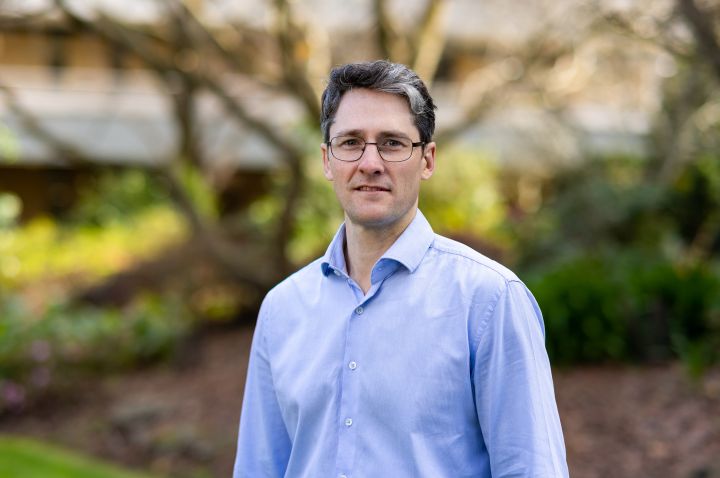
Dr Reid is investigating how legumes regulate their partnership with nitrogen-fixing bacteria, with the aim of advancing legumes grown for dry edible seeds, such as lentils, chickpeas, dry peas and beans.
Agriculture relies heavily on nitrogen fertiliser. Its manufacture is energy-intensive, and its use can contribute to greenhouse gas emissions and nutrient losses. Legumes offer a natural way to obtain nitrogen: they form a symbiosis with bacteria that fix nitrogen in root nodules. Dr Dugald Reid’s research examines how plants regulate this process and how it might be improved in pulse crops.
“Our goal is to understand and ultimately improve this natural process and displace more of the synthetic nitrogen from our cropping systems,” Dr Reid said.
Dr Reid is an ARC Future Fellow and Senior Lecturer in La Trobe’s Department of Ecological, Plant and Animal Sciences. His research uses genetics, genomics and biotechnology to understand how legumes manage their relationship with nitrogen-fixing bacteria.
He completed a PhD at the University of Queensland in 2012, studying the regulation of nitrogen fixation in soybean. He then moved to Aarhus University in Denmark, where he worked as a postdoctoral researcher and later led a research group. There, he investigated how plants control the development and function of the root organs that host bacteria. He joined La Trobe in 2023 and established a research group focused on legume genetics.
His current ARC Future Fellowship investigates the molecular basis of how plants respond to the nutrients available in soil. The work generates large genomic, gene-expression and plant-trait datasets across genetically diverse plant lines and species. To analyse them, his group is adopting machine learning to count root nodules in thousands of images, and AI-supported coding to assist with bioinformatics.
The aim is to link plant form and function to the genes behind them, then use data to identify promising genes or plant types for field validation. Dr Reid said predictive tools may help researchers make that selection more efficiently, but taking results from the glasshouse into the field remains difficult.
“Plants continually respond to the environment that differs enormously between fields, regions and years,” he said.
“Understanding how best to predict field performance from the experiments in the glasshouse is still the largest challenge.”
Dr Reid sees AI contributing most when its predictions are tested in real plants. Models could connect information across genomes, gene expression, protein function and plant traits, and suggest mechanisms or targets for experiments. Making that work useful will require collaboration between people with different expertise and a clear understanding of the agricultural problems they are trying to solve.
That practical connection is one Dr Reid wishes he had pursued earlier.
“Engaging with growers, agronomists or other end users of the basic research I do has given me much better insight into the types of problems that need solving and the approaches that might be viable to get there,” he said.
Dr Reid said he thinks biotechnology must be deployed safely, transparently and under appropriate regulation. Over the next five to 10 years, he expects biotechnology crops to offer more compelling benefits to consumers, clearer environmental benefits or applications in more specialised foods.