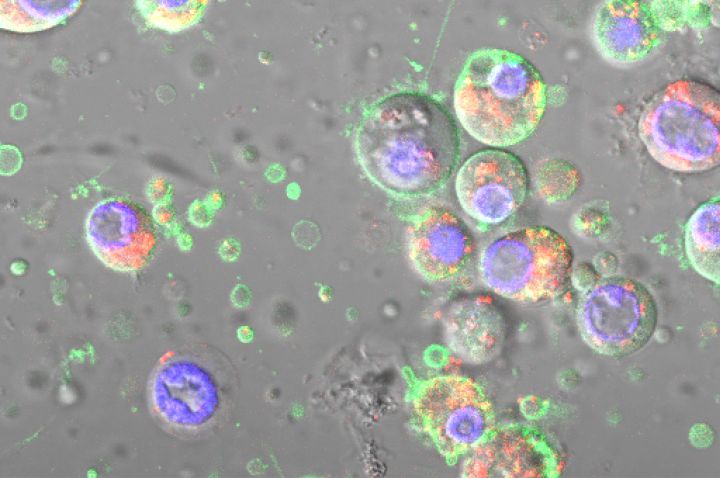
Did you know that there are about 28 – 37 trillion cells in our bodies … and that they communicate, repair themselves and clean up after themselves in order to keep us healthy? They do this by producing tiny packets of information, called Extracellular Vesicles (EVs). Once thought of as leftover waste, scientists now understand that EVs play a key role in keeping us healthy, and are beginning to discover how different sized EVs perform different functions.
What Are Extracellular Vesicles (EVs)?
Extracellular vesicles (EVs) are tiny, membrane‑covered packets released by cells. Cells produce them when they are dying, under stress, or repairing themselves. These vesicles carry important materials such as proteins, genetic information (DNA& RNA), and sometimes even whole cell components. Through these cargoes, EVs help cells communicate with each other and maintain their internal balance.
For many years, EVs were thought to be nothing more than leftover waste from dying cells. However, research has shown that they play an essential role in keeping our tissues and organs healthy. Rather than random debris, EVs are now recognised as active participants in many biological processes, including communication, repair, and disease.
What are Large Extracellular Vesicles (L‑EVs)?
EVs come in different sizes, including small EVs (S-EVs) and large EVs (L‑EVs). While sEVs have been studied more extensively, scientists are increasingly recognising the importance of L‑EVs, which often carry larger and more complex cargo.
Cells produce L‑EVs in many different situations. They are released when cells die, divide, age, experience stress, or interact with other cells. This means L‑EVs are not random—they are shaped by the condition and environment of the cell that produces them. Their contents and function depend on what the cell is experiencing at the time.
How L‑EVs support cell health
One of the key roles of L‑EVs is helping cells stay clean and healthy. Cells constantly generate waste, including damaged proteins and worn‑out components. If this material builds up, it can harm the cell. L‑EVs act like tiny disposal bags, packaging unwanted material and carrying it out.
Once released, nearby cells remove these vesicles, preventing harmful buildup and reducing inflammation. This process is essential for maintaining tissue health and normal body function. It also plays a role during development, when cells need to discard unnecessary parts as they mature and adapt.
L‑EVs as cellular messengers
In addition to waste removal, L‑EVs help cells communicate. They carry signals that can attach to other cells, be taken inside them, or be released into the surrounding environment. These signals reflect the state of the original cell, allowing information to be shared across tissues.
Through this process, L‑EVs help coordinate important functions such as growth, healing, and immune responses. They enable cells to respond dynamically to changes in their environment and to work together more effectively.
L‑EVs in disease and medicine
While L‑EVs are vital for health, they can also play a role in disease. In cancer, for example, cells can release L‑EVs carrying harmful signals that promote tumour growth or help cancer spread. During infections, vesicles can even carry viruses between cells. This highlights their dual nature—they can protect the body, but also contribute to disease under certain conditions.
Because L‑EVs reflect the condition of the cells that produce them, they are being explored as powerful tools in medicine. Scientists are investigating their use as biomarkers, which could help doctors detect disease through simple, non‑invasive tests using blood or urine. Researchers are also studying how L‑EVs could deliver treatments directly to specific cells, acting as natural carriers for therapeutic molecules.
Although L‑EVs are tiny, their impact is significant. They help cells stay healthy, communicate, and adapt to change. As research continues, they could open new ways to diagnose disease, monitor health, and deliver targeted treatments.
At the same time, every new discovery is revealing more about how our bodies work at the smallest levels, showing that even the tiniest systems can have a powerful influence on our health and wellbeing.
--
Professor Ivan Poon is the Director of La Trobe University’s Research Centre for Extracellular Vesicles (RCEV), and a researcher at LIMS and the School of Agriculture, Biomedicine and Environment (SABE). Stephanie Rutter is a LIMS, RCEV and SABE PhD researcher in Professor Poon’s group.
They recently published a review which examined how Large Extracellular Vesicles are produced and their function.
Read the review in Nature Cell Biology.