Tell us about your connection with Ireland.
Mam and Dad both grew up in Ireland, but in their 20s they met here in Melbourne, through friends in the Irish community. They went back to Ireland to get married, then came back here. My brother and I were both born here, but when we were little, we all moved back to Ireland to be closer to family. It was supposed to be a permanent move, but it only lasted ten years. When the Global Financial Crisis came, it hit Ireland hard, so we came back to Melbourne (now with my little sister, who was born in Ireland). We’ve stayed ever since.
Why did you apply to be a Rose of Tralee for this year’s competition?
The Rose of Tralee is an international cultural festival that celebrates Irish people around the world. I guess it means something different to everyone, but to me it’s a celebration of women, and a celebration of Irish culture and values - the sense of community, hospitality, compassion, and kindness. Irish culture has such a big impact, all around the world, and because I’ve always lived between the two countries, I’ve really been able to see that.
It’s broadcast on national television in Ireland every year, and when I was little I remember watching it with my mam’s mam, Nanny Grant. We’d go into the living room, and I was allowed to have my supper in front of the TV – which was crazy, because I’m so clumsy and I’d never be allowed to do that normally!
Ever since I moved here, my nana has always encouraged me to apply, and my excuse was always the same: “I can’t, I’m still studying”.
But this year was different. To be eligible, you need to be between the ages of 18 and 30. I’m 28, and as Melbourne isn’t represented every year, my nana reminded me that the next time it came around I wouldn’t be able to apply – I'll be too old!
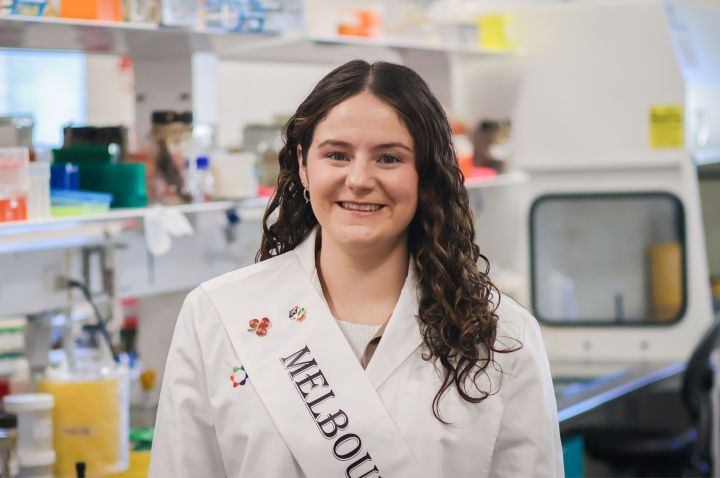
It was a hard decision, because I’m also finishing up my PhD. But, at the very last minute, I decided to put my name in the ring so I could at least go to the selection night, and get a photo for nana in my entry sash. I honestly thought that would be that - I never imagined it would go further than that, and I was shocked when I found out I had been chosen.
How has moving to Australia shaped your career journey – and why did you choose La Trobe University?
In Ireland, I grew up in a place called Ballinteskin, outside a town called New Ross in county Wexford. It’s quite rural, so there would have been more barriers in place to going to university – for example, I would have had to move out of home. When we came to Australia, we moved to metropolitan Melbourne and close to La Trobe. That made everything so easy, and gave me the chance to explore things without any of the limitations I would have had if we had stayed in Ballinteskin.
At high school, I had amazing science teachers who got me interested in biology, and I chose La Trobe University for further studies because it had a whole pile of different biology courses and I would get the opportunity to be in the lab.
During my undergrad years, I wasn’t sure what scientific direction I wanted to pursue, and I never planned on doing a PhD. But I had really engaging lecturers who were clearly excited about their work, and I loved the prac classes run by PhD students and early postdoctoral researchers who got you excited about the hands-on part of science.
You’re PhD research is in microbiology – why do you love this scientific field?
I’m really passionate about using microbial solutions to tackle big problems, from health issues to climate change. I love the idea that there might be solutions that are already available to us without having to create something new – we just need to learn more about how these existing solutions work and how we can use them.
In my third year of undergraduate studies, I took a microbiology subject. Professor Steve Petrovski, who is now my lab head, was talking about phages - a type of virus that can only infect and kill bacteria and nothing else. He told us about his research, and success he had developing ointments or using phages in different settings, and the positive impact this work was having. I loved that, so applied to do Honours.
Fast forward 4 years and I have now nearly finished my PhD, investigating cattle health and their microbiome in agricultural settings. I hope my research can help us identify how we can use good bacteria to improve cows’ digestion and reduce methane emissions. And also, how we can use phages as an alternative to antibiotics when treating mastitis in cattle.
How does it feel to be selected to be Melbourne’s representative for Rose of Tralee?
The more I have thought about it, the more I feel that being the Melbourne Rose in the 2026 Rose of Tralee International festival not only represents me, or my own journey with Ireland and Irish culture. It’s bigger than that. So many of us have the same story - my family, my friends, and the members of the Irish community in Melbourne. Some come for a couple of years on a working holiday visa and return to Ireland. Some have emigrated permanently and now call Australia home. Some are like my parents, who have come and gone between the two countries. I feel like I’ve got a connection to all these different stories, and it’s so nice to be able to go back to Ireland and represent these experiences from Melbourne’s Irish community.
I’m proud to be born in Australia, and I’m proud to be Irish; and, for me, they’re not different. They’re blended through my experience, my culture, and my story, and I hope I can do that for everyone involved.
--
The Rose of Tralee International Festival 2026 took place on 14 – 18 August in Tralee, Ireland. You can stream the full television broadcast on RTÉ Player.
Mikaela Whitty is the Melbourne representative at the Rose of Tralee International Festival 2026. She is a PhD researcher in Professor Steve Petrovski’s Microbial Genetics and Interactions group at LIMS and La Trobe University’s School of Agriculture, Biomedicine and Environment (SABE).
Find out more: Petrovski group – Microbial Genetics and Interactions