Early adoption of the latest innovation has enabled Professor Nilmini Wickramasinghe's work on projects aimed at improving patient outcomes and helping clinicians make better-informed decisions when it matters most.
As Optus Chair of Digital Health at La Trobe’s School of Computing, Engineering and Mathematical Sciences, Professor Wickramasinghe leads research at the intersection of healthcare, data science, and advanced computing. Her work spans some of the most pressing health challenges of our time, including cancer, dementia, diabetes, cardiovascular disease, hearing loss, eye conditions, and fertility treatment.
“Fundamental to my role is the design and development of technology solutions that have real-world impact that provide personalised precise care, patient support, help for health care providers,” Professor Wickramasinghe said.
“All my research life I have been looking at digital health solutions.”
As technology has advanced, so too has her research.
Today, much of that work centres on digital twins, sophisticated virtual models that replicate patients using real-world health data. These models are continually updated and refined, creating a dynamic representation that can be used to simulate different health scenarios, predict outcomes, and test potential interventions.
“I have been using AI for a long time and keep grasping new aspects,” she said.
“My flagship focus is the digital twin, which is quintessentially AI-based. The idea is to produce a digital model of the patient.”
The concept itself has a surprisingly long history. Digital twins were first developed by NASA in the 1960s to create virtual replicas of spacecraft systems, allowing engineers to test scenarios without putting missions at risk. Applying the same idea to healthcare, however, is significantly more complex.
“Digital Twins were first used by NASA in the 1960s. Now AI has evolved and Digital Twins of people, who are much more complex than spacecraft and automobiles, are possible.”
“With current advances in AI we have greater computational power, we can crunch larger volumes of data, (have the) ability to refine models and develop a digital model of patient.”
The result is a more personalised approach to healthcare than traditional treatment models allow.
In diabetes research, for example, Professor Wickramasinghe’s focuses on understanding the specific factors affecting each individual patient rather than relying solely on broad population averages.
“The way I look at it is to identify the critical component of that patient,
“Aspects like BMI, genetic propensity to elevated blood sugar, a bespoke approach.”
This ability to personalise healthcare becomes even more powerful when Digital Twins are combined with emerging agentic AI systems capable of adapting to changing conditions.
“It is dynamic in nature,” she says. “It enables us to have the most accurate representation of a patient in a particular point in time. Life is dynamic, therefore we need to have dynamic capability as well.”
These advances are also helping researchers move beyond identifying patterns and correlations towards understanding cause and effect.
“We are able to focus more on causality than correlation,” Professor Wickramasinghe said.
“We know a patient is more likely to have a particular side effect. It has been harder to achieve, now with advances in AI and processing power we can look at causality.”
That capability is proving particularly valuable in cancer research. One project focuses on patients with triple-negative breast cancer, an aggressive disease that can be difficult to treat. Digital Twins allow researchers to identify specific patient groups that are more likely to benefit from immunotherapy.
“You don't want to subject a patient to therapy which has less likely of clinical benefit if there are unpleasant side effects.”
There is also a broader healthcare benefit. Many advanced therapies come with significant costs, making it increasingly important to match treatments to the patients most likely to benefit from them.
“These are expensive therapies, so it is a value-based healthcare approach.”
Digital twins are helping researchers achieve that by enabling more sophisticated cohort matching and the identification of patient sub-groups with shared characteristics.
Beyond cancer, the technology is being applied across a remarkable range of healthcare settings.
In dementia research, digital twins are enabling earlier and more precise identification of people at risk of developing the condition.
The technology is also being used to model fertility treatments and improve outcomes for patients undergoing IVF.
“We are looking at modelling the IVF process with Digital Twins to identify when the patient is deviating from normal, which means a higher risk of unsuccessful birth, as well as identify which patients are best suited for IVF,
“This will really change the IVF process for the better, making it more personalised and successful.”
Other projects she and her team are examining include the use of digital twins in cardiovascular health, hearing interventions for ageing populations, ophthalmology, including macular degeneration and glaucoma, and orthopaedics.
Across all these applications, the goal is the same: helping clinicians make more informed treatment decisions by testing options in a virtual environment before applying them to a real patient.
“Digital twins support clinical decision making, running simulation models to find the likelihood of treatments working,” Professor Wickramasinghe says.
While the technology continues to evolve rapidly, Professor Wickramasinghe believes the biggest barriers to wider adoption are not technical.
“The technology is not the challenge,” she said.
“The challenge is the regulation, the legal issues, and the quality of the data.”
Healthcare data is among the most sensitive information that exists, creating legitimate concerns around privacy, security and governance. Accessing the quality data required to build effective Digital Twins remains one of the sector’s biggest challenges.
“Challenges include access to the data due to privacy concerns in healthcare.”
At the same time, she has found that patients are often highly supportive of technologies that could deliver more personalised care and better health outcomes.
“Patients are welcoming of the opportunity as they see the benefit to them,” she said.
To realise the full potential of Digital Twins, however, policymakers and regulators will need to keep pace with technological change.
“Sometimes laws, policies and regulations have to catch up,” she says. “We need to address this at national and global level.”
Despite those challenges, Professor Wickramasinghe remains optimistic about what lies ahead.
“From a research perspective it is wonderful, I am excited to be conducting research in this space and have an impact for a patient at a critical time in their healthcare journey.”
She acknowledges that scaling the technology across healthcare systems will take time and significant effort.
“Realistically, to deploy at scale there are many areas that need to be addressed.”
However, after decades spent exploring the possibilities of digital health, she remains confident the obstacles can be overcome.
“I believe we can have success, they are not insurmountable issues,” she says. “I am a realist but I am also optimistic.”
For Professor Wickramasinghe, that optimism is grounded in a simple ambition: using technology to help deliver more personalised, precise and effective healthcare for every patient.
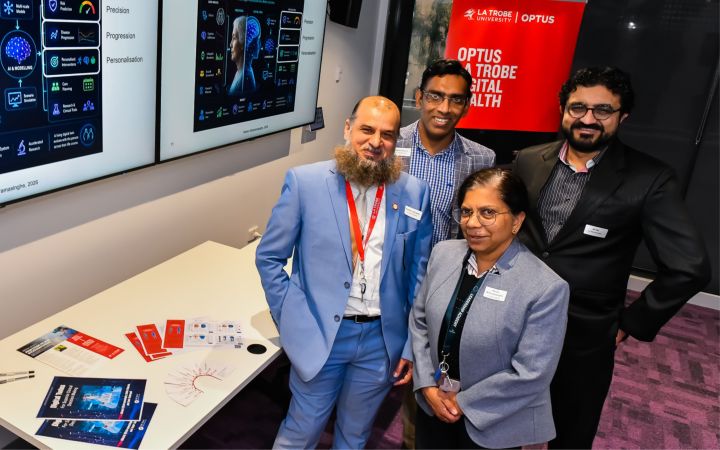
Pictured, from left: Dr Nadeem Shuakat, Dr Nalika Ulapane, Professor Nilmini Wickramasinghe, and Dr Ali Zia attending a La Trobe Industry Innovation Series event at Eagleworks Innovation Centre.