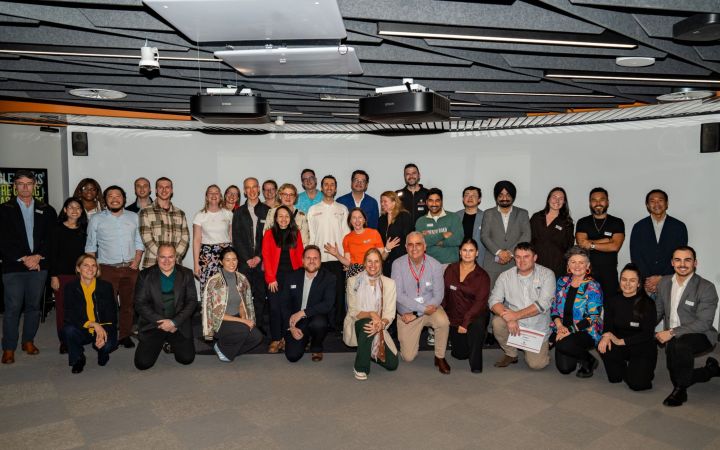
Forty-two emerging founders completed La Trobe's LaunchPad pre-accelerator program as part of the March 2026 cohort, with 27 advancing to LaunchPad Lift-Off - the program's knockout pitch event held at the Eagleworks Innovation Centre.
LaunchPad Lift-Off marked the culmination of the 12-week program and the beginning of a new phase for participants - one where ideas are tested in the real world, customer feedback shapes decisions, and founders take the next steps in their entrepreneurial journey.
Over the past year, founders across two intakes of LaunchPad - a LaunchVic-funded initiative - have continued building, refining and growing their ventures in different ways. Some have gained new customer bases, some have pivoted their ideas, and others have discovered new opportunities they hadn't anticipated when they first joined the program.
This is a look at what happened next.
From uncertainty to direction
Many founders arrived at LaunchPad with a strong instinct for a problem, but a much less certain idea of the business behind it.
For Clare Fargher, Co-Founder of SmartAger, that starting point was familiar: a meaningful problem, but “a lot of unanswered questions about how to build a venture around it.”
What changed wasn’t just the idea, it was the structure around it.
By the end of the 12 weeks, she described her venture as having a “tighter vision, a clearer business model and the platform to build something that could succeed,” along with a sharper pitch that carried them into the LaunchPad Lift-Off Pitch Night.
That shift from ambiguity to direction is a pattern across cohorts. Founders moving from assumptions to evidence, and from ideas to decisions. While every founder's journey looks different, many discover that progress isn't always a straight line.
Learning through the unexpected
For some founders, validation led to refinement. For others, it forced a pivot.
Douglas Lee, founder of FlyOvr, described how structured learning about customer validation taught him to conduct surveys and interviews that ultimately led him to pivot his entire direction.
He also noted the “MVP frameworks moved me from an abstract idea to a working prototype I could actually show people.”
The impact is not just methodological, but behavioural: founders begin making decisions faster, and with less attachment to their first version of the idea.
Clare Fargher reflected that the program helped SmartAger to “test assumptions rather than fall in love with them.”
For many participants, one of the most valuable outcomes extends beyond their venture itself.
The hidden value: financial clarity and technical confidence
Beyond product and pitch development, some of the most immediate changes happen in areas founders often overlook early on.
For Douglas, the impact of the finance fundamentals sessions made a huge difference, for example “tracking every business expense from day one, made me find AI subscriptions with almost no return and I cancelled them.”
Cutting costs before generating any revenue seems like small decisions, but with real outcomes. Early financial discipline can shape the survival of an early venture.
Community as a long-term asset
While individual ventures differ, nearly every founder points to the same enduring outcome: the network.
LaunchPad is often described as collaborative rather than competitive, a cohort where founders actively support each other, share feedback, and stay connected well beyond the program.
Christina and Byron, founders of ADH-Dump, refer to it as a network that “will continue well beyond the program.” A community that can be drawn upon well beyond the lifetime of LaunchPad. That ongoing connection matters because early-stage entrepreneurship rarely unfolds in isolation. Problems don’t end at pitch night, and neither does the support system built during the program.
What does 'success' look like after LaunchPad?
The clearest evidence of impact is not found in the pitch night itself, but in what happens afterwards.
It looks like founders entering discussions to deploy their platforms internationally. It looks like early traction and validated business models; it looks like cost savings identified before revenue exists. It looks like ventures moving from idea to prototype, and from prototype to real-world testing.
And sometimes, it looks like winning pitch night, not because the idea was the most polished on the day, but because the founder had learned how to think, test, and communicate differently.
While every venture continues on a different path, the stories share a common theme: LaunchPad helped founders take meaningful steps forward.
Ready to move your idea beyond the pitch and start building something real? Apply now for the next LaunchPad cohort.