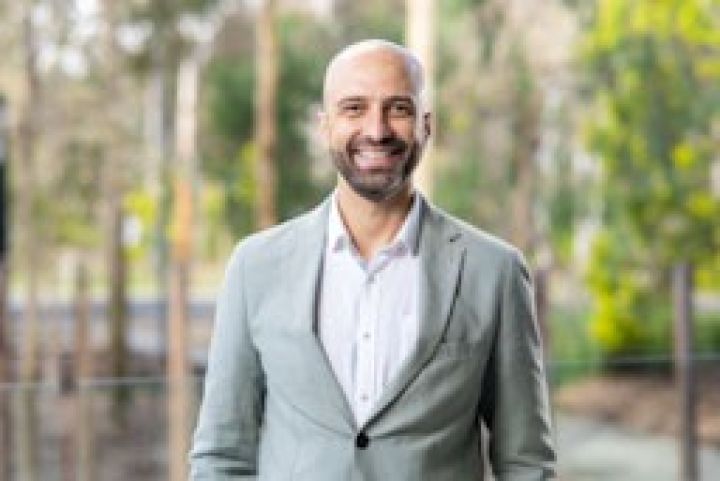
Dr Saimon Moraes Silva’s most ambitious goal is to develop a diagnostic test that could detect cancer biomarkers from a simple finger-prick blood sample.
Specifically, his team at La Trobe University is investigating tests for biomarkers linked to skin-related cancers and breast cancer. The work remains at the laboratory stage, but portable diagnostics could eventually help clinicians identify disease earlier, monitor its progression and assess whether treatment is working. They could be especially valuable outside major cities, where patients may lack ready access to specialist facilities, and samples often have to travel elsewhere for analysis.
An analytical chemist by training, Dr Moraes Silva is a Senior Lecturer in Chemistry, an NHMRC Emerging Leadership Fellow and Director of La Trobe’s Biomedical & Environmental Sensor Technology (BEST) Centre. His broader research focuses on moving sophisticated molecular testing out of specialist laboratories and into smaller devices that can be used near patients or directly in the field.
Under Dr Moraes Silva’s leadership, the BEST Centre brings together researchers with expertise in chemistry, physics, engineering, biology and clinically focused fields. Together, they can work across the development process, from identifying a useful biological marker to designing a device and preparing it for manufacture.
“Our idea is to take these measurements out of the laboratory, bringing testing closer to the people and places that need it,” he says.
His research includes portable sensors for microRNAs – molecules that can indicate cancer. He is also developing biosensors that use selected DNA or RNA strands to recognise a target and produce an electrical signal. His group combines chemistry, biophysics and bioengineering to make these tools accurate, practical and affordable. One challenge is keeping sensors working in blood, where unwanted molecules can coat the electrode and disrupt the signal. Dr Moraes Silva has developed a lubricin-based coating to help prevent that fouling.
From prototype to production
Turning a successful lab experiment into a commercial product takes more than just science; it needs industry expertise. The BEST Centre bridges this gap by pairing its research capabilities with commercial partners who bring essential manufacturing know-how. These collaborations are flexible, extending beyond diagnostic manufacturers. Hospitals, government agencies, and other end-users are integral to the process, helping to define real-world needs and validating that a device works in practice, not just in the lab.
One such partner is Melbourne-based Triton Biosensors, which has experience manufacturing electrochemical test strips and point-of-use testing systems. The collaboration is exploring how technologies developed at La Trobe could move towards larger-scale production and commercialisation.
The centre is also commissioning an R&D prototype line capable of producing thousands of test strips in a run. For Dr Moraes Silva, it will bridge the gap between making a small number of devices in the laboratory and showing that a design can be produced consistently at scale.
This appetite for real-world impact extends well beyond clinical diagnostics. La Trobe spin-out Eolas Dx, co-founded by Dr Moraes Silva, is developing a smartphone-based system for measuring sulphur dioxide in wine. BEST researchers are also working with Victoria Police Forensic Services on saliva tests for illicit drugs for roadside testing. The centre’s work also extends to environmental monitoring and other forms of point-of-need testing. Yet, beyond these technical milestones, Dr Moraes Silva considers his most significant output to be human capital. He takes particular pride in developing people – asked about his proudest achievement, he points to supervising PhD candidates and watching young scientists build their careers.
“I work with a lot of young researchers who are super talented and very committed,” he says. “Seeing them grow throughout their research journeys is the best achievement for me.”
Healthcare remains his longest-term research goal, despite the longer path from laboratory research to real-world use. Above all, he wants to see the cancer tests now in development reach patients.
Over the next five to 10 years, his measure of success is straightforward: “I hope the technologies we’re developing make it into the hands of the people who need them,” he says.