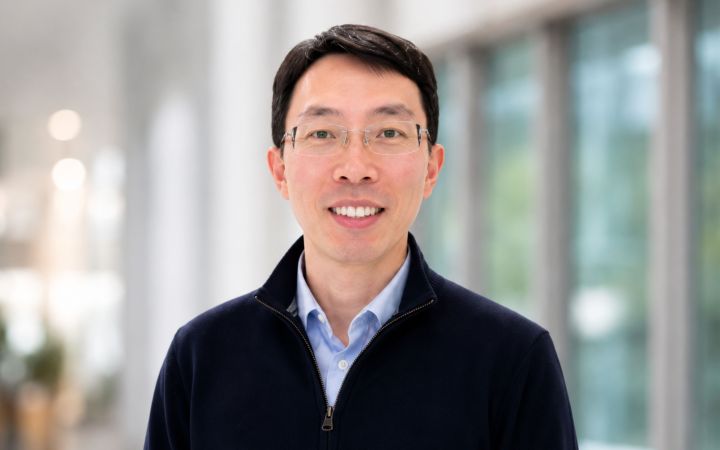
Most people use a camera to capture a moment. For Dr Kang Han, a camera can also be the starting point for rebuilding a world.
A single photo is flat. It records a scene from one angle, in two dimensions. But people, machines, and robots move through a three-dimensional world. Dr Han’s research asks how artificial intelligence can take multiple 2D images, captured from different positions, and reconstruct the shape, depth, and detail of the real environment they came from.
It sounds technical, but the motivation is practical. If a machine is going to help humans in a factory, warehouse, healthcare setting or home, it needs more than a flat view of what is in front of it. It needs to understand where objects are, how they relate to each other, and how the surrounding space works.
“We live in a 3D world,” Dr Han says. “We need to let the machine understand the 3D world.”
Dr Han is a Postdoctoral Research Fellow at the Cisco-La Trobe Centre for AI and Internet of Things, where his work brings together computer vision, computer graphics, deep learning, and 3D reconstruction. At La Trobe, he is applying that expertise to problems where better 3D understanding can help people inspect and manage complex environments.
One example is work with the Australian Institute of Marine Science on 3D reconstruction for the Great Barrier Reef. Reef scientists need to understand whether coral structures are growing, changing, or being affected by environmental pressures. A collection of 2D underwater images cannot easily show that change from every angle, or measure it with the precision scientists need.
Dr Han’s role was to develop the core algorithm that could turn underwater images into a high-fidelity 3D model. The underwater environment made the problem far harder: light changes as it travels through water; images are less clear than they would be in air; and, the reef itself has intricate, irregular geometry.
The goal was to reconstruct a clear 3D structure researchers could inspect from any angle.
From reconstruction to understanding
For Dr Han, the reef project shows how partners can bring the right problems to university AI teams. Before working on underwater reef imagery, his research focused on 3D reconstruction in more controlled settings. The collaboration pushed the work into a more difficult environment, and that challenge helped shape the research direction.
He sees the same pattern elsewhere. Warehouse operators are interested in digital representations of their spaces so they can better manage physical assets. Through the Cisco-La Trobe Centre, Dr Han and his colleagues are also working on a photorealistic 3D version of La Trobe’s campus, with potential uses in visualisation, navigation, and immersive digital maps.
What AI adds is fidelity. Traditional 3D reconstruction can produce useful models, but Dr Han says they often still look visibly computer-generated. AI can capture more of the detail needed to make a virtual environment feel closer to the physical one.
That matters for digital twins, virtual reality, and future navigation systems. It also points towards Dr Han’s longer-term research vision. He describes his work as moving through three stages: reconstruction, understanding, and action.
Reconstruction means building the 3D model. Understanding means teaching AI to describe and interpret that model, recognising objects, layouts, and relationships in the scene. Action means enabling robots or other AI systems to plan and operate in the physical world.
Today’s large language models interact largely through language on a screen. Dr Han is interested in what comes next, when AI systems can perceive physical spaces and act within them. That frontier, sometimes called physical AI, is still at an early research stage. Dr Han is working towards something more autonomous than pre-programmed movement: a robot that can receive a task, understand its surroundings, and work out how to complete it.
Industry partners are central to that journey because they bring real-world need. They turn abstract technical challenges into practical problems with constraints and impact.
“It’s not only publishing papers,” Dr Han says. “It’s trying to solve the real-world problem and make real impact.”
Connect with Dr Kang Han
La Trobe Profile: Kang Han
Email: K.Han@latrobe.edu.au
Hear more from Dr Han at the upcoming La Trobe Innovation Series event, AI Innovation to Impact. To stay up to date on future La Trobe Industry events, articles, and news, subscribe to the Industry newsletter or Follow ‘La Trobe Industry’ on LinkedIn and Eventbrite.