For months, Conor Hogan had watched the results of his experiments appear on a screen. Then, during his PhD in Dublin, he bent down to look beneath the apparatus and saw the chemistry for himself.
As he varied the voltage, an orange glow pulsed from the electrode.
“I just thought it was the most beautiful thing I’d ever seen in my life,” he says.
The phenomenon was electrochemiluminescence: chemical reactions that produce light when triggered by electricity. It became a focus of his research. Decades later, a student’s phone video of a similar reaction still gives him “the same chill,” he says.
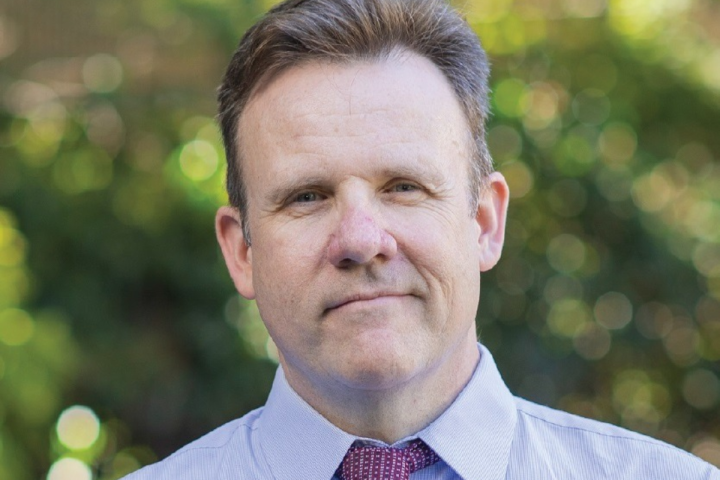
That fascination has sustained a career spent understanding electrochemical reactions and, increasingly, finding practical uses for them. Today, Professor Hogan leads the ARC Research Hub for Molecular Biosensors at Point-of-Use (MOBIUS) at La Trobe University.
His research explores how electrochemical systems behave and how their signals can reveal the presence or concentration of particular molecules. That knowledge could help detect disease markers in blood, monitor health or identify pollutants in water.
For much of his career, the reward has been understanding something nobody understood before. “I love the idea that the human race knows a tiny bit more about some tiny thing as a result of something I’ve done,” he says.
Increasingly, he also wants to see that knowledge become useful technology.
One opportunity emerged from the device people already carried in their pockets. Biosensing instruments can be expensive to manufacture, but smartphones contain sophisticated components produced in enormous quantities.
Hogan and his colleagues developed a way to trigger a light-producing reaction with a voltage pulse and capture it using a phone camera. A small sensor attached to the phone could potentially replace a separate instrument, lowering the cost of testing.
The aim was to make medical testing more accessible, particularly in places with few doctors and limited healthcare resources.
A later project, AudioDAC, repurposed smartphone audio technology to perform electrochemical measurements. It now underpins work on several applications, including a test for sulphur dioxide, a preservative used in wine. La Trobe spin-out Eolas Dx, which Hogan co-founded with Dr Saimon Moraes Silva, is commercialising the wine test.
His team has also demonstrated measurements of DNA, lead in water and glucose in blood.
“The beautiful thing about AudioDAC is that we’re not asking people to buy a specialised instrument. We’re using technology that is already in their hands to perform sophisticated electrochemical measurements,” he says.
Bringing people and ideas together
Turning promising chemistry into a working device takes more than chemists. In 2019, Hogan established La Trobe’s Biomedical and Environmental Sensor Technology (BEST) Centre to bring together the expertise needed.
“You need people who are experts in chemistry and biology and physics and electrical engineering and software,” he says. “There are so many different parts to it.”
At industry events, researchers and businesses demonstrated their technologies and discussed their work over a glass of wine. Relationships formed at those gatherings helped lay the foundations for MOBIUS.
BEST continues under Dr Moraes Silva’s leadership, while Professor Hogan leads the MOBIUS hub. He says additional funding and collaboration have accelerated research, opening opportunities to turn years of fundamental science into practical applications and support Australian manufacturing.
Professor Hogan sees two routes for bringing university inventions to market: working with existing industry partners and establishing spin-out companies. Eolas Dx could help commercialise technologies from his laboratory and those of his co-founders at La Trobe.
Professor Hogan is optimistic that several of the technologies from his laboratory will reach practical use within the next four or five years, with potential applications extending to sensors that help first responders or defence personnel identify biological threats.
The glow of those light-producing reactions still drives him, as does the prospect of what they could help people do.
“I want to see it out there. I want to see applications. I want to see it make a difference to people’s lives,” he says.
Connect with Conor Hogan
Linkedln Profile: Conor Hogan
Email: C.Hogan@latrobe.edu.au
Conor spoke at a recent La Trobe Innovation Series event, Biosensors in Action. To stay up to date on future La Trobe Industry events, articles, and news, subscribe to the Industry newsletter or Follow ‘La Trobe Industry’ on LinkedIn and Eventbrite.