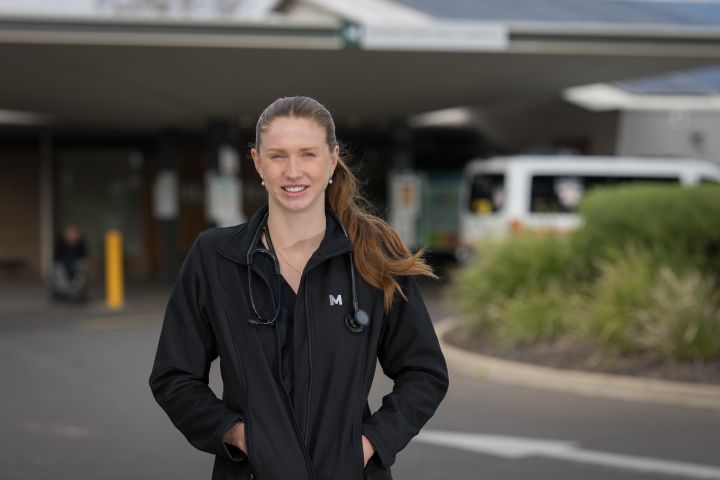
Part of the very first cohort of Biomedical Science (Medical) students at La Trobe in 2019, Abby graduated from the University of Melbourne’s Doctor of Medicine program in 2025 through the Rural Pathway.
Abby was one of 10 graduates from the pathway in 2025, with a further four students from the same cohort expected to graduate in the coming years after taking a gap year or undertaking additional study, including a Master of Public Health.
Today, Abby is working as an intern at Mildura Base Hospital, where she is beginning her career close to home and planning to pursue a future as a rural generalist doctor, providing comprehensive medical care in rural and regional communities.
“I have loved working in my hometown, alongside people I grew up with who share a passion for caring for our local community,” Abby says.
“I have been so grateful to be home with my family and friends and have their support in my first year of internship.”
For Abby, practising medicine in a rural community is more than a career choice. It is deeply connected to her own experiences growing up in Mildura and seeing the challenges faced by people living outside metropolitan areas.
“Growing up in a rural community, I understand first-hand the healthcare gap that exists and know that this can lead to poorer outcomes for my family and friends,” she says.
“I don’t believe that patients should be disadvantaged in the country and want to be a part of improving the health landscape of my hometown.”
Abby’s journey highlights the value of rural medical training pathways in developing a skilled health workforce for regional and rural communities. Studying through the Rural Pathway allowed her to pursue medicine while remaining connected to her hometown throughout her education.
“Without the Rural Medicine Training pathway offered by La Trobe University and the University of Melbourne, I would not have the opportunity to contribute to Mildura’s medical workforce and help improve the outcomes for the people I know and love,” Abby says.
She also valued being able to study within driving distance of home, which enabled her to remain involved in her community while completing her studies and helped make the transition back to Mildura a natural one.
“For me, it has allowed for a smooth transition back home,” she says.
Now, as she embarks on the first year of her medical career, Abby hopes her experience will inspire other students considering a future in rural medicine.
Her advice is simple: understand your “why”.
“Medicine is a long, challenging degree, especially when you have to move away from home,” she says.
“For me it was the knowledge that I would one day return home to serve my community that motivated me throughout my journey.”
From being part of La Trobe’s inaugural Biomedical Science (Medical) cohort to returning home as a doctor, Abby’s story reflects the impact of rural medical education and the importance of creating pathways that support students to train, live and ultimately build their careers in the communities they know best.
As Abby begins her career at Mildura Base Hospital, she is already contributing to the future of rural healthcare in the place she calls home.