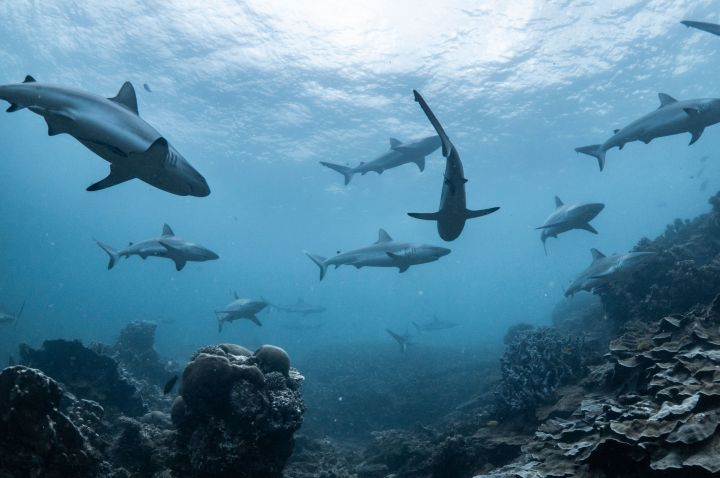
World-first research from Dr Lucille Chapuis, ARC DECRA Fellow, is helping unlock the mysteries of fish hearing to better protect marine life from noise pollution.
“Man-made noise from shipping, construction and resource extraction is rapidly transforming underwater soundscapes, with far-reaching implications for marine animals,” she explains. “Because sound travels further in water than in air, hearing is a primary sense for fish. It helps them detect prey, avoid predators, communicate and navigate.”
Despite this, there are no established regulatory guidelines to protect fish from acoustic pollution. One reason, Lucille says, is a major knowledge gap.
“We still don’t fully understand how fish hear, or how their diverse inner ear structures shape hearing ability. Unlike mammals, fish have an incredible variety of inner ear shapes and sizes, which reflects wide variation in hearing sensitivity and frequency detection,” she says.
Lucille’s research focuses on elasmobranchs, including sharks, rays and skates.
By combining advanced bioimaging, biomechanical modelling and artificial intelligence, she’s investigating how inner ear structure, hearing function and acoustic environments are linked.
“My DECRA project aims to test the long-standing but unverified ‘eco-acoustic constraints’ hypothesis, which is the idea that fish hearing evolved in response to the soundscapes they inhabit.”
Lucille was among the first to document sharks’ behavioural responses to sound in the wild and produced the first audiogram for a sea snake. She also helped develop new methods for studying sound-induced behaviours in aquatic species and created some of the first high-resolution 3D models of elasmobranch ears.
“With this project, I hope to build the first digital model of a shark ear, reverse-engineering the structure to better predict hearing abilities in unstudied species.”
Dr Chapuis’ work could also pave the way for future regulations on underwater noise.
“With more than 1,000 species of sharks and rays already threatened by overfishing and habitat loss, understanding their sensitivity to noise is essential for marine conservation and effective policy.”