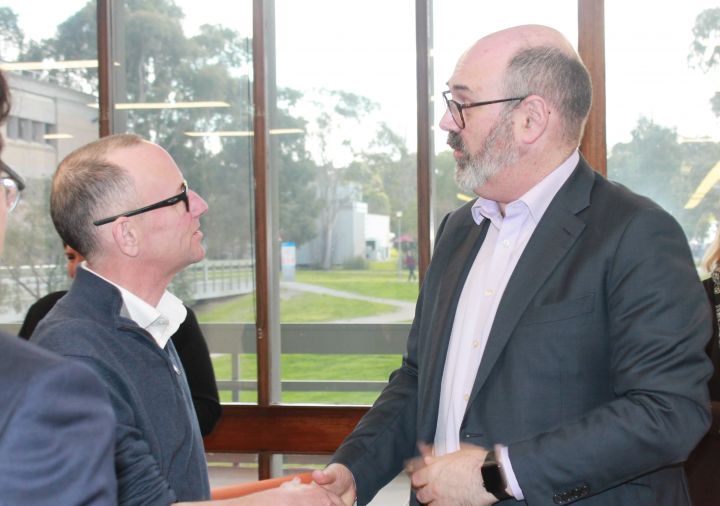
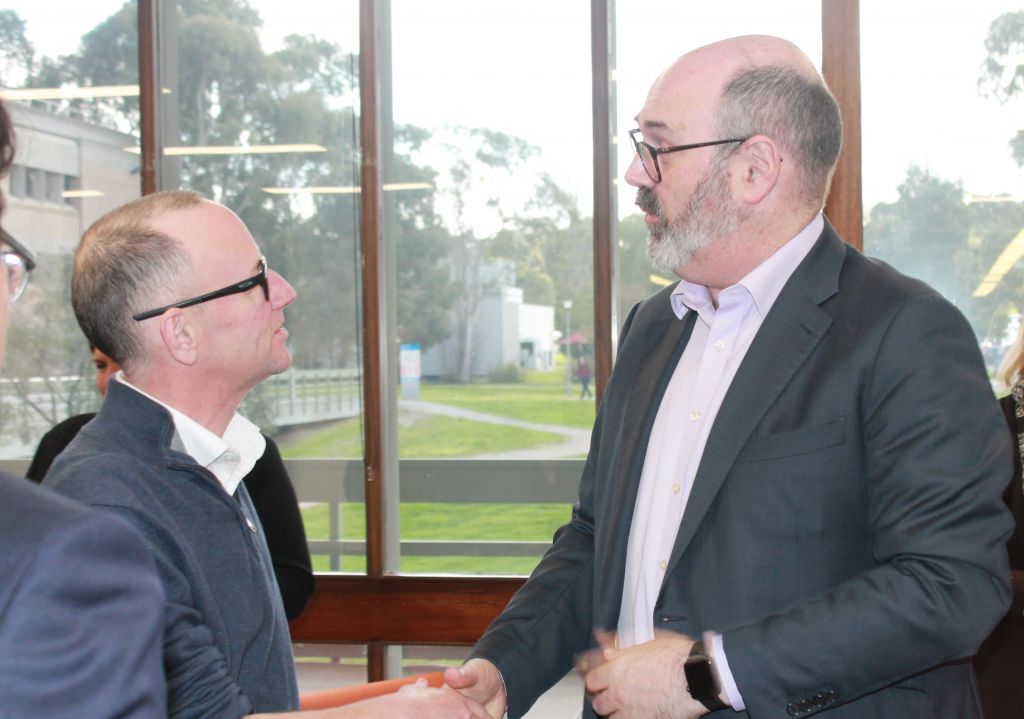
Institute Director, Professor of Practice Chris Roche (left) with Pro Vice-Chancellor (ASSC) Professor Simon Evans at the morning tea celebrating new research contracts.
The Institute for Human Security and Social Change (the Institute) has recently attracted close to $3 million in funding for a range of projects working with the Australia Pacific Training Coalition, Solomon Islands governance and justice programs, the Developmental Leadership Program, Northern and Central Land Councils and the Research for Development Impact Network.
With projects based in the Northern Territory, Solomon Islands, and across the Pacific Islands, this work will continue to put the Institute and La Trobe University on the map and support La Trobe’s vision to promote positive change and address the major issues of our time through being connected, inclusive and excellent. The Institute has also recently submitted and ARC linkage proposal in partnership with some of Australia’s leading Non-Governmental Organisations (NGOs) to explore the future of international NGOs.
The Institute held a morning tea on Monday 26 August with staff from across the university to celebrate the recent signing of the new research contracts. The event was hosted by Professor of Practice Chris Roche, Institute director and Institute Advisory Committee chairperson Jeremy Hobbs, and attended by Pro Vice-Chancellor, Arts, Social Sciences and Commerce, Professor Simon Evans.
Australia Pacific Training Coalition (APTC) - $1.6 million over four years
The Australia Pacific Training Coalition (APTC) is a centre of training excellence for people to gain Australian-standard skills and qualifications for a wide range of vocational careers throughout the Pacific. The Institute is collaborating with the APTC to provide research, technical support and mentoring around monitoring, evaluation and learning. The Institute’s partnership with the APTC began in 2018 and will last four years.
Solomon Islands governance and justice programs – contract extended for three years at $750,000.
The Institute is providing research support to two Department of Foreign Affairs and Trade (DFAT) programs in the Solomon Islands: their justice program, and their governance program. Both programs are running from 2017-2021. These programs implemented by Cardno’s Solomon Islands Resource Facility. They aim to integrate politically astute ways of working with space to learn and adapt, as part of wider trends to ‘do development differently’. The Institute has successfully supported a local Monitoring and Evaluation team, managed by Cardno, to implement a multi-method Monitoring, Evaluation and Learning Framework. The Institute initially signed a one-year contract in 2018 to provide research support to these programs. This contract has now been extended for another three years to 2021, at an additional value of $750,000.
Developmental Leadership Program (DLP) - $340,000 over three years
Over the last decade the DFAT funded Developmental Leadership Program (DLP) has explored how leadership, power and political processes drive or block successful development. The Institute has been a partner of the DLP for the last five years, and will now enter a third phase from 2019-2021. This phase of the DLP will have a greater focus on developmental leadership and how external actors can contribute to this, with a focussed, policy-relevant, and theoretically tighter enquiry, working in partnership with the University of Birmingham in the UK. It includes funding for a PhD scholarship at La Trobe for a researcher to accompany the program.
Support to Northern Territory (NT) land councils - $105,000 over three years
The Institute has a growing body of work advising indigenous organisations on their research, monitoring and evaluation in particular with the Central Land Council (CLC) and the Northern Land Council (NLC) in the Northern Territory. The CLC is an Aboriginal organisation governed by a council of 90 elected Aboriginal members. Each year, Institute Co-Director Linda Kelly and team support the CLC to develop their Community Development Program Monitoring Report, which tracks change over time through quantitative and qualitative assessments. The Institute’s contract has been renewed for $30,000 to support the CLC to develop their monitoring report this year.
The success of the Institute’s work with CLC has now been extended to working with the Northern Land Council (NLC). The Institute supported the Northern Land Council (NLC) to successfully receive three years funding from the Prime Minister and Cabinet for a project to develop monitoring systems suitable for Aboriginal controlled community development. The Institute will now work with the NLC over the next three years to support their monitoring and evaluation, with a contract valued at $85,000.
Research for Development Impact (RDI) Network - $70,000 over one year
The Institute is delivering the Enhancing Research Use in International Development research project with the RDI Network. Over the next year the project will allow policymakers, practitioners and researchers to meaningfully reflect on and work towards stronger evidence use in international development. The project will work to shift the sector towards further valuing and using research and evidence; affect shifts in the use of research at the organisational level within participating organisations; and allow individuals to increase capacity, facilitate change and increase their research uptake and use.
ARC Linkage Submission
The Institute recently applied for an Australian Research Council (ARC) Linkage Grant to explore the future of international NGOs. If successful, the Institute will partner with nine international NGOs and humanitarian agencies as they implement changes to their organisational practice and structures addressing questions of power and legitimacy. The nine international NGOs we will partner with are Oxfam New Zealand, CARE Australia, Australian Council for International Development (ACFID), WaterAid Australia, Central Land Council, The Voice Inc. (PNG-based), Oxfam Australia, Australian Red Cross Society and the International Women’s Development Agency (IWDA).
About the Institute for Human Security and Social Change
The Institute seeks to actively contribute to progressive social change in Australia and the Pacific. Increasingly recognised as a resource in re-imagining how social change happens, the Institute works to translate research findings into practice, education and policy.