Aligning interactive learning activities with learning outcomes
Designing any learning resource starts in the same place: with identifying your learning outcomes.
Learning outcomes are the foundation on which everything else is built. If you'd like inspiration and examples for writing these, please see Writing effective learning outcomes.
Let’s imagine you have written the learning outcomes. The verbs you choose signal what you want your students to achieve after going through this online learning resource, for example:
identify or recognise if you're building subject knowledge
apply, demonstrate, create if you're developing skills
analyse or evaluate if your goal is higher-order thinking, like making judgements, justifying decisions, evaluating evidence, and other kinds of thinking students will need to do in their future professions
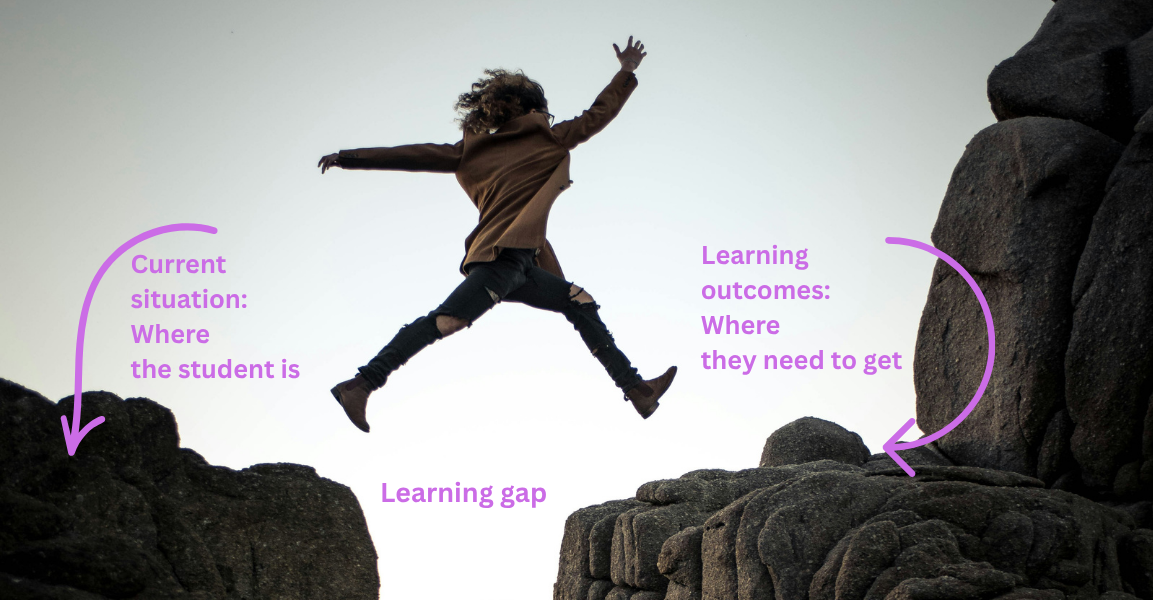
With your outcomes set, the next step is to build the content that drives them. This is what sets learning content apart from an article or blog post: a blog post exists to inform or entertain, but learning content exists to bridge a learning gap and move students from where they are towards the defined learning outcome.
Figure 1: Image by Micah & Sammie Chaffin on Unsplash. Accessed and reproduced with permission on 15/06/2026
Matching a skill outcome like demonstrate communicationskills with a patient to a 40-page PDF written like a journal article is like expecting someone to become a concert pianist by reading a book about pianos. They might be able to identify the parts of a piano - that's knowledge. But they won't be able to play – that’s a skill, and skills require learning activities to offer opportunities to practise.
The information presented here shows you how to close the gap between your learning outcomes and the online activities that drive them, using text-based activities and a handful of H5P interactions.
The number one rule
Match the verb in your outcome to the action in your learning activity.
If your outcome says students will identify, give them something to find. If it says apply or create, give them a situation to act in. If it says evaluate, give them options to judge. If it says reflect, give them an opportunity to consider their experiences, decisions or actions and identify learning.
When the verb and the learning activity match, alignment mostly takes care of itself. Assessment falls into place too, because it asks students to perform that same verb under exam or assignment conditions.
Start with the main verb in your learning outcome, then choose an activity that gives students an opportunity to perform that action. The activity types below are commonly used to support each of these verbs.
Verb
Skill
Activity type (H5P or text-based)
Identify
Find or recognise key information, features, risks or needs
Text-based scenario
Image hotspot
Multiple choice
Understand
Explain, interpret or connect ideas and information
Text-based scenario
Accordion
Interactive video
Multiple choice
Apply
Use knowledge or skills in a situation or make decisions
Text-based scenario
Branching scenario
Interactive video
Audio interaction
Evaluate
Compare options, justify choices or judge effectiveness
Text-based comparison
Interactive video
Audio interaction
Multiple choice
Reflect
Consider experiences, decisions or actions and identify learning or future improvements
Text-based reflection
Interactive video
Text-based interactive learning activities
Before reaching for shiny digital interactions, remember that text-based learning activities can be simple to create and equally effective as digital ones if they are well-designed.
Text-based activities use words for engaging with the learning content. But you can add visuals too. Break up longer passages with decorative images that give the eye a rest, or strengthen the content with visuals that support learning, such as diagrams, graphics or visual representations of concepts.
A scenario drops students into a situation and asks them to act, which is exactly what apply and demonstrate types of learning outcomes call for.
Example:
You are a graduate nurse on a busy morning shift. Mr Tan, 67, is scheduled for surgery at 10 am. At 9:30, the surgeon's office calls: the operation has been postponed until tomorrow due to an emergency case. Mr Tan has been fasting since midnight, is visibly anxious, and his daughter has taken the day off work to be with him.
Your task: Write a few bullet points, then say aloud how you would communicate the postponement to Mr Tan and his daughter.
How will you:
deliver the news
acknowledge their frustration
and explain what happens next?
Then let students check their response against a model answer, for example:
A quality response would include the following:
Deliver the news early and clearly, without burying it in small talk. For example: "Mr Tan, I've just heard from the surgical team, and I'm sorry to say there's been a change to your plan for today. Your operation has been postponed until tomorrow."
Acknowledge the impact: the fasting, the anxiety, the daughter's day off. For example: "I know this is really disappointing, especially after fasting since midnight. And Sarah, I realise you've taken the day off to be here.
Avoid blaming colleagues or the system ("the surgeons are hopeless today").
Explain the next steps: when surgery will happen, whether fasting can stop, and who will confirm.
Invite questions and check understanding before leaving the room.
Reflection questions ask students to judge, not just describe, identify or recognise. The trick is to make the question interesting.
Example:
Take a moment to reflect on your unconscious bias. When you label someone's behaviour as "suspicious", can that judgement ever be completely neutral? What factors (fatigue, stereotypes, past experiences) might be shaping your assessment without you noticing? Write your answer somewhere you can come back to it - a notebook, a text processing application, whatever works.
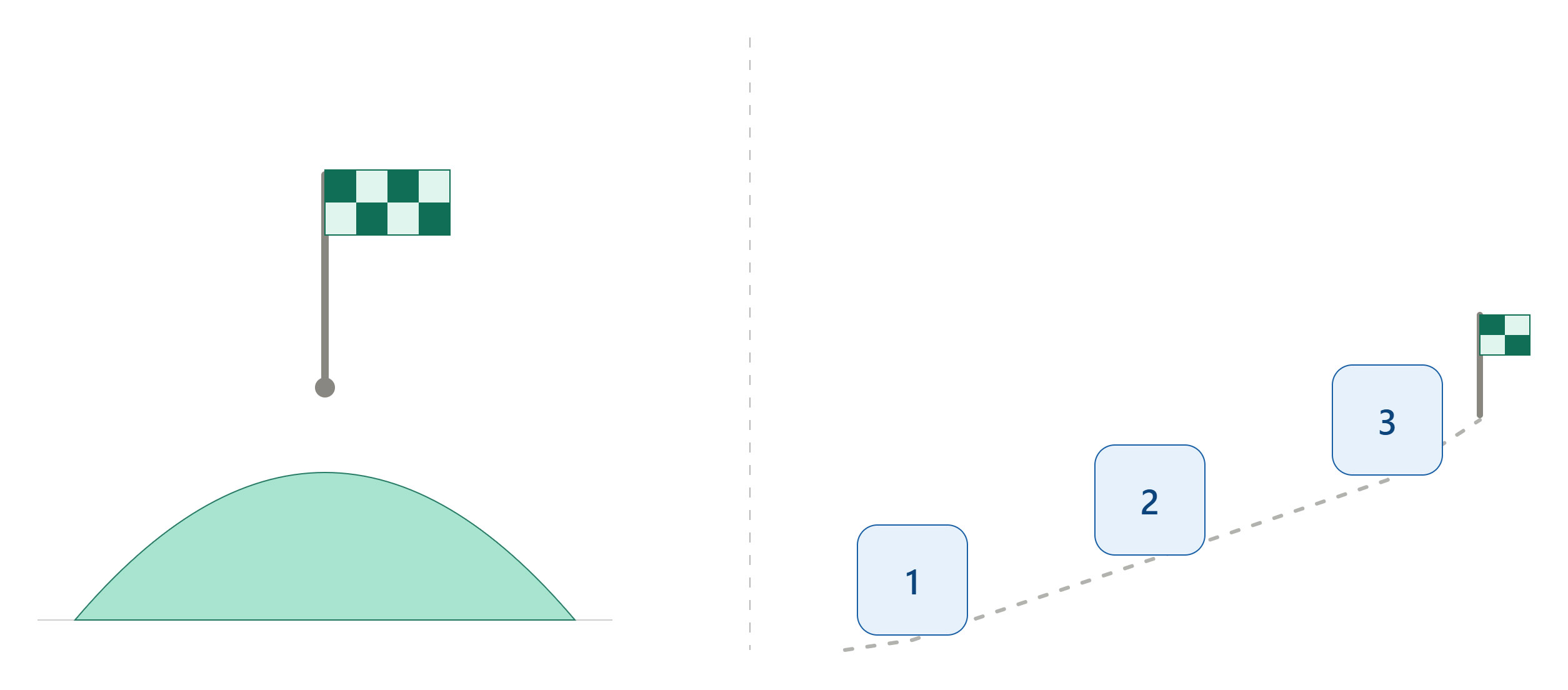
Comparison tasks ask students to hold two things side by side and spot the differences, which is what analyse and differentiate outcomes are after. The text-based comparison can become stronger when a comparative image is added, using a metaphor or a real-world image of the concepts being discussed.
The trick is to choose two things for comparison that are easy to confuse.
Example:
Goals and objectives are often used interchangeably, but they do different jobs.
Figure 2: The goal is the destination. The objectives are milestones along the way. Image by Claude AI, accessed and reproduced with permission 15/06/2026
Goal
Objective
Think of a goal as your destination, where you ultimately want to arrive.
Objectives are the milestones along the road: the specific, measurable markers that prove you're heading the right way.
Your task: List two ways goals and objectives are similar, and two ways they differ. Then test yourself with the give-away question: which one could you actually measure?
Digital interactive learning activities
You can create digital interactions using authoring tools like H5P. These ask the student to click or drag and drop to reveal the content. The following examples are activity types you can use in H5P.
Accordions collapse content into expandable headings. Their real strength lies in managing cognitive load by decluttering the page rather than in driving deep learning. But add a prompt, and your accordion turns from content storage into an interactive learning activity.
For example, after the Mr Tan scenario, add:
Once you have practised your communication, select the heading below to compare your response with a sample answer. How did you go?
In a hotspot interaction, students select regions of an image to reveal information. So which kind of learning outcome does it serve best – knowledge or skills?
If you said knowledge, you’ve nailed it. Hotspots are ideal for outcomes built on verbs like identify, label, locate and recognise. Students explore an image and pinpoint where things are and what they are called.
Example:
Select the markers on the following image to learn about the components of a homeostatic control system.
Figure 3. Homeostasis as a self-correcting loop. Image by Claude AI, accessed and reproduced with permission 15/06/2026
Multiple-choice questions suit almost any learning outcome, from knowledge (theory) to skills (practice). The challenge isn't creating the question to match the knowledge or skills outcomes; it's crafting the wrong answers, also known as distractors.
You are invited to write distractors based on the common mistakes students actually make.
Example:
Notice that distractors aren't just silly options. They are the things stressed practitioners genuinely say under pressure.
In addition, this "show, don't tell" version makes the feedback land harder. Students see the patient escalate or settle in real time, which is far more memorable than being told, "This invites a power struggle."
Video content supports Universal Design for Learning (UDL) by offering another means of representing concepts, so students aren't reliant on reading alone to make sense of it. This medium lends itself to any learning outcomes, depending on how it is used.
You can make any video interactive by using H5P's Interactive Video activity type. Drop a text, a multiple-choice question or a hyperlink at any point in a YouTube video, and the video can be set to pause until the student responds. This interaction turns passive watching into active thinking. See the example at the 0:30 mark in the video.
Example:
Select the play icon or access the video transcript to watch a video that raises the question of what history is for. Before you hear their take, you’ll be invited to pause and reflect.
If your learning outcome involves any oral communication skill – speaking or active listening – audio is essential. Speaking is more than words: tone, pace, pauses, the warmth in a voice, the breath before bad news. Listening is more than words, too: the catch in a client's voice, the trailing off, the things said between the lines. None of it survives on the page.
Pair every audio file with an accurate transcript, and you keep it accessible to all students, including those who are deaf or hard of hearing, or who prefer to read and listen at the same time.
Example:
You're seeing a new client for a mental health assessment. As usual, you open with: "What's been going on that made you want to seek support?"
Select the play icon to listen to the client's response, then answer: What signs and symptoms can you spot?
Why audio here? On the page, the pauses and the quickening pace vanish — yet those are exactly the signs you want students to notice. Reading the transcript, they'd catch the worry the client puts into words; hearing it, they catch the racing speech, the breathlessness and the exhaustion underneath. That's the difference between recognising anxiety as a word and recognising it as a presentation.
How to include audio content in an open educational resource
Send us your audio recording, and we'll upload it for you. You can use Zoom or Teams to record a conversation, scenario, discussion or explanation. If you send us the recording file, we can extract the audio for you to drop straight into the resource. Please also send the transcript. Both Zoom and Teams auto-generate one, so just download it, check it for accuracy and pass it along with the recording.
Summary
Aligning interactive activities with learning outcomes isn't complicated. It comes down to matching the verb in your outcome to what students actually do, whether that's a quick text-based scenario or a richer H5P interaction. Knowledge outcomes want things to find and recognise; skills outcomes want situations to act in; higher-order outcomes want judgements to make and defend.
So, here's your invitation: open your own online resource and read it through the lens of this article. What is one text-based learning activity and one H5P interaction you would use to achieve the learning outcomes?