








A talented group of La Trobe students have shown what human-centred Artificial Intelligence looks like in practice, by developing a proof-of-concept, AI-powered tool designed to help streamline the way public transport infrastructure is checked for accessibility.
The students teamed up with La Trobe’s Centre for Technology Infusion as part of their final-year capstone project. The aim of the project was to explore how AI and computer vision could make accessibility auditing for public transport infrastructure more efficient, consistent and scalable.
The student project team included Akshad Shelar, Nadil Silva, Pragna Guruprasad, Pasan Jayarathna and Rui Hong Gan and they were supported by their capstone lecturer Dr Scott Mann.
The team was presented with several project options, but the AI public transport accessibility project held the most appeal because of its potential to make a real difference to the everyday lives of people with disability.
“We weren’t just interested in building an AI tool. We wanted to work on something that could make a genuine difference. The opportunity to improve accessibility and inclusion was what drew us to the project,” said Akshad.
It’s a sentiment echoed by Akshad’s team members.
“One of the challenges was working out what ‘accessible’ means when a real person is going to depend on your answer,’’ said Pragna.
“Most of this auditing still gets done by hand, one station at a time and that reframed the whole project for me. It was never about building something clever, it was about building something for the people who actually have to use it.’’
It really opened my eyes to what it takes to make public transport usable in practice, not just compliant on paper. – Pasan Jayarathna
How the tool works
The tool works by using computer vision and AI to analyse photos of infrastructure such as tram and bus stops, and platforms.
It examines images, identifies selected accessibility features and barriers and then generates a report highlighting potential compliance issues or areas that may need manual review by an auditor or a stakeholder.
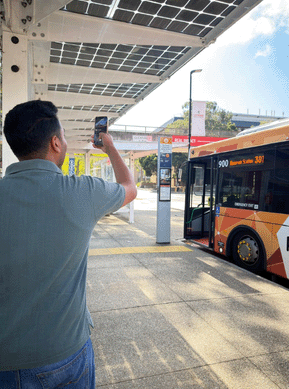
Akshad noted that the tool is not meant to replace human auditors, instead it demonstrates how AI could help reduce the time, cost and inconsistency involved in manual accessibility audits while still supporting human decision-making.
“Good AI implementation is not about replacing people completely. It is about giving people better tools, better evidence and better information to make decisions,’’ he said.
Beyond the technical challenge, the project gave the team valuable experience working with stakeholders, presenting ideas and responding to real-world requirements. Regular reviews and feedback sessions with CTI helped them think beyond the software itself and focus on the needs of the people who may eventually use the technology.
“Working with CTI pushed us to think beyond whether the technology worked technically. We had to consider how someone might actually use the system, what information they would need from it, where its limitations were, and how we could translate feedback into the next iteration,’’ said Akshad.
Looking beyond technology
The experience has left a lasting impression on the student team, by encouraging them to think about the experiences of people using public transport and how technology could be used to support more inclusive outcomes.
For Pasan the project represented a shift in focus – away from technology and onto the people who would ultimately benefit from it.
“It really opened my eyes to what it takes to make public transport usable in practice, not just compliant on paper. Working alongside my team and speaking with public transport staff showed me that writing the code is only half the battle, the real challenge is designing for how people actually navigate space every day.’’
For Nadil, Working with La Trobe’s Centre for Technology Infusion highlighted how technical skills developed at university can be applied to real life challenges.
“My biggest takeaway was learning how to bridge the gap between the technical skills we developed at university and their application to real-world problems, while also building my confidence and deepening my understanding of how technology can contribute to meaningful outcomes in the community.’’
Rui Hong Gan added that working on a project with genuine community impact reinforced the importance of communication, teamwork and using technology to solve meaningful problems.
Working as part of such a large project taught me the importance of clear communication and maintaining good internal handovers between team members. Meeting and working closely with the team throughout the project also made my university experience much more meaningful. – Rui Hong Gan
The team also acknowledged the support of their Capstone lecturer, Dr Scott Mann, whose guidance helped them navigate the technical complexity of the project and develop the prototype through each stage of the semester.
The project is currently at proof-of-concept stage, with future work focused on more testing, improving accuracy and refining the system with the help of accessibility experts and transport stakeholders.
“We have built a working prototype that demonstrates how computer vision and AI can be used to support accessibility auditing of public transport infrastructure. The system can analyse images, detect selected accessibility-related features and generate a structured report that highlights potential compliance issues or areas requiring further manual review.
“It’s not a replacement for formal auditing yet, but it shows the technical feasibility of using AI in a way that could help reduce the cost, time and inconsistency involved in current manual auditing processes,” said Akshad.
Find out more about La Trobe’s Centre for Technology Infusion.
Feature image: Pragna Guruprasad – Bachelor of Information Technology (Software Engineering), Akshad Shelar – Bachelor of Information Technology (Data Science), Pasan Jayarathna – Bachelor of Information Technology (Cloud Computing), Nadil Silva – Bachelor of Information Technology (Artificial Intelligence), Rui Hong Gan – Bachelor of Information Technology (Cyber Security), Dr Scott Mann and Erik Van Vulpen – Deputy Director, Centre for Technology Infusion.